Introduction
Most e-commerce stores convert between 2% and 2.5% of their visitors. That means for every 100 people who land on your site, 97 or 98 leave without buying. IRP Commerce's June 2026 data puts the average at 2.03% — and that number hasn't moved much in years.
Cart abandonment compounds the problem. Baymard Institute's analysis of 50 studies puts the average abandonment rate at 70.22%. Most shoppers who add something to their cart never check out.
Both figures are changeable. They reflect a specific failure: the moment a shopper hits a question — about sizing, shipping, return policy, product differences — and nobody answers it. Doubt accumulates. The tab closes.
AI conversational agents change that equation by engaging shoppers at exactly that moment. This guide covers what the conversion data actually shows, which capabilities drive the lift, a practical implementation roadmap, and the KPIs that tell you whether your deployment is working.
Key Takeaways
- Chat-engaged shoppers convert at 12.3% versus 3.1% for those who don't engage, per Rep AI's 2025 behavioral data
- AI agents cut median purchase time from 15 minutes to 8 minutes, reducing the friction that causes shoppers to abandon before checkout
- 70.22% cart abandonment is a solvable problem when AI detects hesitation signals and responds before the shopper leaves
- Start with one high-volume use case; focused deployments consistently deliver faster ROI than full-platform rollouts
- Track assisted conversion rate, cart recovery rate, and AOV lift — not just chat volume
What Makes AI Conversational Agents Different From Traditional Chatbots
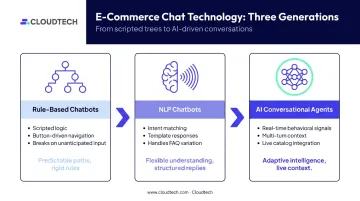
Three distinct generations of e-commerce chat exist, and only the third one moves the conversion needle.
Generation 1 — Rule-based chatbots: Scripted decision trees. The bot presents buttons, follows branching logic, and breaks the moment a shopper asks something unanticipated. According to AWS's definition, these systems rely on predefined rules and cannot interpret free-form input.
Generation 2 — NLP chatbots: These systems understand intent and match it to pre-written templates. They handle more variation but still depend on fixed responses. Reliable for simple FAQs; they fall short the moment a shopper needs a real recommendation.
Generation 3 — AI conversational agents: Real-time decisioning using behavioral signals, purchase history, and live catalog data. These systems carry context across conversation turns, interpret nuanced questions, and adapt responses based on what they know about the shopper.
The Capability Gap in Practice
Consider the question: "Does this run big?"
- A rule-based bot returns a link to the size chart
- An AI conversational agent cross-references return data, review sentiment, and purchase patterns to say: "This style runs about half a size large — most customers with your purchase history order down"
The first response adds friction. The second eliminates the hesitation that causes cart abandonment — and that gap compounds across thousands of daily sessions.
Conversational AI vs. Agentic AI
One distinction that matters when evaluating solutions: conversational AI answers questions and guides decisions. Agentic AI takes autonomous action — updating a cart, applying a discount, initiating checkout. AWS defines agentic AI as systems that act autonomously toward predetermined goals and execute multi-step workflows.
The most effective e-commerce deployments combine both layers: conversational capability to resolve uncertainty, and agentic capability to immediately act on that resolution.
The Conversion Rate Impact: What the Data Shows
The Core Conversion Lift
Rep AI's 2025 AI Ecommerce Shopper Behavior Report compared shoppers who engaged with AI chat against those who didn't:
- Chat-engaged shoppers: 12.3% conversion rate
- Non-engaged shoppers: 3.1% conversion rate
- Rep AI's characterization: roughly 4x lift
Worth noting: this is observational vendor data, not a randomized trial. Shoppers who initiate chat may already be more purchase-intent than those who don't. That said, the magnitude of the gap is consistent with what behavior-triggered engagement typically produces, making it a useful directional benchmark for setting pilot targets.
In practical terms: if your store generates 10,000 monthly sessions and you shift 20% of them into AI-assisted interactions at 12.3% conversion versus 3.1%, that's roughly 920 additional conversions per month — before accounting for AOV effects.
Speed-to-Purchase and AOV Effects
The same Rep AI report found:
- AI-assisted shoppers completed purchases in a median 8 minutes versus 15 minutes without AI — 47% faster
- Returning shoppers interacting with AI spent 25% more per session than returning shoppers who didn't
AI agents surface complementary items and upgrades at the exact moment a shopper is actively deciding. A post-checkout email does the same thing at the wrong moment. In-conversation recommendations hit at peak intent.
The Market Signal for SMBs
90% of retail and CPG companies expect to increase AI budgets in 2026, per NVIDIA's 2026 retail survey. Their 2025 survey found 40% already using generative AI for digital shopping assistants. SMBs without AI-assisted chat are now competing directly against stores that have already built it into the purchase flow.
Key AI Agent Capabilities That Drive E-Commerce Conversions
Proactive Abandonment Detection
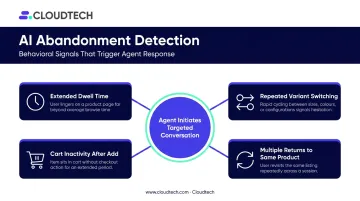
Modern AI agents monitor behavioral signals in real time, intervening before a shopper leaves — not after:
- Extended dwell time on a product page
- Repeated variant switching without adding to cart
- Cart inactivity after item addition
- Multiple returns to the same product
When these signals appear, the agent initiates a conversation — not a generic pop-up, but a targeted response to the specific friction visible in the session. The trigger logic matters as much as the response quality. An intervention 30 seconds too late catches an empty tab.
Personalized Product Recommendations
Machine learning models combine browsing history, past purchase patterns, and real-time session behavior to surface suggestions that fit the shopper's context.
Satya Jewelry's Rep AI deployment illustrates this at scale: by using an AI concierge to explain jewelry symbolism and guide product discovery (rather than defaulting to discounts), chat-engaged shoppers saw AOV rise from $125 to $172 — a 37% lift — with an 11% in-chat conversion rate.
The mechanism: recommendations presented during the decision, not after it.
Context-Aware, Multi-Turn Dialogue
Persistent context is what separates a useful AI agent from an irritating one. A shopper who asks about waterproofing on Tuesday and returns Friday to buy shouldn't have to re-establish their needs from scratch.
AI agents carry conversation history across sessions. This continuity compresses decision cycles — the shopper picks up where they left off, rather than starting over. Fewer restarts mean fewer exits.
24/7 Scalability Without Staffing Costs
Human support teams degrade under peak load. During product launches and holiday periods, queue times rise, quality falls, and abandonment accelerates at the exact moment conversion opportunity is highest.
AI agents handle unlimited simultaneous conversations without quality loss. IBM's 2024 analysis found customer-facing conversational AI associated with a 23.5% lower cost per contact across industries — a more defensible benchmark than older forecasts, and a useful target for SMBs calculating ROI.
Escalation to Human Agents
The handoff protocol matters as much as the automation itself. Good escalation triggers include:
- Sentiment detection indicating frustration
- Query complexity exceeding the agent's confidence threshold
- Explicit customer request for a human
Poor handoffs — where context is lost and the customer must repeat their situation — can do more damage than having no AI at all. The human agent needs full context; the customer shouldn't feel a gap.
A 2024 Gartner survey found 64% of customers would prefer companies not use AI for customer service. That's not an argument against AI agents — it's a warning that execution quality determines whether they build or erode trust.
How to Implement AI Conversational Agents: A Step-by-Step Guide
Step 1 — Identify Your Highest-Friction Moments
Pull your analytics and find where shoppers drop. Product pages with high exit rates, checkout steps with abandonment spikes, and cart inactivity patterns all indicate where a conversation would have the most impact.
Your starting use case should be:
- High enough traffic volume to generate statistically meaningful data
- Simple enough to handle without escalation — sizing questions, order status, shipping policy
- Tied to a clear before/after metric you can report on
Teams that start with one focused use case consistently see faster ROI than those attempting full-platform rollouts on day one.
Step 2 — Map Data and Integration Requirements Before Choosing a Vendor
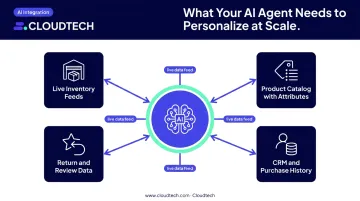
An AI agent without access to live data defaults to generic responses that don't convert. Before signing with any vendor, build a full integration map covering:
- Live inventory feeds
- Product catalog with attributes, variants, and descriptions
- CRM and purchase history
- Return and review data
Bring this map to every vendor conversation. Without it, any "personalization" the agent claims to offer is cosmetic.
Step 3 — Design Conversational Flows Around Decision Moments
There's a meaningful difference between a support-first flow and a revenue-first flow.
Support-first: "How can I help you today?"
Revenue-first: "Still deciding? Customers with similar needs found this size comparison helpful."
Write triggers and prompts that activate at intent signals — not just when something goes wrong. The goal is to engage the shopper at the exact moment their decision is forming, not after they've already decided to leave.
Step 4 — Deploy on AWS-Native Infrastructure for Speed, Security, and Scale
Getting the conversational flow right is only half the equation. The infrastructure running underneath determines how your agent performs under pressure.
SMBs working with an AWS consulting partner like Cloudtech can use pre-built components to reach production in weeks rather than months. Key components include Amazon Lex for natural language understanding, Amazon Bedrock for LLM capabilities, and Amazon Q for Business for knowledge retrieval.
AWS Partner Funding programs may be available to offset upfront costs depending on your deployment scope. Cloudtech holds AWS Advanced Tier Partner status and was selected as one of 26 global partners under AWS's Small Business Acceleration Initiative, which is specifically designed to support SMB cloud adoption.
Step 5 — Run a 30-Day Pilot, Measure, and Iterate
The first 30 days have one job: validate that the use case works and find where it doesn't.
Track:
- Resolution rate without human escalation
- Escalation rate and escalation triggers
- CSAT for AI-handled interactions
Iterate on conversation flows based on where shoppers encounter friction. Once the pilot stabilizes and your core metrics trend positively, that's the signal to expand — whether to additional channels, product categories, or post-purchase flows.
How to Measure AI Agent Success: KPIs That Matter
Conversion KPIs
| KPI | What It Measures | Benchmark |
|---|---|---|
| Assisted conversion rate | % of AI chat sessions resulting in purchase | Rep AI dataset: 12.3% |
| Cart recovery rate | % of abandoned carts recovered through AI engagement | Snow Teeth Whitening case: 33.85% for eligible flow |
| Revenue per visitor (AI vs. unassisted) | Isolates the revenue impact of AI engagement | Compare cohorts, not totals |
Revenue per visitor is more reliable than conversion rate alone. An agent that inflates conversion through excessive discounting can lower AOV enough to be net-negative on revenue.
Operational Efficiency KPIs
- Resolution rate without escalation: Rep AI reports 93.7% in its 2025 aggregate data
- Average handle time: Track alongside resolution rate — a fast resolution that leaves the question unanswered costs more to fix than a slower one that gets it right
- Cost per resolved interaction: IBM's cross-industry benchmark of 23.5% lower cost per contact gives you a target to measure against
What Continuous Optimization Looks Like
Deployment is the starting point, not the finish line. Effective teams build ongoing optimization into their workflow from day one:
- Adjust trigger timing based on where shoppers disengage
- Refine response logic based on escalation patterns
- Raise or lower intent thresholds for incentives based on margin impact
- Use resolved and escalated interaction data to retrain and tighten response logic
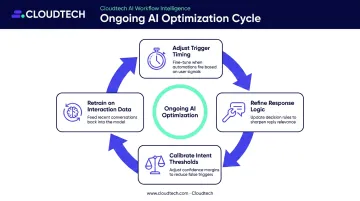
Teams that skip this step typically see performance plateau within 60-90 days. Regular iteration — even monthly threshold reviews — keeps the system aligned with actual shopper behavior and margin goals.
Frequently Asked Questions
What is a typical conversion rate for e-commerce?
Broad benchmarks cluster near 2%–2.5% — IRP Commerce reported 2.03% for June 2026, and Statista's global figure was 2.4% for December 2024. Rates vary by category, device, and funnel quality. The specific benchmark matters less than the gap between AI-assisted and unassisted sessions in your own store.
What is the conversion rate for chatbots?
Rep AI's 2025 behavioral data shows chat-engaged shoppers converting at 12.3% versus 3.1% for non-engaged shoppers. This is observational vendor data, not a controlled trial, but the gap reflects what happens when friction is resolved at the moment of hesitation.
Which AI agents are best for e-commerce?
The right choice depends on your integration requirements, catalog size, and existing tech stack. AWS-native solutions (Amazon Lex, Bedrock-powered agents) offer strong scalability and security control; dedicated e-commerce AI platforms deploy faster out of the box. Evaluate on resolution rate, catalog integration depth, and action capability — not just chat quality.
What is the difference between an AI conversational agent and a traditional chatbot?
Traditional chatbots follow scripted decision trees and match keywords to pre-written responses. AI conversational agents understand natural language, carry context across turns, analyze behavioral signals, and can take actions like updating carts or initiating checkout. The practical difference shows up when a shopper asks an unanticipated question.
How long does it take to see results after deploying an AI conversational agent?
Businesses focused on a single high-volume use case typically see measurable improvements in conversion and cart recovery within 30–60 days. Performance continues to improve as the system learns from ongoing interactions, making the pilot and iteration phase critical to long-term results.
How do AI agents help reduce cart abandonment?
AI agents detect hesitation signals in real time — extended dwell time, stalled carts, repeated page switching — and initiate targeted conversations that address the specific objection before the customer closes the tab. Timing and response relevance determine whether the outreach recovers the sale or gets dismissed.