Introduction
Finance teams are buried in paper — or its digital equivalent. Invoices arrive via email, loan files come in as scanned PDFs, compliance filings land in formats that change every quarter, and contracts pile up in shared drives with no systematic review. The result: financial professionals spend more time processing documents than acting on the insights inside them.
The scale of this problem is real. According to Ardent Partners' 2024 AP Metrics report, the average cost to process a single invoice is $12.53 — nearly four times the $3.23 benchmark achieved by best-in-class teams. Multiply that gap across thousands of monthly invoices and the operational drag becomes significant.
Generative AI changes the equation. Unlike traditional OCR, which simply converts document images to raw text, generative AI uses large language models (LLMs) to understand, extract, classify, and summarize what's inside financial documents — no matter how inconsistent the format, source, or structure.
This guide covers:
- The core limitations of legacy document processing approaches
- The highest-value GenAI use cases for financial workflows
- How the technology works on AWS
- A practical path to getting started
Key Takeaways
- GenAI processes both structured and unstructured financial documents — invoices, contracts, loan files, compliance reports — with high accuracy and minimal manual intervention
- Key use cases span invoice automation, loan origination, contract analysis, and regulatory compliance — each delivering measurable time and cost savings
- Amazon Textract, Amazon Bedrock, and Amazon Comprehend give financial teams the tools to build production-ready GenAI document pipelines on AWS
- Best-in-class AP teams using automation process invoices 82% faster and at 78% lower cost than their peers
- Financial firms can skip the build-from-scratch burden: an AWS-certified partner compresses deployment from months to weeks
Why Traditional Financial Document Processing Falls Short
The Cost and Speed Problem
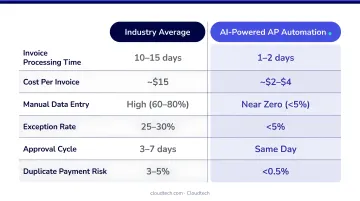
Manual document processing isn't just slow : it's also expensive and error-prone. Ardent Partners reports that best-in-class AP teams process invoices 82% faster and at 78% lower cost than average performers, with exception rates of 10.1% compared to 21.5% for the rest of the market. That gap exists almost entirely because of automation.
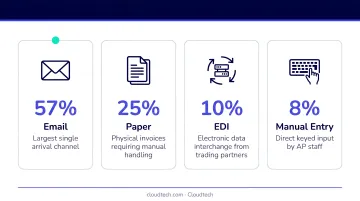
Invoices also arrive through at least three distinct channels, according to Levvel Research:
- 40% via email
- 26% via paper
- 18% via EDI/XML
On top of that, 33% of organizations still rely on manual data entry for initial capture. No single template-based system handles that kind of input diversity well.
Why Legacy OCR Breaks in Financial Services
Traditional OCR was built for consistency. It matches pixel patterns against fixed templates and outputs text , which works fine until a supplier changes their invoice format, a lender submits loan documents in a non-standard layout, or a counterparty sends a contract with embedded tables and handwritten margin notes.
Financial documents are inherently variable:
- Hundreds of different supplier invoice formats, none standardized
- Loan files with nested tables, embedded figures, and multi-page attachments
- Contracts with clause structures that vary by counterparty and jurisdiction
- Regulatory filings that change format when rules change
Template-based systems require constant maintenance. Every new counterparty format triggers a new template build. At scale, this becomes a full-time operational burden.
The Compliance Dimension
Manual processes create more than inefficiency — they create compliance exposure. The SEC's FY2024 enforcement results included more than $600 million in civil penalties against over 70 firms for recordkeeping failures. FinCEN separately assessed a record $1.3 billion penalty against TD Bank for BSA/AML compliance failures.
Fragmented audit trails, inconsistent document handling, and the inability to demonstrate real-time compliance with SOX, AML/KYC, and Dodd-Frank are direct consequences of manual workflows. The regulatory cost of getting this wrong has never been higher.
Key Use Cases of Generative AI in Financial Document Processing
Accounts Payable and Invoice Automation
GenAI extracts key invoice fields — vendor name, amounts, line items, due dates, purchase order references — across thousands of inconsistent supplier formats without requiring document-specific templates.
It also cross-references extracted invoice data against purchase orders, flags discrepancies for human review, and routes clean invoices straight through to payment systems. Top-performing AP teams already achieve 2.1x higher straight-through processing rates than their peers — GenAI is the primary driver of that gap.
Loan Origination and Credit Document Analysis
Loan files are among the most document-intensive workflows in financial services. Fannie Mae's research found that 73% of lenders cited operational efficiency as their primary motivation for AI/ML adoption in 2023 — up from just 42% in 2018. AI-based mortgage loan file review and compliance checks were among the most appealing capabilities cited.
GenAI ingests loan applications, credit agreements, income statements, and supporting documentation to extract covenants, risk metrics, repayment terms, and borrower details. This accelerates underwriting decisions and removes the manual burden of reviewing complex, multi-hundred-page credit files.
Contract Analysis and Management
Manual contract review breaks down at volume. GenAI surfaces critical clauses — payment obligations, renewal dates, termination conditions, indemnification terms — across entire contract portfolios without human review of every page.
This enables legal and finance teams to:
- Monitor obligations across hundreds of active agreements
- Flag upcoming renewal or termination windows automatically
- Identify compliance-relevant terms that require action
- Track contract lifecycle from execution through close-out
Regulatory Compliance and Reporting
Compliance teams spend significant time on document review. A Thomson Reuters survey found that one-third of compliance practitioners spent more than one full day per week just tracking regulatory changes — before any document review or remediation.
GenAI handles the heavy lifting across the compliance document cycle:
- Extracts and organizes data for regulatory submissions
- Automates AML/KYC document review and ISDA agreement processing
- Generates audit trails with minimal manual input
- Monitors for regulatory updates and flags documents needing revision
Financial Statement Analysis and Reporting
Month-end and year-end close processes rely on synthesizing data from balance sheets, income statements, cash flow reports, and supporting filings. GenAI compresses this work by:
- Generating narrative summaries from raw financial data
- Identifying trends and anomalies across reporting periods
- Calculating key ratios automatically
- Producing draft management reports for analyst review
Close cycles get faster, analytical output becomes more consistent, and finance teams can handle more without adding headcount.
How Generative AI for Financial Document Processing Works
Document Ingestion and Digitization
Every pipeline starts with getting documents into a machine-readable state. Financial documents arrive from multiple sources — email attachments, scanned files, ERP exports, document management platforms — in varying formats and quality levels.
On AWS, Amazon Textract handles this step. It extracts text, tables, and form data from PDFs and images, including handwritten content, and produces structured, machine-readable output as the foundation for all downstream processing. Textract includes purpose-built APIs for specific document types: AnalyzeExpense for invoices and receipts, and Analyze Lending for mortgage document classification and extraction.
Semantic Understanding with Large Language Models
Raw text extraction is only the starting point. What sets GenAI apart is the ability to interpret meaning — not just characters on a page.
LLMs deployed via Amazon Bedrock (supporting Claude, Llama, Titan, and other models) understand that "net 30" is a payment term, that a specific clause contains a contractual obligation, or that a figure represents a covenant ratio. This semantic understanding enables accurate extraction even when document layouts and phrasing vary significantly across counterparties.
Document Classification and Intelligent Routing
Once documents are ingested and understood, they need to go somewhere. Amazon Comprehend applies NLP capabilities to:
- Classify documents by type (invoice, contract, loan application, compliance filing)
- Identify named entities specific to financial terminology
- Route documents to the correct downstream workflow without manual triage
Custom classification models can be trained on organization-specific financial vocabulary, improving accuracy over time.
Retrieval-Augmented Generation (RAG) for Contextual Analysis
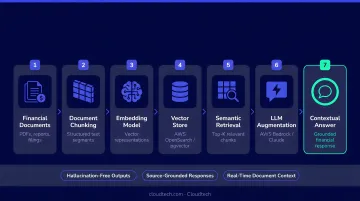
Once documents are classified and routed, deeper contextual analysis requires a different mechanism. RAG is the architecture that grounds GenAI responses in real document data rather than model inference. Document content is converted into vector embeddings stored in a vector database. When a query is made — "summarize all covenant obligations in this credit agreement" — the system retrieves the relevant document sections before generating a response.
This prevents hallucination and keeps summaries, compliance checks, and extracted data anchored to what's actually in the documents — not what the model predicts should be there.
Validation, Output Generation, and System Integration
The final stage converts AI outputs into action. The pipeline validates extracted fields, compliance flags, summaries, and draft reports against predefined rules, then pushes them downstream via APIs into:
- ERP systems and accounting platforms
- CRM and loan origination systems
- Compliance dashboards and audit tools
- Document management repositories
High-stakes exceptions route to human reviewers with full context, preserving accountability without breaking the automation pipeline. Every action is logged via AWS CloudTrail, maintaining a complete, immutable audit trail.
Key Benefits of Generative AI for Financial Document Processing
Operational Efficiency at Scale
The efficiency gap between automated and manual document processing is substantial. Best-in-class AP teams process invoices 82% faster and at 78% lower cost than peers — benchmarks that reflect the compounding value of straight-through processing at volume.
For most routine documents, GenAI handles end-to-end processing without human touchpoints. Teams shift their time toward exception handling, analysis, and strategic work.
Improved Accuracy and Reduced Financial Risk
AI doesn't get tired, distracted, or rushed at month-end. It applies extraction rules consistently across every document, every time. This matters because data entry errors in financial workflows have real consequences: duplicate payments, incorrect regulatory filings, missed covenant obligations.
Higher data quality also improves downstream analytics — accurate source data means the financial models and reports built on top of it are more reliable.
Elastic Scalability Without Headcount Growth
Document volume grows with business activity — more suppliers, more loans, more regulatory requirements. Hiring additional staff to keep pace is expensive and slow.
A GenAI pipeline on AWS cloud infrastructure scales elastically. From 500 invoices a month to 50,000, the system maintains consistent speed and cost per document. For SMBs in financial services experiencing growth, that kind of elastic capacity is something headcount alone can't replicate.
Built-In Compliance and Audit Readiness
GenAI systems automatically generate detailed audit trails, maintain document version histories, and flag regulatory risks in real time. AWS security controls are built into the architecture from the start:
- Encryption at rest and in transit
- Role-based access via IAM
- Immutable logging through CloudTrail
- Threat detection via GuardDuty
When an auditor or regulator asks for documentation of a decision or transaction, the answer is already logged, searchable, and verifiable.
How to Get Started with GenAI for Financial Document Processing on AWS
Step 1 — Map your highest-volume workflows first. Before building anything, identify your most repetitive document processes — typically accounts payable, loan intake, or compliance reporting — and quantify what they currently cost in time and errors. This scoping exercise establishes ROI targets and prevents over-engineering the initial deployment.
Step 2 — Select the right AWS services for your use case. AWS provides a comprehensive native stack for financial document AI:
| Service | Role in Pipeline |
|---|---|
| Amazon Textract | Document extraction — text, tables, forms, handwriting |
| Amazon Comprehend | NLP classification and entity recognition |
| Amazon Bedrock | LLM access — Claude, Llama, Titan |
| Amazon S3 | Secure document storage |
| AWS Lambda / Step Functions | Workflow orchestration |
| AWS PrivateLink | Private, compliant data connectivity |
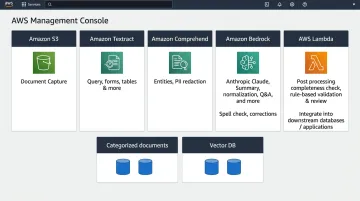
The right combination depends on document complexity, volume, and regulatory requirements.
Step 3 — Work with a certified AWS partner to accelerate deployment. Building and securing a GenAI document pipeline from scratch requires deep cloud architecture expertise. Cloudtech, an AWS Advanced Tier Partner specializing in intelligent document processing and generative AI on AWS, offers a fixed-price IDP solution — delivered in two weeks — so financial services SMBs reach production without a drawn-out build cycle.
Cloudtech's structured approach covers three entry points:
- IDP Workflow Assessment — identifies which document workflows to prioritize first
- GenAI Strategy Workshop — aligns AI initiatives to specific business outcomes
- Four-Week Proof of Concept — validates a target workflow before full-scale rollout
Every engagement includes hands-on training so client teams operate the solution independently from day one.
Frequently Asked Questions
What is the best AI for analyzing financial documents?
The right combination depends on the use case. Amazon Textract and Amazon Bedrock together provide enterprise-grade extraction and semantic analysis for most financial document types. Working with an AWS partner ensures the architecture is matched to your specific documents, volumes, and compliance requirements, not applied as a one-size-fits-all solution.
What types of financial documents can generative AI process?
GenAI handles both structured and unstructured formats: invoices, contracts, loan applications, credit agreements, bank statements, ISDA documents, tax filings, regulatory compliance reports, KYC/AML records, and financial statements. Both printed and handwritten content is supported.
How does generative AI differ from traditional OCR for financial document processing?
Traditional OCR matches pixels to templates and outputs raw text, causing failures whenever document layouts shift. GenAI uses LLMs to interpret meaning and context, preserving structure and handling variable formats accurately. The result is a system that doesn't require constant template maintenance as counterparty formats evolve.
Is generative AI for financial document processing secure and compliant?
Yes. Enterprise-grade AWS implementations use encryption at rest and in transit, IAM-based access controls, and immutable audit logging via CloudTrail. Private deployment via AWS PrivateLink supports SOX, GDPR, and financial services data residency requirements.
How long does it take to implement a GenAI financial document processing solution?
Simple invoice automation pipelines can be deployed in as little as two weeks using pre-built AWS architectures. More complex multi-document workflows typically take two to three months. Working with an experienced AWS partner like Cloudtech significantly reduces time-to-deployment compared to building in-house.
What AWS services are used for generative AI financial document processing?
The core stack includes Amazon Textract for extraction, Amazon Bedrock for LLM access, Amazon Comprehend for NLP and classification, and Amazon S3 for secure storage. Workflow orchestration runs through AWS Lambda or Step Functions, with AWS PrivateLink handling compliant private connectivity.