Introduction
Most e-commerce stores convert somewhere between 1% and 4% of visitors. That means for every 100 people who land on a product page, 96 leave without buying — and a significant portion do so not because they weren't interested, but because they hit a wall. A question went unanswered. Shipping costs appeared without warning. A sizing concern lingered just long enough for them to close the tab.
This is the conversion problem that AI chatbots are now built to solve.
In 2026, chatbots have moved well past their origins as basic FAQ widgets. The data now shows that AI-assisted shopping sessions convert at meaningfully higher rates than unassisted ones — not because chatbots are novel, but because they remove friction at the exact moments shoppers are most likely to abandon.
This guide covers what the current benchmarks actually show, which chatbot use cases deliver the strongest conversion impact, how to deploy effectively, and how to measure results with enough precision to know what's working.
Key Takeaways
- Global e-commerce conversion rates sit between 1–4%, with Statista reporting 1.4% for Q1 2026
- AI-assisted chat is associated with up to 4x higher conversion rates compared to unassisted sessions (12.3% vs. 3.1%)
- The global cart abandonment rate is 70.22% — proactive chatbots can recover a share of those sessions
- Pre-purchase product guidance and checkout intervention deliver the fastest, most measurable ROI
- Successful deployment hinges on live product data integration, a defined escalation path, and chatbot-specific conversion tracking
E-Commerce Conversion Rate Benchmarks in 2026
The Baseline Problem
E-commerce conversion rates have remained stubbornly low despite years of investment in site design, UX improvements, and marketing optimization. Statista's Q1 2026 data puts the global average at 1.4% of visits converting to purchases. IRP Commerce's May 2026 platform benchmark comes in higher at 1.93% — the difference reflects methodology, not a contradiction.
The practical takeaway: most stores are converting fewer than 2 in every 100 visitors, and that number hasn't moved much in years.
Conversion Rates by Vertical
Benchmarks vary considerably by category. IRP Commerce's May 2026 data and Dynamic Yield's rolling benchmark platform show the following ranges:
| Category | IRP Commerce (May 2026) | Dynamic Yield (2026) |
|---|---|---|
| Health & Wellbeing / Beauty | 2.41% | 5.37% |
| Food & Beverage | 1.20% | 5.03% |
| Fashion, Clothing & Accessories | 1.53% | 2.81% |
| Kitchen & Home Appliances | 3.00% | — |
| Home & Furniture | — | 1.20% |
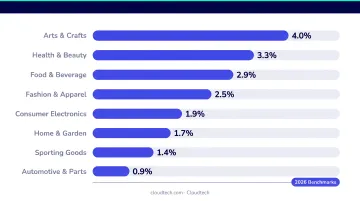
The spread between IRP and Dynamic Yield figures reflects different customer panels and calculation methods — use these as directional benchmarks, not absolutes. What holds across all sources: low-ticket, high-frequency categories (food, beauty) convert higher than considered or big-ticket purchases (furniture, electronics).
The Performance Gap
Those vertical averages mask a wide internal spread. Top-quartile e-commerce stores routinely hit 4-5% conversion — three to four times the global average — without proportionally higher traffic. The gap comes down to trust, speed of information delivery, and friction reduction at key decision points. Those are the same variables AI chatbots directly address.
How AI Chatbots Directly Impact E-Commerce Conversion Rates
The Headline Numbers
Rep AI's 2025 AI Ecommerce Shopper Behavior Report — based on 17 million shopper interactions across their customer network — found that shoppers who engaged with AI chat converted at 12.3%, compared to 3.1% for shoppers who did not. That's roughly a 4x difference.
This is vendor-sourced data drawn from Rep AI's customer base, not a randomized study. Even so, the gap is large enough to be meaningful — and the underlying logic holds: chatbots remove information barriers at the exact moments shoppers hesitate most.
Speed-to-Purchase
The same report found AI-assisted shoppers completed purchases 47% faster (a median of 8 minutes versus 15 minutes without AI assistance). Purchase decisions don't age well. The longer a shopper sits in uncertainty, the more likely they are to leave and not return.
Cart Abandonment Recovery
Baymard Institute calculates the average documented cart abandonment rate at 70.22%, derived from 50 independent studies. That's the baseline problem chatbots are well-positioned to address.
Proactive AI chat — triggered when a shopper shows exit intent, goes inactive, or lingers on a checkout field — can intercept hesitation before it becomes abandonment. Vendor-reported recovery figures range from 15–35% of otherwise-lost sessions, though these numbers carry methodology caveats and shouldn't be treated as industry-wide benchmarks.
Reactive vs. Proactive Chat Modes
This distinction matters for deployment decisions:
- Reactive chatbots wait for the shopper to initiate — useful for support, but passive on conversion
- Proactive chatbots trigger based on behavioral signals: time on page, scroll depth, cursor movement toward the exit
Proactive modes consistently outperform reactive ones for conversion because they intercept the hesitation moment, not the aftermath.
Revenue Per Visit
Beyond conversion rate, AI product recommendations within chat can increase average order value. Two data points frame the opportunity:
- Dynamic Yield's GlassesUSA.com case study showed an 88% increase in average revenue per user from deep-learning recommendations — a product recommendation engine result, but directly applicable to AI chat with recommendation capabilities
- McKinsey's personalization research puts the typical revenue lift at 10–15% across implementations
High-Impact Chatbot Use Cases That Drive Conversions
Pre-Purchase Product Guidance
This is the highest-value use case for conversion rate improvement. Shoppers have questions about fit, compatibility, specs, delivery time, and return policies before they buy. When those questions go unanswered, they leave — to search elsewhere, to contact support later, or simply to abandon the session.
A chatbot trained on live product data can answer these questions instantly, at 2 a.m. on a Sunday, without a support ticket. Across most e-commerce categories, this single use case removes more conversion-blocking friction than any other chatbot deployment.
Checkout Assistance and Payment Friction
Baymard's abandonment research identifies the top reasons shoppers quit at checkout:
- Extra costs too high (shipping, tax, fees) — 39% of respondents
- Delivery too slow — 21%
- Didn't trust the site with payment info — 19%
- Forced account creation — 19%
- Checkout process too long or complicated — 18%
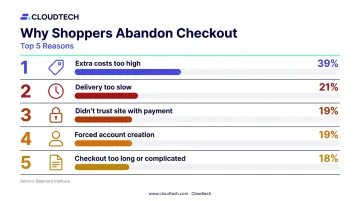
A chatbot on the cart or checkout page can address most of these in real time — clarifying shipping costs before they become a surprise, confirming return policies, and reassuring shoppers about payment security. Each resolved concern is a prevented abandonment.
Personalized Product Recommendations via Conversation
Conversational recommendations outperform static widgets for one reason: they feel guided, not algorithmic. A chatbot that asks "What's the occasion?" or "Do you need this by Friday?" narrows options based on actual intent. That's more effective than a recommendation carousel, which relies on browsing history alone.
Post-Purchase Upsell and Repeat Purchase Triggers
Order confirmation conversations are underused conversion opportunities. A well-timed chatbot message post-purchase can introduce:
- Complementary product suggestions tied to the item just purchased
- Loyalty program enrollment while engagement is highest
- Subscription or repeat-purchase offers with a single-click opt-in
This extends conversion value past the first sale — without interrupting the buying experience.
How to Deploy an AI Chatbot for Maximum Conversion Impact
Start with the Highest-Friction Moments
The most common deployment mistake is trying to automate everything at once. A better approach:
- Identify the 2–3 questions causing the most abandonment — typically product fit, shipping cost, and checkout trust
- Build and test the chatbot around those scenarios first
- Expand scope once you have baseline performance data
This creates faster, more measurable ROI than a broad deployment with no clear success criteria.
Integrate with Live Product and Order Data
A chatbot that can't access real-time inventory, pricing, or shipping estimates will give generic answers — and generic answers erode trust faster than no answer at all. Effective deployment requires backend integration with your e-commerce platform so the chatbot can pull live data when it needs it.
For SMBs without enterprise-level budgets, AWS-powered solutions keep infrastructure costs in check as query volume grows. Cloudtech, an AWS Advanced Tier Partner, builds conversational AI using Amazon Lex and AWS Bedrock, connected to live data pipelines through Lambda and Glue. This keeps product and inventory data current without requiring a dedicated data engineering team on staff.
Define the Escalation Path
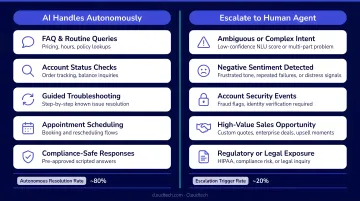
A chatbot that traps users in a loop is worse than no chatbot. Every deployment needs a clear human handoff:
- Autonomously handle: the top 80% of pre-purchase questions
- Escalate to a human: high-value queries (large orders, complex customization), repeated confusion signals, or any shopper who explicitly asks for a person
- Handoff should be seamless: the human agent should receive the conversation context, not start from scratch
Measure Chatbot-Specific Conversions
Once your escalation path is set, the next question is whether the chatbot is actually moving the needle. Standard site analytics won't tell you — you need segmented data:
- Fire a GA4 event when a shopper starts or receives AI chat assistance
- Attach a
chatbot_assisted=trueparameter to subsequent funnel events in that session - Track separately: add-to-cart from chat, checkout start from chat, purchase after chat
- Build comparison segments: chatbot-assisted sessions vs. non-assisted sessions
Without this segmentation, you're measuring the chatbot's impact on overall site metrics — which is too diluted to act on.
Measuring Chatbot Performance: Metrics That Matter
Primary KPI: Conversion Rate Lift
Compare purchase conversion rate between chatbot-assisted sessions and non-assisted sessions. This is your headline metric, and it should be tracked from day one — even before you have statistically significant data, the directional trend is informative.
Set up a 30-day baseline period before and after deployment using the same traffic segments. This gives you a clean before/after comparison that isn't contaminated by seasonal shifts.
Pre-Purchase Engagement Metrics
These tell you whether the chatbot is functioning as a sales layer or a FAQ widget:
- Track response time on product questions to confirm shoppers get answers before they leave
- Measure conversation-to-add-to-cart rate — the share of chatbot sessions that end with a cart action
- Monitor pre-purchase question resolution rate to see how often the bot handles inquiries without human escalation
Cart Recovery and Revenue Attribution
For every abandoned cart session where the chatbot intervened, track:
- How many sessions the chatbot engaged
- What percentage recovered (completed purchase within the attribution window)
- Revenue attributed to those recoveries
Keep a consistent attribution window — 24 hours is a reasonable starting point — and apply it uniformly to avoid inflating numbers.
Frequently Asked Questions
What is the average conversion rate for e-commerce in 2026?
Current benchmarks range between 1–4% depending on the source and vertical. Statista puts the global average at 1.4% for Q1 2026; IRP Commerce's May 2026 platform data shows 1.93%. For most store types, 2–3.5% is a reasonable target — food, beverage, and health categories consistently convert higher than electronics or luxury goods.
How much do AI chatbots improve e-commerce conversion rates?
Rep AI's 2025 report — based on 17 million shopper interactions — found AI-assisted sessions converted at 12.3% versus 3.1% for non-assisted sessions, roughly a 4x difference. Results depend heavily on placement and live product data integration, with pre-purchase guidance and cart recovery showing the strongest gains.
What is the difference between an AI chatbot and a live chat widget?
A live chat widget connects shoppers to human agents in real time. An AI chatbot uses natural language processing to respond instantly and autonomously, at any hour, without staffing costs. The key practical advantage is 24/7 availability at scale — a chatbot handles the same question volume whether it's noon on a Tuesday or midnight on a holiday.
What e-commerce chatbot use cases deliver the fastest ROI?
Pre-purchase product guidance and checkout abandonment intervention. Both target moments where purchase intent exists but a specific friction point causes drop-off — answering these questions in real time removes the barrier before the shopper decides to leave.
How long does it take to see conversion results from an AI chatbot?
Early engagement indicators — conversation-to-cart rate, response resolution rate — are visible within 2–4 weeks. Statistically meaningful conversion rate lift typically requires 30–60 days of data, depending on your traffic volume. Higher-traffic stores reach significance faster.
How do I choose the right AI chatbot infrastructure for my e-commerce store?
Prioritize solutions that connect to your existing product catalog and order management system, support escalation to human agents, and run on a secure, scalable cloud backend. AWS-based deployments are widely used for their pay-per-use cost model and built-in security controls, making them a practical choice for SMBs that need enterprise-grade reliability without the infrastructure overhead.