The result? Leads researching vehicles at 10 PM find a competitor who responds immediately. DAS Technology's 2025 Automotive Lead Response Study, based on over 1,700 lead submissions through dealership vehicle-detail pages, found that 19% of dealers took more than one hour to respond — a window in which most buyers have already moved on.
This article goes beyond theory. You'll see what AI chatbots are actually doing for automotive businesses — with real brand examples from Toyota, BMW, Mercedes-Benz, and Hyundai — along with the measurable outcomes and operational benefits tied to day-to-day dealership performance.
Key Takeaways
- Automotive AI chatbots handle inquiries, schedule test drives, calculate financing, and automate post-sale follow-ups around the clock
- Core benefits include 24/7 lead capture, faster sales cycles, lower operating costs, and stronger customer retention
- Major automakers including Toyota, BMW, and Hyundai have deployed chatbots with documented gains in engagement and conversion rates
- Businesses that delay adoption hand leads to competitors who respond instantly, at any hour
- ROI depends on CRM/DMS integration and ongoing conversation monitoring — cloud infrastructure scalability determines how well the system grows with demand
What Is an AI Chatbot in the Automotive Industry?
An automotive AI chatbot is software powered by natural language processing (NLP) and machine learning that communicates with customers via text or voice, guiding them through vehicle research, service scheduling, financing questions, and more, without requiring a staff member for every interaction.
Where These Tools Are Deployed
Automotive chatbots operate across multiple customer touchpoints:
- Dealership websites — handling inventory questions and appointment booking
- Messaging apps — WhatsApp, Facebook Messenger, and SMS channels
- CRM and DMS-connected platforms — logging interactions and updating lead records in real time
- Connected vehicles — answering service questions and scheduling maintenance from inside the car
What Actually Measures Value
Knowing where chatbots operate is only half the picture — what they deliver is what justifies the investment. Value shows up in leads captured after hours, test drives booked without staff involvement, and routine inquiries resolved without a human touchpoint. A chatbot handling 300 simultaneous inquiries during a model launch while pulling from live inventory data will outperform a technically sophisticated one that isn't connected to your systems.
Key Benefits of AI Chatbots in the Automotive Industry
Each benefit below maps to outcomes dealerships actively track — lead conversion rates, cost per interaction, appointment volume, and customer satisfaction scores.
24/7 Lead Capture and Customer Engagement
Automotive chatbots don't go offline when the showroom does. They engage website visitors, respond to social media inquiries, and qualify leads at 2 AM just as effectively as during business hours.
In practice: a visitor browsing inventory late at night receives instant vehicle recommendations, gets a trade-in estimate, and books a test drive — all without a salesperson involved.
The DAS Technology data makes the stakes clear. With 19% of dealers taking over an hour to respond to inquiries even during business hours, the after-hours gap is far worse. Buyers who don't receive an instant response don't wait — they move to whoever responds first.
KPIs impacted:
- Lead capture rate
- Cost per lead
- After-hours conversion rate
- Chat-to-appointment ratio
This benefit matters most for dealerships with high web traffic, limited overnight staffing, or those running digital ad campaigns that drive clicks at all hours.
Faster Sales Cycle Through Process Automation
Chatbots compress the time between a buyer's first question and their decision to visit by automating the most time-consuming steps:
- Inventory search and preference matching
- Test drive scheduling and reminders
- Financing pre-qualification
- Follow-up sequences
Instead of waiting days for a callback on financing, a buyer gets instant EMI calculations within the chat. Instead of back-and-forth scheduling calls, they confirm a slot in seconds and receive an automated reminder.
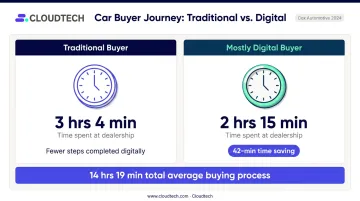
Cox Automotive's 2024 Car Buyer Journey Study found that buyers spent an average of 14 hours 19 minutes on the total buying process. The same research showed "Mostly Digital" buyers — those completing more than 50% of steps online — spent 2 hours 15 minutes at the dealership compared to 3 hours 4 minutes for buyers who completed fewer steps digitally. A separate Cox Automotive digitization study quantified this as a 42-minute saving at the dealership for more digitally engaged buyers.
KPIs impacted:
- Test drive conversion rate
- Average days to close
- Appointment show rate
- Deals handled per sales rep per month
This benefit is most pronounced during high-demand periods — new model launches, seasonal promotions — or for dealerships managing large inventories where manual matching of buyer preferences to available stock is slow.
Lower Operating Costs at Scale
By automating repetitive, high-volume interactions — appointment confirmations, service reminders, FAQs, and insurance queries — chatbots reduce staff time on routine contact and free human teams for complex cases and high-value deals. A single chatbot handles hundreds of simultaneous inquiries across a dealership's website and messaging channels, replacing what would otherwise require multiple staff on first-response and scheduling.
For context on cost impact at scale: a McKinsey case study of an AI-enabled customer service transformation at a financial institution reported a greater than 20% reduction in cost to serve and a 40–50% reduction in service interactions handled by assisted channels. While not automotive-specific, the same dynamic applies: automated handling replaces high-volume routine contact, and the cost math holds.
Unlike human teams, a chatbot scales instantly during peak periods without hiring or overtime.
KPIs impacted:
- Cost per customer interaction
- Support staff hours on routine tasks
- Customer satisfaction score (CSAT)
- First-response time
Dealership groups managing multiple locations, parts manufacturers fielding high volumes of specification queries, and service centers with dense appointment scheduling demand will see the strongest returns here.
Real-World Examples of Automotive AI Chatbots in Action
These examples ground the benefits above in actual deployments — showing what global automotive brands have built and what outcomes they've reported.
Toyota
In August 2024, Toyota Connected North America and Saatchi & Saatchi deployed a GPT-4-powered marketing chatbot designed to educate users about Toyota vehicles conversationally. When a user showed purchase interest, the bot directed them to Toyota's site to price and configure a vehicle.
Toyota Connected reported an uptick in engagement and website clickthroughs compared to traditional banner ads. No specific CTR figure was published, but conversational AI outperforming static display ads on engagement is a consistent pattern across the industry.
BMW's AI Assistant
BMW Group has deployed an AI assistant that answers customer queries 24/7 through websites and apps, drawing on verified product and service knowledge. It handles inquiries outside business hours: the exact window where dealerships typically lose leads to slow response times. BMW Group's official AI page confirms the deployment but does not publish specific performance metrics.
Mercedes-Benz in the Middle East
Mercedes-Benz Cars Middle East launched a bilingual Facebook Messenger chatbot supporting both English and Arabic, enabling users to book test drives, explore the model range, receive launch notifications, and get model recommendations based on stated preferences.
By meeting buyers on a platform they already use, in the language they prefer, Mercedes reduced friction at the first digital touchpoint. For a region with a large Arabic-speaking buyer base, that language capability is a direct lead-generation lever.
Hyundai Mexico
Hyundai Mexico's digital program — Hyundai Live — combined one-to-many livestream broadcasts with a 24/7 website chatbot. According to giosg case studies, the live-selling project generated more than 1 million live stream viewers over nine months and averaged 70 pre-qualified leads forwarded to dealerships per month, delivering a reported 300% ROI. A separate chatbot deployment produced more than 100 automated leads sent to dealerships per week.
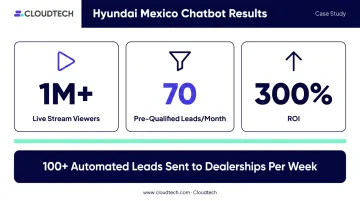
The Hyundai Mexico case demonstrates that combining content marketing with chatbot-driven lead qualification creates a compounding effect — content drives awareness, and the chatbot converts that attention into qualified pipeline.
Across these four brands, the pattern is consistent: chatbot ROI shows up quickly, and the results aren't exclusive to global OEMs with nine-figure budgets. Hyundai Mexico's 300% ROI came from a focused deployment, not an enterprise-scale overhaul.
What Happens When Automotive Businesses Skip AI Chatbots
Inaction carries a real cost. Dealerships without chatbots lose after-hours leads to competitors who respond instantly — and staff spend too much time on repetitive queries while buyers experience slow, inconsistent communication that erodes trust before they ever set foot in the showroom.
Four risks grow the longer you wait:
- Rising cost-per-lead as manual handling limits the volume of inquiries a team can manage
- Inconsistent customer experience — a buyer on the website gets a different response time than one on WhatsApp or social media
- Scaling problems during high-demand periods without proportionally increasing headcount
- Missed upsell and retention opportunities — without automated post-sale follow-up and service reminders, repeat business erodes
These friction points show up directly in buyer behavior. Cox Automotive's 2024 Digitization of Automotive Retail Study found that 97% of dealers reported customers repeating online steps in the dealership, and 83% said this repetition impedes dealership efficiency. When digital and in-store experiences aren't connected, buyers feel the friction — and some don't return.
How to Get the Most Value from Automotive AI Chatbots
Chatbot ROI depends on implementation quality. A chatbot that isn't integrated with the dealership's CRM or DMS, isn't trained on real inventory and pricing data, and isn't monitored for conversation quality will underperform. The technology is only as good as the infrastructure and data behind it.
Three Conditions for Maximum ROI
- Live system integration — the chatbot connects to real inventory, CRM, and scheduling systems so responses are accurate and actions are real-time, not just informational
- Regular conversation review — lead capture rates, appointment completions, and drop-off points are reviewed and used to refine conversation flows on an ongoing basis
- Seamless human escalation — complex or high-value inquiries escalate to a human agent with full chat context preserved, so the buyer never has to repeat themselves
What Good Implementation Looks Like in Practice
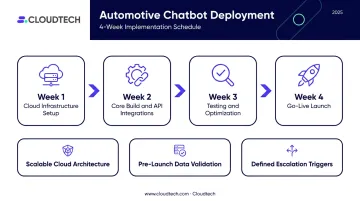
Successful automotive chatbot deployments share a consistent delivery structure. The most effective rollouts follow a phased model: cloud infrastructure setup and architecture in week one, core build and API integrations in weeks two and three, then testing, optimization, and go-live in week four. That four-week cadence keeps deployments on schedule while leaving room to validate data accuracy before launch.
Key elements that separate high-performing deployments from underperforming ones:
- Scalable cloud architecture — chatbot infrastructure built on secure, cloud-native foundations handles traffic spikes without degrading response quality
- Pre-launch data validation — inventory feeds, pricing rules, and scheduling APIs are tested before go-live to prevent inaccurate responses at launch
- Defined escalation triggers — clear handoff rules (by inquiry type or buyer stage) ensure human agents receive full conversation context, not a cold transfer
For dealerships without in-house cloud or AI infrastructure, working with an AWS-certified implementation team ensures the chatbot is built on a scalable, secure foundation from day one. Cloudtech's team includes Sarah Karandy, a Senior Technical Program Manager who previously launched major U.S. auto dealership platforms at Dealer.com — bringing direct automotive platform experience to cloud-based AI deployments.
Conclusion
AI chatbots in the automotive industry deliver real, quantifiable results — not through novelty, but by solving specific operational problems: missed after-hours leads, slow sales cycles, high routine support costs, and inconsistent customer experience across channels.
The brands already seeing results — Toyota, BMW, Mercedes-Benz, Hyundai — aren't outliers. The technology is accessible to dealerships and automotive SMBs willing to invest in proper implementation.
The cost of inaction is concrete: every unanswered after-hours inquiry is a lead that went to a competitor who picked up first. Dealerships that deploy chatbots now aren't just gaining speed — they're capturing customers that unresponsive competitors are actively losing.
Frequently Asked Questions
What is an AI chatbot in the automotive industry?
An automotive AI chatbot is an NLP-powered tool that converses with customers via text or voice to handle vehicle inquiries, book appointments, calculate financing, and more. It operates across websites, messaging apps, and CRM-connected platforms without requiring staff involvement for every interaction.
How do AI chatbots help car dealerships increase sales?
Chatbots increase sales by capturing and qualifying leads 24/7, guiding buyers through inventory search and financing options instantly, and reducing the time between first inquiry and appointment. The result is higher test drive conversion rates and faster deal closure, all without adding headcount.
Can small or mid-sized dealerships afford AI chatbot technology?
Yes. Chatbot solutions range from off-the-shelf tools to custom AWS-powered deployments, with costs scaling to dealership size. The priority is choosing a solution with real CRM integration — platforms that charge enterprise pricing for features smaller operations don't need rarely deliver proportional ROI.
How do automotive chatbots integrate with CRM and DMS systems?
Well-built automotive chatbots connect directly to CRM platforms and DMS systems via API to pull live inventory data, log customer interactions, update lead records in real time, and push appointment confirmations automatically. That integration — handled during deployment — is what separates functional chatbots from ones that only answer static questions.
What is the difference between a basic chatbot and an AI-powered automotive chatbot?
Basic chatbots follow rigid pre-set scripts and fail when questions deviate from expected patterns. AI-powered chatbots use NLP to understand intent, maintain context across a conversation, ask follow-up questions, and adapt responses — enabling them to handle complex queries such as trade-in estimations, multi-scenario financing comparisons, and side-by-side model evaluations.
What KPIs should dealerships track to measure chatbot performance?
The key metrics are: lead capture rate, chat-to-appointment ratio, average first-response time, test drive show rate, cost per customer interaction, and CSAT score. Regular review of these metrics is what separates deployments that improve over time from ones that plateau after launch.