The math doesn't work at current staffing levels. And hiring more agents isn't a sustainable answer.
Conversational AI offers a practical path forward. Unlike the scripted chatbots that frustrated shoppers for years, modern AI systems understand natural language, connect to backend retail data, and resolve issues end-to-end—without human intervention for the majority of inquiries.
This article covers what conversational AI actually means in a retail context, the core benefits backed by research, how well-known brands are using it today, and practical guidance on implementing it effectively—whether you're an enterprise retailer or an SMB getting started.
Key Takeaways
- Conversational AI uses NLP, machine learning, and generative AI to hold context-aware conversations across text and voice—unlike rigid rule-based chatbots
- Core benefits include 24/7 support, personalized recommendations, reduced operational costs, and consistent omnichannel engagement
- Walmart, Sephora, and Starbucks are already using conversational AI to automate millions of interactions and personalize customer experiences at scale
- Successful implementation starts with one high-impact use case—WISMO automation or FAQ handling—then scales from there
- SMBs can adopt conversational AI without large engineering teams—AWS-certified partners can get deployments live in weeks, not months
What Is Conversational AI in Retail?
Conversational AI is software that uses natural language processing (NLP), machine learning, and generative AI to understand customer intent and respond in context-aware, human-like ways—across both text and voice channels.
That distinction matters. Traditional rule-based chatbots follow rigid decision trees, matching keywords to pre-scripted responses. They break down the moment a customer phrases something unexpected.
IBM's guidance on chatbot types puts it plainly: rule-based systems "support predefined questions and answer options," while AI chatbots "can understand users' questions regardless of exact phrasing."
Why Retail Is a Strong Fit
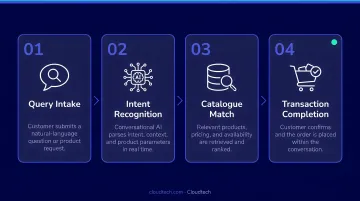
Conversational AI connects to your backend infrastructure and takes action, not just answers questions:
- Pull real-time order status from your OMS and relay it to the customer
- Initiate a return or exchange without agent involvement
- Deliver personalized product recommendations based on purchase history
- Check inventory across locations and complete transactions
That capability to act, not just reply, is what separates conversational AI from its predecessors and what makes it genuinely useful in retail environments.
The Market Opportunity
This isn't a niche experiment. Grand View Research projects the global conversational AI market will reach $41.39 billion by 2030, growing at a 23.7% CAGR from 2025 to 2030. On the retail side, Salesforce surveyed 1,700 retail decision-makers and found 75% believe AI agents will be essential to their operations by 2026.
For retailers, the question is no longer whether to adopt conversational AI—it's how quickly they can deploy it before the gap with competitors widens.
Key Benefits of Conversational AI for Retailers
24/7 Support Without Adding Headcount
Customer patience is short. HubSpot reports that 66% of consumers expect a customer service response within five minutes or less. That expectation doesn't pause after business hours.
Conversational AI handles order status queries, return policy questions, and product inquiries around the clock—on website chat, SMS, WhatsApp, or mobile apps—without hold queues. H&M's U.S. customer service page reflects this directly: their AI Assistant is available 24/7, while live agents are limited to opening hours.
The result isn't just convenience. It's capacity. Human agents stop spending their day answering "where's my order?" and start handling cases that actually need them.
Personalization That Drives Revenue
Generic responses don't convert. McKinsey research shows personalization typically drives 10–15% revenue lift, with some retailers seeing as much as 25% depending on execution.
The reason conversational AI delivers on this is data access. When an AI system connects to your CRM and purchase history, it can:
- Recommend products based on what a customer has bought before
- Personalize promotions based on browsing behavior
- Adjust tone and context based on loyalty status
McKinsey also found that 71% of consumers expect personalized interactions, and 76% get frustrated when it doesn't happen. Conversational AI closes that gap at scale.
Operational Efficiency and Cost Reduction
The volume of routine retail inquiries is staggering—and most of it requires no human involvement. Gartner predicts that by 2029, agentic AI will autonomously resolve 80% of common customer service issues and reduce operational costs by 30% across the contact center.
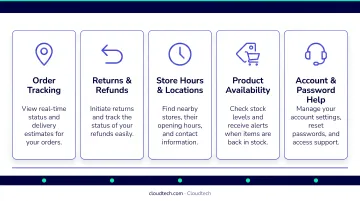
High-volume, low-complexity requests conversational AI handles well:
- WISMO (Where Is My Order?) queries
- Return and refund initiation
- Store hours and location questions
- Stock availability checks
- Sizing and fit guidance
Freeing agents from these interactions gives them capacity for escalated complaints, high-value customer conversations, and situations where empathy matters.
Consistent Omnichannel Engagement
Customers don't stay on one channel. They might start a query on your website, follow up via SMS, and finish on your mobile app. Rule-based systems break at these transitions because they have no memory between sessions.
Conversational AI retains context across channels, so customers never have to repeat themselves. Whether someone contacts you on WhatsApp or your website, they get the same accurate, helpful response—and that consistency is what builds trust over time.
First-Party Data Advantage
Every AI-customer conversation generates behavioral signals: what products customers ask about, what they hesitate on, what they buy after getting a recommendation. As third-party cookie tracking phases out, this first-party data becomes a competitive asset.
Retailers can use it to refine audience segments, improve targeting accuracy, and build recommendation engines that get smarter over time—without relying on external data sources.
Real-World Use Cases and Examples of Conversational AI in Retail
Order Management and WISMO
Order status queries are among the highest-volume, most repetitive requests in retail customer service. A single peak-season day can generate thousands of "where's my package?" contacts—all of which follow the same pattern and require the same data lookup.
Conversational AI handles this end-to-end: it connects to the OMS, retrieves real-time tracking data, and delivers the answer without any human involvement. It can also initiate returns and send proactive shipping updates when delays occur.
Walmart's Global Tech team is one of the clearest public examples. Their blog describes bots that "immediately assist customers with simple questions about order status, returns, and more" and confirms the system has reduced millions of customer contacts. At that scale, the operational impact on their contact center is substantial.
Personalized Shopping Assistance
Digital shopping lacks the one thing that drives in-store conversion: a knowledgeable sales associate who asks the right questions and surfaces the right product. Conversational AI replicates that dynamic digitally.
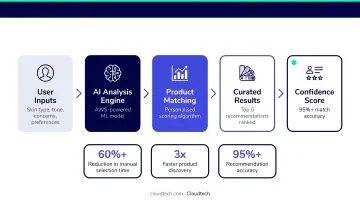
AI shopping assistants guide customers through product discovery by asking about preferences—size, budget, use case, style—and returning relevant recommendations. The interaction feels less like a search query and more like a conversation.
Sephora has been at the front of this. Starting with a Kik chatbot in 2016, they've expanded to include the Smart Skin Scan—an in-app AI tool that delivers personalized skincare recommendations and a four-step routine based on individual skin analysis.
Recommendations are tailored to the specific customer, not drawn from a static bestseller list. That's the difference between a search filter and an actual shopping assistant.
Customer Support Automation and FAQ Handling
Beyond WISMO, conversational AI can cover the full range of standard support queries: return policies, store hours, stock availability across locations, and sizing guidance. Across all channels, simultaneously, with consistent answers.
H&M deployed an AI assistant—early work started via Kik—that helps customers navigate the product catalog and handles support queries around the clock. The consistent availability alone reduces the volume of contacts reaching human agents, which matters most during high-traffic retail periods like Black Friday or end-of-season sales.
The Capterra benchmark is useful context here: their 2023 survey found 53% of consumers rated retail chatbot experiences fair or poor. That's a bar set by legacy rule-based bots. Conversational AI systems—with NLP, context retention, and real data access—operate at a meaningfully different level.
Loyalty Programs, Proactive Outreach, and Promotions
Most loyalty engagement is passive: the customer logs in to check their points, or they miss out entirely. Conversational AI makes loyalty proactive.
Retailers use it to notify customers when wishlisted items are back in stock, nudge them toward rewards they haven't redeemed, or push personalized promotional offers through messaging apps—without requiring the customer to initiate anything.
Starbucks Deep Brew is a well-documented example. Starbucks has described it as central to their AI and personalization strategy—analyzing purchase patterns and external factors to drive more relevant promotions and allocate store labor more efficiently.
The same logic applies to any retailer with loyalty data and a messaging channel. The infrastructure is the differentiator, not the industry.
In-Store Assistance via Digital Kiosks
Conversational AI isn't exclusive to e-commerce. Physical retailers are deploying virtual assistants on in-store kiosks and interactive displays to help customers:
- Locate products within the store or across nearby locations
- Check real-time inventory before committing to a purchase
- Complete orders when a local item is out of stock
- Escalate to a human associate for complex questions
This matters for omnichannel continuity. A customer who starts researching online shouldn't get a different experience when they walk into the store. AI-enabled kiosks create a consistent thread across both environments—the same product knowledge, the same ability to check inventory, the same escalation path to a human if needed.
Best Practices for Implementing Conversational AI in Retail
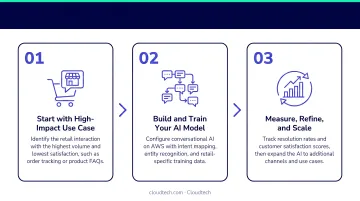
Start With One High-Impact Use Case
The instinct to automate everything at once usually leads to a system that does many things poorly. Start instead with one clearly defined, high-volume pain point.
Good first use cases for retail:
- WISMO automation — High volume, well-defined data needs, fast ROI
- FAQ handling — Return policies, store hours, sizing questions
- Customer identity verification — Useful before escalation to a human agent
Nailing one use case builds internal confidence, demonstrates measurable results, and creates a foundation for expanding to more complex workflows over time.
Integrate Deeply With Existing Retail Systems
Conversational AI without data access produces generic, frustrating responses. The system needs to connect to your CRM, OMS, inventory platform, and e-commerce stack to actually resolve issues, not just acknowledge them.
Before selecting a platform, audit your existing tech stack and prioritize solutions with native connectors for your key systems. AWS-native tools like Amazon Lex and Amazon Connect are a strong foundation for retailers already operating on AWS. Amazon Connect Customer Profiles includes pre-built connectors for Salesforce, ServiceNow, Zendesk, Marketo, and Shopify, covering the most common retail CRM and e-commerce integrations.
For SMB retailers navigating this complexity, working with an AWS-certified partner like Cloudtech can compress deployment timelines significantly, connecting conversational AI tools to existing systems in weeks rather than months without compromising security or data governance.
Train on Your Specific Catalog, Brand Voice, and Policies
A model trained on generic data will underperform for your specific products and customers. Feed the system with:
- Your full product catalog with attributes and descriptions
- Brand voice guidelines and preferred terminology
- Historical customer service transcripts
- Return policies, shipping terms, and FAQs
Build in a retraining process. Inventory changes, seasonal promotions, and policy updates all affect what the AI needs to know. Schedule quarterly reviews to keep the model current.
Plan the Human Handoff From the Start
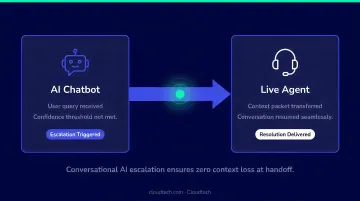
Conversational AI works as part of a hybrid model—not a full replacement for human agents. Define escalation triggers clearly before deployment:
- Complex complaints that require judgment
- High-value customers or sensitive situations
- Any interaction where the AI signals low confidence
When the AI hands off, it should pass full conversation context to the agent automatically. Customers who have to repeat themselves after a handoff lose trust in the entire system. Brief your customer-facing staff on how the AI supports their work—agents who understand the system perform better with it.
Common Challenges and How to Overcome Them
Data Privacy and Compliance
Chat interactions capture customer PII: names, order details, loyalty identifiers, purchase history. GDPR requires a documented lawful basis before processing that data, along with data minimization and defined retention periods. CCPA gives California residents rights to know, delete, correct, and opt out of data sharing.
In practice, compliance requires several parallel workstreams:
- Build consent mechanisms directly into chat flows
- Set retention policies for conversation logs and enforce them
- Encrypt data at rest and in transit
- Ensure your platform can respond to data subject access and deletion requests
Choosing a platform with compliance controls built in—and working with partners who understand AWS security tooling like AWS KMS and Amazon Macie—reduces implementation risk from the start.
Legacy System Integration Complexity
Many retailers run on fragmented tech stacks where connecting an AI layer to an older OMS or POS system involves significant custom work. Underestimating this is one of the most common reasons implementations run over budget.
Recommendations:
- Conduct a technical audit before selecting a platform
- Prioritize solutions with flexible APIs and documented integration patterns
- Factor integration cost and timeline into your total budget from the start
- Consider partners with pre-built retail connectors to avoid starting from scratch
Balancing Automation With the Human Touch
Over-automating creates a different problem: customers with complex complaints or high-value concerns who can't reach a human when they need one. That erodes trust faster than a hold queue does.
Design intentional escalation paths. Review conversations where the AI fell short—not just where it succeeded. Use those failure cases to improve both the AI's training and your escalation criteria. The measure of a well-designed system isn't how much it automates—it's how consistently it resolves customer issues, whether by AI or a human agent.
Frequently Asked Questions
Which conversational AI platform is best for the retail industry?
The right platform depends on your tech stack, use cases, and budget. Amazon Lex integrates well for retailers already on AWS, while Cognigy and Yellow.ai suit enterprise contact center environments. SMBs should prioritize platforms with pre-built retail connectors and fast deployment timelines.
How is AI being used in the retail industry?
AI in retail covers customer service automation (order tracking, returns, FAQ handling), personalized product recommendations, inventory optimization, loyalty program engagement, in-store virtual assistants, and proactive marketing outreach via SMS and messaging apps.
What is the difference between a chatbot and conversational AI in retail?
Traditional chatbots follow pre-scripted decision trees and break when customers phrase questions unexpectedly. Conversational AI uses NLP and machine learning to understand intent, retain context across a conversation, and take real actions within connected systems, making it capable of resolving issues end-to-end.
How does conversational AI improve customer experience in retail?
It eliminates hold queues with instant 24/7 responses, delivers personalized interactions based on purchase history, and maintains consistent engagement across every channel. Proactive outreach with relevant updates or offers reduces friction throughout the shopping journey.
Can small retail businesses benefit from conversational AI?
Yes. Modern platforms have made conversational AI accessible without large engineering teams. Starting with a single use case—like automating order status queries—can deliver measurable cost savings and improved customer satisfaction within weeks.
What metrics should retailers track to measure conversational AI success?
Key metrics include containment rate (queries resolved without human escalation), first-contact resolution rate, CSAT score, average handle time reduction, conversion rate uplift from AI-assisted interactions, and cost per contact.