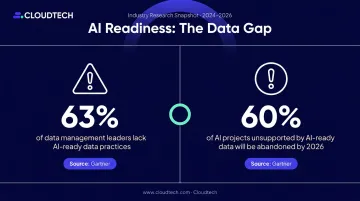
According to Gartner, 63% of data management leaders lack — or aren't sure they have — the right AI data management practices in place. The same research predicts that 60% of AI projects unsupported by AI-ready data will be abandoned through 2026. That's not a model problem. That's a data strategy problem.
This guide covers exactly what a GenAI data strategy is, what you need before you build one, how to construct it step by step, the variables that determine success, and the most common mistakes to avoid. It's written specifically for SMBs that want to move from pilot to production without wasting months on the wrong foundation.
Key Takeaways
- A GenAI data strategy defines how you collect, organize, govern, and serve data to AI models — skip it and your outputs will be unreliable
- Start with a specific business problem, not a technology selection
- Data quality, governance, and infrastructure must come before model training — the data audit is where most GenAI projects succeed or fail
- SMBs can build a production-ready foundation one use case at a time
What Is a Data Strategy for Generative AI?
A GenAI data strategy is the framework an organization uses to identify, collect, store, govern, and apply the right data to train or fine-tune generative AI models. It's different from a general data strategy because its purpose is model-readiness — not just reporting or business intelligence.
GenAI models have specific data requirements that general-purpose data strategies weren't built to meet.
IBM reports that approximately 80% of enterprise data is unstructured — sitting in PDFs, emails, documents, and collaboration tools. Before any of that data can feed a generative AI model, it has to be extracted, transformed, and structured into a consumable format. That conversion process belongs at the center of your data strategy, not tacked on as a technical task at the end.
Why SMBs Can't Skip This Step
Large enterprises have dedicated data engineering teams to handle these problems. SMBs typically don't — which makes the stakes higher, not lower.
Without a structured strategy, SMBs commonly deploy GenAI on:
- Fragmented data spread across disconnected CRMs, ERPs, and cloud storage
- Inconsistently formatted records with missing or duplicated fields
- Ungoverned data with no clear ownership or access controls
- Untracked sources that may violate compliance requirements
Feed a model data like that, and it will return confident-sounding answers that are simply wrong. A lightweight, structured strategy catches these problems before they reach production.
What You Need Before You Start
Rushing into a GenAI build without these foundations produces hallucinating models, compliance violations, and wasted infrastructure spend. These three readiness checks are non-negotiable.
Business and Team Readiness
Before any technical work begins, identify at least one executive sponsor who can align the data strategy with actual business goals. Then confirm that key stakeholders are involved from day one:
- IT, which owns infrastructure and data access
- Legal/compliance, which owns regulatory requirements and risk
- Business unit owners, who define what "good output" looks like
Without this alignment, technical teams build data pipelines that don't match what the business actually needs. That gap shows up fast once you start auditing what data you actually have.
Data Inventory and Quality Baseline
Conduct a preliminary scan of where your data currently lives. Common sources include:
- CRM systems — customer records, interaction history
- ERP platforms — transaction data, inventory logs
- Cloud storage — documents, contracts, unstructured reports
- Third-party APIs and external data feeds
For each source, note whether the data is clean, labeled, and complete. Document gaps — they define the remediation work that has to happen before any model training can begin.
Infrastructure and Compliance Readiness
Verify that your cloud environment can support the storage, compute, and security demands of GenAI workloads. Separately, confirm which data regulations apply to your specific situation — this depends on your industry, geography, and corporate structure, not just your technology stack:
- HIPAA — applies to healthcare organizations handling electronic protected health information (ePHI)
- GDPR — applies when your data includes EU residents, regardless of where your company is based
- SOX Section 404 — applies to public companies where GenAI participates in financial reporting
- CCPA/CPRA — applies to California-based for-profit businesses meeting specific revenue or data thresholds
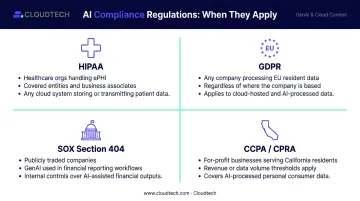
These are not universal mandates. Map your data, geography, and corporate structure before labeling anything compliant.
How to Build a Data Strategy for Generative AI
Step 1: Define Your Business Problem and AI Use Case
Don't start with technology. Start with a specific business question.
Examples of well-defined use cases:
- "How do we automate responses to customer support queries without increasing headcount?"
- "How do we generate compliant financial summaries from transaction records faster?"
- "How do we extract structured data from inbound clinical documents automatically?"
Once you have the question, set measurable success criteria before selecting any technology:
- What does a "good" output look like?
- What accuracy threshold is acceptable?
- How will you evaluate model performance against real business outcomes?
Specificity at this stage determines which data you actually need — and eliminates the temptation to collect everything and figure it out later.
Step 2: Audit Your Existing Data Assets
Inventory all internal data sources and map them directly to your use case. This means two categories:
- Structured data — transaction records, customer databases, form submissions
- Unstructured data — emails, PDFs, support tickets, scanned documents
Only include data that directly serves the use case you defined in Step 1. Everything else is out of scope.
Assess each dataset across four dimensions:
| Dimension | What to Check |
|---|---|
| Completeness | Are there missing fields or records? |
| Accuracy | Is the data correct and trustworthy? |
| Consistency | Does it align across different systems? |
| Recency | Is it current enough to be useful? |
Document every gap. These gaps are your remediation backlog — and they must be addressed before model training begins.
Step 3: Design and Build Your Data Infrastructure for GenAI
Choose a storage architecture that handles both structured and unstructured data at scale. A cloud-based data lakehouse — combining the flexibility of a data lake with the governance controls of a data warehouse — is the most practical architecture for GenAI workloads.
On AWS, three services form the core of a GenAI-ready data pipeline:
- Amazon S3 — durable object storage for raw and curated documents, the foundational storage layer
- AWS Glue — serverless ETL and data cataloging to discover, transform, and prepare data before model use
- Amazon Bedrock — fully managed foundation model access with built-in RAG (Retrieval-Augmented Generation) capabilities via Knowledge Bases
Retrieval-Augmented Generation (RAG) is worth understanding specifically: rather than retraining the base model, RAG retrieves relevant documents from your data store, adds them to the model prompt, and generates a response grounded in your proprietary data. For SMBs, this means domain-specific accuracy at a fraction of what full model training costs.
With the architecture in place, your data pipeline should define, at minimum:
- How data is ingested from source systems
- How it's transformed and cleaned
- How it's chunked and indexed for retrieval
- How it's served to the model at inference time
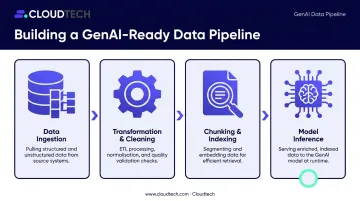
For SMBs unfamiliar with architecting this stack, working with an AWS-certified consulting team cuts setup time and avoids common architectural mistakes. Cloudtech builds these pipelines for SMBs on S3, Glue, and Bedrock, with engagements typically running two to four weeks.
Step 4: Establish a Data Governance Framework
Governance must be embedded in the architecture before any data touches a model — not added after deployment.
Three things to establish before training begins:
- Data ownership and access controls — Define who owns each dataset, who can access it, and what approval workflows govern changes
- Data lineage documentation — Track where data came from and how it was transformed, so model outputs can be traced to their source (required for regulated industries)
- AI-readiness standards — Define what "clean enough" means for your use case, and build validation checkpoints at each pipeline stage to catch issues before they propagate into outputs
For healthcare and financial services clients, lineage documentation isn't optional — it's the audit trail that satisfies HIPAA's activity logging requirements and SOX's internal control documentation standards.
Step 5: Test, Monitor, and Continuously Improve
Governance defines the standard; testing confirms whether your pipeline meets it. Before full deployment, validate model outputs against a known dataset with predetermined expected results. Compare outputs statistically to catch hallucinations or systematic errors.
After deployment, treat your GenAI data infrastructure like a live system:
- Monitor for data drift — when incoming data changes in ways that degrade model accuracy
- Track pipeline failures — set alerts for ingestion errors, transformation failures, or retrieval issues
- Schedule quality reviews — periodically re-evaluate whether training data still reflects current business reality
Cloudtech, for example, configures Amazon CloudWatch and AWS X-Ray for post-deployment observability, keeping pipeline performance visible on an ongoing basis rather than treating deployment as a final handoff.
Key Variables That Determine Success
Outcomes from generative AI are shaped by what you control on the data side. These four variables consistently separate successful deployments from abandoned ones.
Data Quality and Completeness
Generative AI models learn patterns from training data. Poor, incomplete, or biased data produces equally poor outputs — and the problem compounds as those outputs feed downstream processes.
More than a quarter of surveyed organizations estimate they lose over $5M annually from poor data quality. The implication for GenAI is direct: errors in training sets create systematic failures at scale, not isolated mistakes.
Data Governance Maturity
Without governance, organizations lose track of where data came from, whether it's compliant to use, and how transformations altered it. In healthcare and financial services, this creates both operational and legal exposure.
Audit trail requirements are impossible to meet without lineage documentation from day one. Common governance gaps that create problems downstream include:
- No documented data lineage across ingestion, transformation, and output stages
- Missing consent or licensing records for third-party training data
- Undefined ownership when model outputs are challenged or audited
Domain Specificity of Training Data
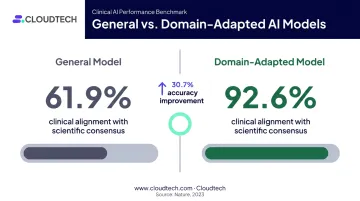
General-purpose models lack the context of your specific business. The performance gap between a generic model and one fine-tuned on domain-specific data is substantial.
A 2023 Nature study comparing general versus medically adapted language models found that clinical alignment with scientific consensus improved from 61.9% (general model) to 92.6% (domain-adapted model). In a clinical setting, that gap determines whether a model is a useful tool or an active risk. The same logic applies in financial services, manufacturing, and any domain where terminology and workflows are specialized.
Infrastructure Scalability
GenAI workloads are compute-intensive. An infrastructure that handles 100 queries per day in a pilot will break under production load. Scalability must be designed in from the start.
For SMBs that can't over-provision hardware upfront, cloud-native, auto-scaling architectures solve this directly. Amazon Bedrock's on-demand and provisioned throughput options separate variable consumption from reserved capacity. You pay for what you use at pilot scale, then commit capacity as production demand grows.
Common Mistakes When Building a GenAI Data Strategy
- Skipping the data audit: Choosing a GenAI tool before knowing what data you have creates a mismatch between model requirements and reality, leading to poor outputs or costly rework
- Treating governance as an afterthought: Retrofitting access controls and compliance policies after infrastructure is built is expensive, incomplete, and often fails regulatory audits
- Chasing too many use cases at once: Trying to solve five business problems simultaneously makes success nearly impossible to measure; start with one, prove value, then scale
- Underestimating infrastructure costs: Compute, storage, model inference, and ongoing maintenance all add up — and scaling costs can escalate quickly once production traffic grows
Conclusion
A data strategy for generative AI works best when it starts with a specific business problem, is backed by clean and governed data, and runs on infrastructure built to scale. Most GenAI failures trace back to skipping one of those three foundations — not the model choice.
SMBs don't need to build everything at once. A focused, incremental approach — one use case, one governed data source, one cloud-native pipeline — creates a replicable pattern that scales into a second use case, then a third, without rebuilding from scratch. For teams that want to move faster without building this infrastructure from scratch, working with an AWS Advanced Tier Partner like Cloudtech — whose team is 70% ex-AWS — gets you from strategy to a production-ready deployment in weeks, not months.
Frequently Asked Questions
What is a generative AI solution?
A generative AI solution is an application powered by a large language model (LLM) or similar AI model that generates new content — text, code, images, or data summaries — based on user inputs. For business use, these solutions depend on a strong underlying data strategy to produce accurate, consistent outputs.
What is generative AI data?
Generative AI data refers to the datasets used to train, fine-tune, or prompt a generative AI model — including both broad general datasets and organization-specific internal data. The quality, structure, and governance of that data determine how accurate and trustworthy the model's outputs will be.
What data do you need to train a generative AI model?
Generative AI models need a combination of general-purpose training data and domain-specific internal data — business documents, transaction records, or customer interactions, for example. Before use, that data must be clean, labeled or structured appropriately, and compliant with applicable regulations.
How does data governance affect generative AI performance?
Weak data governance means training data is flawed, and flawed training data produces outputs you can't rely on. Without lineage tracking and access controls, there's no way to audit how a model reached a conclusion — a serious problem in regulated industries where compliance and accountability aren't optional.
How long does it take to build a data strategy for generative AI?
Timelines vary based on data maturity, use case complexity, and existing infrastructure. A focused, single-use-case strategy for an SMB with basic cloud infrastructure already in place can be designed and implemented in weeks. Enterprise-wide strategies spanning multiple domains typically take several months.