Introduction
Businesses generate enormous volumes of documents daily: invoices, medical records, contracts, shipping manifests, loan applications. According to IDC, roughly 90% of enterprise data is unstructured, and most of it sits in formats that software cannot directly read, route, or act on.
Traditional OCR has been the go-to fix for decades. Scan a document, extract the text, pass it downstream. But the limitations are significant: poor accuracy on handwriting, brittleness with non-standard formats, and zero ability to understand what the text actually means.
Generative AI changes what document recognition can do at a foundational level — moving from character extraction to genuine document understanding. This guide covers what Generative AI OCR is, how it differs from traditional approaches, where it delivers real business value, and how SMBs can implement it on AWS without needing an in-house data science team.
Key Takeaways
- Traditional OCR fails on handwriting, degraded images, and novel document formats
- Generative AI OCR processes documents holistically, using language and vision models to understand context
- Healthcare, financial services, legal, and logistics organizations see the highest ROI
- Amazon Textract and Amazon Bedrock together offer a scalable, SMB-accessible implementation path
- LLM inference costs have dropped sharply, making Gen AI OCR viable for smaller organizations
What is Traditional OCR and Why It Falls Short
Traditional OCR software converts images of text into machine-readable characters using template-matching and rule-based pattern recognition. It has worked well enough for decades — provided documents are clean, consistently formatted, and match the templates it was trained on.
The problems surface quickly in real-world conditions:
- Handwriting: High variability in stroke styles makes character matching unreliable
- Non-standard fonts: Unusual typefaces or layouts confuse rule-based engines
- Degraded image quality: Faded ink, skewed scans, and watermarks cause recognition failures
- Novel formats: Documents outside the training template set produce garbage output
- No semantic understanding: Traditional OCR reads characters, not meaning — it cannot infer context or validate whether extracted data makes sense
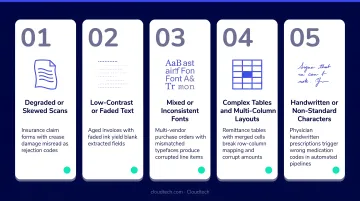
The accuracy gap is measurable. On the SROIE document dataset, Microsoft's TrOCR achieved an F1 score of 96.58 compared with just 54.57 for Tesseract OCR — the most widely used traditional engine. On complex industrial documents, accuracy for leading traditional systems drops from 86.7% on clean benchmarks to 60.3% in real conditions.
The RPA Compounding Problem
OCR errors don't stay isolated. When OCR feeds into Robotic Process Automation (RPA) workflows, bad extraction breaks downstream bots — triggering exception queues, manual review loops, and processing delays. A single misread field on an invoice can stall an entire payment workflow.
A clinical research review found manual record abstraction had a pooled error rate of 6.57%. Even OCR-assisted data entry produced error ranges from 2 to 358 errors per 10,000 fields.
In healthcare, financial services, and legal workflows, those error rates translate directly into compliance risk and operational cost.
What is Generative AI OCR? A Plain-Language Definition
Generative AI OCR applies large generative AI models — transformer-based large language models and multimodal vision-language models — to the task of document recognition. The difference from traditional OCR isn't just better accuracy. It's a fundamentally different way of reading documents.
Traditional OCR reads character by character. Generative AI OCR processes the entire document holistically, using pretrained knowledge of language structure, visual patterns, and document conventions to interpret content — even when it's ambiguous, degraded, or formatted in ways the system has never seen before.
The Full Document Pipeline
A common misconception: Generative AI OCR isn't just "smarter scanning." It enables a complete document intelligence pipeline:
- Digitization — Convert document images to machine-readable text
- Classification — Identify document type (invoice, contract, claim form)
- Extraction — Pull specific fields, tables, entities, and relationships
- Validation — Check extracted data for logical consistency and completeness
- Action — Route, approve, flag, or feed data into downstream systems
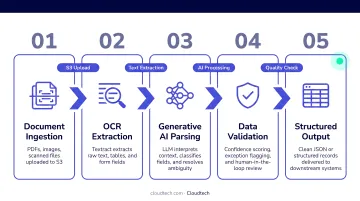
Each step depends on the one before it. Skip validation and you're feeding bad data downstream. Skip the action layer and the extracted information just sits there. The technology that makes all five steps possible is worth understanding.
The Technologies Behind It
- Transformer architectures with attention mechanisms — allow the model to focus on relevant parts of a document when interpreting any single element
- Vision-language pretraining — models trained on paired image-text data understand both visual layout and linguistic content simultaneously
- Few-shot and zero-shot learning — Google Document AI, for example, shows that zero-shot extraction requires only a field schema, while few-shot extraction works with as few as five example documents
That last capability is a practical unlock for smaller teams. Traditional OCR requires labeled training data and manual configuration for every new document type. Generative AI OCR adapts rapidly with minimal examples — no data science team required.
Key Capabilities That Make Generative AI OCR More Powerful
Handwriting and Non-Standard Text Recognition
Handwriting varies enormously — stroke pressure, letter size, spacing, and style differ between individuals and even within the same document. Traditional OCR cannot reliably handle this variability.
Generative models pretrained on massive visual-text datasets, including handwritten content, handle this across languages and styles. On the IAM handwriting benchmark, TrOCR Large achieved a character error rate of 2.89, compared with 3.2 CER for traditional GCRNN/CTC approaches.
The practical impact spans industries that have long relied on manual review:
- Healthcare organizations can digitize physician handwritten notes and signed consent forms
- Legal teams can process handwritten annotations in contracts
- Archival teams can extract text from historical records in multiple scripts and languages
These documents were previously unprocessable by automation.
Complex Document Layout Understanding
Multi-column layouts, nested tables, embedded figures, footnotes, and mixed-format pages all cause traditional OCR to misread or reorder content. A two-column medical form becomes garbled text. A financial table loses its row-column relationships.
Generative models use pretrained knowledge of how documents are typically structured to parse these layouts correctly. Their ability to process both text and visual elements together (what researchers call "multimodal" processing) means charts, diagrams, and signatures become contextual cues that improve adjacent text extraction accuracy.
Degraded and Low-Quality Document Restoration
Where traditional OCR fails on damaged documents entirely, generative models can infer missing or obscured text from surrounding context. Combined with GAN-based image restoration techniques, the system can reconstruct damaged portions of document images before running text recognition.
A two-stage pipeline called PreP-OCR demonstrated this concretely: by combining document image restoration with semantic-aware post-OCR correction, it reduced character error rate by 63.9% to 70.3% across 13,831 pages of historical archives.
Error Correction and Semantic Validation
Language modeling capabilities allow generative systems to detect and correct common OCR misreads automatically. The classic example: "rn" read as "m," or a pipe character read as "I." In context, a language model knows that "rnedical" should be "medical."
This built-in correction layer sits on top of raw recognition output. Traditional OCR engines have no equivalent: once they misread a character, that error passes downstream unchecked.
Generative AI OCR vs. Traditional OCR: Key Differences
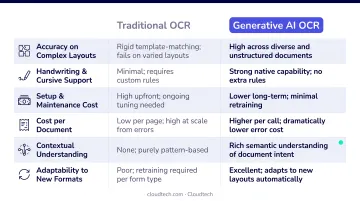
| Category | Traditional OCR | Generative AI OCR |
|---|---|---|
| Training requirement | Manual configuration + labeled templates per document type | Pretrained on massive datasets; adapts via few-shot or zero-shot |
| Accuracy on unstructured documents | Degrades significantly on non-standard formats | Maintains high accuracy across variable formats |
| Handwriting recognition | Poor to unreliable | Strong across styles and languages |
| Handling new document types | Requires retraining or manual rules | Adapts with minimal examples or schema-only input |
| Context/semantic understanding | None — character-level only | Full document comprehension and error correction |
| Integration complexity | Lower for simple, fixed pipelines | Requires orchestration but more capable end-to-end |
| Cost trend | Stable but limited ceiling | Rapidly declining; increasingly SMB-accessible |
Traditional OCR remains cost-effective for very high-volume, single-format, well-structured document pipelines — for example, standardized government forms or fixed-template invoices from a single vendor. Generative AI OCR is the right choice when document variety, quality, or semantic understanding requirements are high.
Cost is shifting fast too. Epoch AI data shows LLM inference prices have fallen rapidly, with the cost to reach GPT-4-level performance on difficult benchmarks declining roughly 40x per year. What was enterprise-only pricing two years ago is now accessible for SMB workloads.
Industry Applications: Where Generative AI OCR Delivers the Most Value
Healthcare
Healthcare organizations handle enormous volumes of unstructured documents — physician handwritten notes, insurance claims with incomplete fields, prior authorization forms, and patient intake paperwork. Manual entry errors in this context carry direct patient safety implications.
OCR-based data entry in an ICU study reduced data recording time to 3.4 minutes per patient — a 43.9% reduction versus manual methods — while achieving 96.9% data accuracy.
Generative AI OCR extends these gains by handling the document types basic OCR cannot process:
- Handwritten physician notes with variable penmanship
- Prior authorization forms with incomplete or inconsistent fields
- Multi-page patient intake packets from different source systems
- Insurance claims missing structured data markers
Cloudtech has direct healthcare experience building HIPAA-compliant data infrastructure for organizations like Klamath Health Partnership, and uses Amazon Textract for intelligent document extraction in healthcare data pipelines where regulatory compliance is non-negotiable.
Financial Services
Invoice processing, 3-way matching, loan document review, and compliance extractions all involve high variability in document formats. Every supplier sends invoices differently. Every loan applicant submits different document combinations.
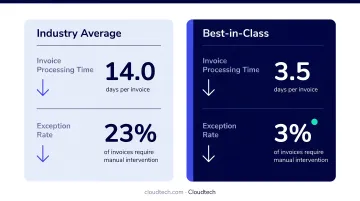
The performance gap between organizations using automation and those without is stark: Ardent Partners reports that best-in-class AP teams process invoices in 3.1 days versus 17.4 days for others, with exception rates of 9% versus an industry average of 22%.
Manufacturing and Logistics
A single international shipment can involve up to 50 pages of documentation exchanged with up to 30 stakeholders, with the documentation process alone taking six hours. Bills of lading, shipping manifests, and supplier documents arrive in dozens of languages and formats.
Generative AI OCR processes this format diversity without requiring manual template configuration for each vendor or trade lane — a critical advantage when supplier rosters span dozens of countries.
Legal and Contract Management
Contracts are dense, variable, and high-stakes. WorldCC data shows the average business loses nearly 9% of contract value annually through poor contract management — with the worst performers losing 15% or more. Contract data is scattered across an average of 24 different systems.
Automated extraction of key clauses, renewal dates, party obligations, and liability terms brings that scattered data into a single, searchable layer — at a volume and consistency rate that manual review cannot match.
Implementing Generative AI OCR on AWS for SMBs
AWS provides a well-integrated set of services for building a production-ready Generative AI OCR pipeline without requiring a dedicated data engineering team.
The Core AWS Architecture
Amazon Textract is the foundation. It goes beyond basic OCR to extract text, handwriting, tables, forms, key-value pairs, and signatures from scanned documents. Its APIs are purpose-built for real business document types: general extraction, form analysis, invoice and receipt processing, identity document handling, and mortgage package review.
A typical pipeline combines:
- Amazon S3 — document storage and pipeline entry point
- AWS Lambda — event-driven orchestration triggered on document upload
- Amazon Textract — OCR and structured data extraction
- Amazon Bedrock — generative AI model access for classification, validation, summarization, and question-answering over extracted content
- Amazon Q Business — natural language interface for non-technical users to query document data
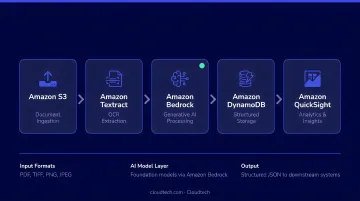
Connecting these layers is where the real work happens. Cloudtech builds these end-to-end pipelines for SMB clients so that extracted document data becomes queryable and actionable across the business. Engagements start with a one-day discovery workshop, move through solution design and implementation, and include knowledge transfer so the client's team can operate the system independently.
Key Implementation Considerations for SMBs
Before deploying, SMBs should evaluate:
- Start narrow. Pick one use case first (invoice processing, medical record extraction, or contract review) before expanding scope.
- Document volume and format diversity determine which Textract API configuration fits and whether Bedrock's generative layer is needed from day one.
- Compliance requirements vary by industry. Healthcare pipelines need HIPAA-compliant architecture; financial services clients need audit trails and access controls. Cloudtech supports both.
- ERP/CRM integration scope should be mapped before build-out begins. AWS Lambda and Glue handle orchestration, but downstream system requirements shape the architecture.
- Accuracy benchmarking against your actual documents matters more than vendor benchmarks. Validate before full deployment.
On cost: AWS Textract's free tier covers 1,000 pages per month for text extraction and 100 pages for forms and tables. Beyond that, pricing starts at $0.0015 per page for basic text detection. For most SMBs processing a few thousand pages monthly, total AWS costs typically run under $50/month before generative AI layer usage.
Frequently Asked Questions
What is OCR in generative AI?
OCR in generative AI refers to applying large generative models — which understand language, context, and visual layout — to convert document images into machine-readable text. Unlike traditional character matching, these models comprehend the full document, correct errors from context, and extract structured data from variable formats.
What is the best generative AI OCR tool?
The best tool depends on your use case and infrastructure. Amazon Textract handles extraction at scale, while Amazon Bedrock adds generative AI capabilities like classification and validation. Evaluate based on document type, volume, accuracy requirements, and compliance needs.
How is Generative AI OCR different from traditional OCR?
Traditional OCR matches characters using predefined templates and rules. Generative AI OCR uses pretrained language and vision models to understand context, handle novel formats, recognize handwriting, and auto-correct errors — making it far more adaptable to the unpredictable formats businesses encounter daily.
Can Generative AI OCR handle handwritten documents?
Yes. Generative models pretrained on large visual-text datasets recognize varied handwriting styles without manual labeling or templates. That's why physician notes and signed forms — historically a manual data entry burden — are now strong candidates for automation.
What industries benefit most from Generative AI OCR?
Healthcare, financial services, legal, and manufacturing/logistics see the highest value. Each industry handles large volumes of unstructured, variable-format documents where extraction errors carry real downstream consequences — denied claims, compliance gaps, delayed shipments.
How do I get started with Generative AI OCR on AWS?
Start with Amazon Textract for document extraction, layer in Amazon Bedrock for generative AI capabilities like classification and validation, and use S3 and Lambda to build the event-driven pipeline. Working with an AWS-certified partner like Cloudtech accelerates deployment and ensures your pipeline is architected for compliance and scalability .