Introduction
Millions of people interact daily with systems that still put them on hold, route them through phone trees, or leave their questions unanswered until business hours return. That friction isn't inevitable — it's a solvable infrastructure problem.
Conversational AI — NLP- and ML-powered systems that enable human-like dialogue through voice and chat — is no longer experimental. It's operational infrastructure. Juniper Research forecasts global conversational AI revenue will rise from $14.6 billion in 2025 to over $23 billion by 2027, driven largely by three sectors with a shared problem: enormous volumes of routine interactions that have always been slow, costly, and frustrating.
Banking, healthcare, and education are where these systems face their hardest tests — and deliver their clearest results. This article breaks down the real use cases reshaping each sector, the implementation realities organizations face, and what it actually takes to deploy these systems successfully.
Key Takeaways
- Conversational AI in banking eliminates call-center friction, automates routine transactions, and enables 24/7 personalized service at scale
- In healthcare, AI virtual assistants cut administrative overhead by handling scheduling, triage, and patient follow-up
- Education institutions use conversational AI for personalized tutoring, student advising, and enrollment automation — addressing the limits of one-size-fits-all instruction
- Deployment success across all three sectors requires secure cloud infrastructure and tight integration with existing core systems
- Starting with focused, high-value use cases and iterating on real interaction data drives measurably faster ROI
Conversational AI in Banking: Redefining Customer Relationships
From Call Centers to Intelligent Assistants
Banking became one of the earliest and most aggressive adopters of conversational AI for a straightforward reason: scale. According to the CFPB's 2023 report on chatbots in consumer finance, all 10 of the largest U.S. commercial banks had deployed customer-service chatbots, with over 98 million Americans interacting with a bank chatbot in 2022 alone.
The shift away from rigid IVR phone trees toward NLP-powered assistants goes deeper than convenience. Modern banking AI interprets intent rather than matching keywords. It accesses real-time account data, guides customers through multi-step flows, and hands off to human agents with full conversation context intact — no repeated account numbers, no lost history.
Bank of America's Erica is the benchmark case: the virtual assistant surpassed 3 billion client interactions by August 2025, averaging more than 58 million interactions per month across nearly 50 million users since launch.
Key Use Cases in Banking
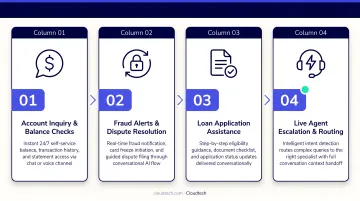
- Customer onboarding: AI guides new users through account opening, identity checks, and product selection — connecting to backend systems and triggering activation workflows automatically. Drop-off rates fall; onboarding time shrinks.
- Fraud alerts: Conversational AI monitors transaction patterns and notifies customers of suspicious activity in real time. Customers can lock cards or escalate without waiting in call queues — a genuine shift from reactive to proactive security.
- Loan applications: Chatbots qualify credit interest, collect application data through natural dialogue, and route high-intent prospects to human reps. Conversational intake consistently outperforms static web forms for complex financial products.
- Emotion-aware escalation: Advanced systems detect frustration or urgency and hand off to live agents with full context. Agent assist tools simultaneously surface relevant account data, cutting handling time on complex cases.
The Deloitte 2025 Consumer Banking Survey found that 74% of banking customers still prefer human representatives for simple routine queries, and 37% had never interacted with a bank chatbot at all. The opportunity is substantial, but the design challenge is just as real. Conversational AI in banking earns trust through accuracy and speed — deployment alone isn't enough.
Conversational AI in Healthcare: Improving Access and Reducing Administrative Burden
The Administrative Bottleneck Conversational AI Is Breaking
Healthcare's administrative problem is measurable and expensive. The AMA's 2025 physician survey found that practices complete approximately 39 prior authorizations per physician per week, consuming roughly 13 hours of physician time weekly — with 40% of practices employing staff who work exclusively on prior authorization. That's before accounting for appointment scheduling, insurance verification, and routine patient queries.
Conversational AI directly targets this bottleneck. AI-powered virtual assistants handle appointment scheduling, prescription refill requests, pre-visit intake forms, and post-discharge follow-ups at scale — tasks that require significant staff time but minimal clinical judgment.
The efficiency gains are documented. Ochsner Health implemented Epic Conversational AI for SMS-based scheduling in April 2025 and saw appointment confirmation rates rise from 42.8% to 51.7% — a 21% increase — while estimating 539 call-center staff hours saved over seven months. The system uses NLP intent detection, so patients can reply with natural language or typos like "The Friday time, please" rather than exact keywords.
Key Use Cases in Healthcare
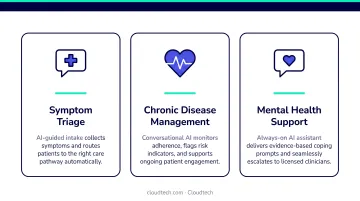
- Symptom triage: AI walks patients through structured assessments, evaluates severity, and routes them to the right care level. Research in JMIR found median nurse triage time of 17 minutes versus 5 minutes for an AI-powered eTriage tool — though accuracy limitations require ongoing clinical oversight.
- Chronic disease management: Conversational AI sends medication reminders, collects patient-reported outcomes between visits, and flags deterioration signals for care team follow-up. A 2025 JMIR systematic review of 25 studies confirmed broad deployment and growing clinical adoption.
- Mental health support: Behavioral health tools provide always-available emotional support, guided exercises, and crisis escalation pathways — addressing access gaps that are especially acute in underserved populations. A JMIR Mental Health scoping review found high acceptability in 8 of 10 studies, with one RCT reporting a moderate depression-symptom effect size.
These use cases share one hard requirement: HIPAA compliance from the start, not bolted on later.
Every data layer requires encryption (AES-256 at rest, TLS in transit), role-based access controls, audit logging retained for a minimum of six years, and signed Business Associate Agreements with any cloud provider handling PHI. Cloudtech structures its healthcare conversational AI deployments around these controls, building compliant architecture before any patient-facing functionality goes live.
Conversational AI in Education: Personalizing Learning at Scale
The Gap Between Student Need and Institutional Capacity
Traditional education systems weren't built for individualized support at scale. Instructors are stretched thin. Administrative processes are repetitive. Student learning needs vary dramatically across a single classroom, let alone across thousands of students at a large institution.
Conversational AI fills these gaps without replacing educators. It acts simultaneously as an on-demand tutor, academic advisor, and administrative assistant — available around the clock and scalable across any student population.
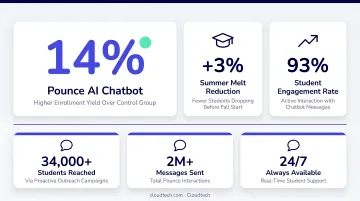
Georgia State University's Pounce chatbot is the most rigorously studied example. The evidence is hard to argue with:
- Students receiving AI outreach were 3.3 percentage points more likely to enroll in the fall semester, per an RCT published by Brookings
- A follow-up RCT with 4,442 students found Pounce increased loan take-up by 4 points and course registration by 3 points
- First-generation students saw an 8-point increase in loan acceptance — the group that needed it most
- In its 2016 pilot, Pounce cut summer melt from 19% to 9% and handled 185,000 student interactions
Key Use Cases in Education
The Pounce results point to a broader pattern. Across institutions, conversational AI is being deployed in three distinct ways.
On-Demand Tutoring and Learning Support
AI tutors provide step-by-step explanations, generate practice problems, and adapt to each student's pace — reinforcing concepts between class sessions. A 2025 RCT published in Nature Scientific Reports found students learned more in less time with an AI tutor than with in-class active learning, and reported feeling more engaged throughout the process.
Enrollment, Advising, and Administrative Q&A
Universities and K-12 institutions deploy chatbots to answer admissions questions, guide students through enrollment, and provide 24/7 academic advising. That translates to measurable enrollment improvements, particularly for first-generation and underserved students — exactly the populations where early intervention matters most.
Faculty and Operational Automation
Conversational AI handles routine educator communications — course updates, deadline reminders, grading FAQs — so faculty aren't buried in inbox management. The time recovered goes back to instruction and mentorship, which is where it belongs.
Key Challenges and the Infrastructure Powering Conversational AI
Deploying conversational AI in regulated industries is technically demanding. The common failure points across banking, healthcare, and education fall into four categories:
- Regulatory compliance: HIPAA in healthcare, PCI-DSS and SOX in banking, FERPA in education — each requiring specific controls around data handling, access, and audit
- Legacy system integration: EHRs, core banking platforms, and LMS systems were never built to communicate with modern AI layers; integration requires well-structured API design, careful testing, and phased rollouts
- Data privacy and access controls: Conversational AI touches sensitive data constantly — patient records, financial transactions, student information — and requires least-privilege access policies, encryption at every layer, and real-time monitoring
- Maintaining accuracy across multi-turn conversations: NLP systems must handle context, ambiguity, and domain-specific language without hallucinating or misrouting users
The Cloud Infrastructure Beneath It All
Conversational AI is only as effective as the infrastructure beneath it. Low-latency, secure, scalable cloud environments aren't optional — they're the foundation.
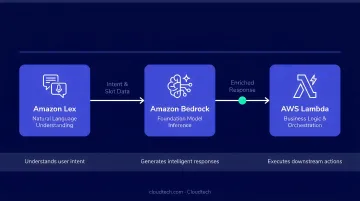
AWS provides the enterprise-grade backbone most organizations use:
- Amazon Lex V2 handles natural language understanding and automatic speech recognition for voice and text interfaces, with a streaming API for bidirectional real-time conversation
- Amazon Bedrock provides a fully managed service for building generative AI applications, with Guardrails that detect harmful content, block or mask PII (SSNs, dates of birth, addresses), and run contextual grounding checks to reduce hallucinations
- AWS Lambda scales to 1,000 concurrent execution environments every 10 seconds per function — handling conversation spikes without pre-provisioning
Cloudtech specializes in helping SMBs in healthcare and financial services architect, secure, and deploy these solutions on AWS without enterprise-level cost or complexity.
In one documented healthcare deployment, Cloudtech built a HIPAA-compliant voice agent managing an 8-node conversational architecture — covering greeting, identity verification, insurance confirmation, slot availability, and booking confirmation. It completes full scheduling workflows in a single call averaging under five minutes, with warm transfers to human agents executing in under two seconds.
Those tools only deliver value when connected to existing systems — and that's where many organizations underestimate the effort. For conversational AI to produce accurate, contextual responses, it must connect deeply to core platforms. Cloudtech's integration approach includes:
- Deep API integration with EHRs, core banking platforms, and LMS systems
- Data synchronization across platforms to maintain consistent context
- Collaborative configuration with client IT teams to reduce surprises
- Gradual rollout planning to catch issues before they reach live users
What's Next: The Future of Conversational AI Across Industries
The next shift is from reactive to proactive. Today's systems answer questions when asked. Gartner predicts 40% of enterprise applications will feature task-specific AI agents by 2026, up from less than 5% in 2025 — systems that anticipate needs, trigger workflows, and coordinate across departments without waiting for a prompt.
What this looks like in practice:
- Banking: An AI that flags unusual spending patterns before fraud occurs and proactively contacts the customer — not after a transaction posts
- Healthcare: An AI that prepares pre-visit summaries for clinicians based on patient history, recent messages, and flagged vitals — before the appointment begins
- Education: An AI that identifies at-risk students based on engagement patterns and initiates support outreach before they disengage entirely
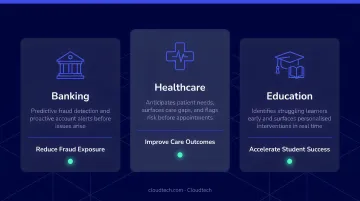
Each of these examples shares a common thread: the system acts on data before a human has to. That shift becomes sharper as generative AI merges with conversational AI — enabling personalized financial guidance, real-time clinical documentation, and learning curricula that adapt to individual student performance as it changes.
Organizations that start with a focused, high-value use case — appointment scheduling, fraud alerts, enrollment support — and iterate based on real interaction data will capture this next wave. Broad, unfocused deployments tend to generate maintenance overhead before they generate results.
Frequently Asked Questions
What industries is conversational AI disrupting, including banking, healthcare, and education?
Banking, healthcare, and education are all seeing measurable impact. In banking, AI is handling customer service and fraud detection at scale. In healthcare, it's cutting administrative load and improving patient access. In education, it's personalizing learning and automating enrollment workflows.
How is conversational AI disrupting the banking industry?
It replaces call-center friction with 24/7 intelligent service — enabling self-service transactions, real-time fraud alerts, seamless onboarding, and personalized financial guidance without proportionally growing headcount. Bank of America's Erica has logged over 3 billion interactions — the most cited real-world benchmark in the sector.
How is conversational AI being used in healthcare?
Healthcare organizations use it primarily for appointment scheduling, symptom triage, chronic disease engagement, and post-discharge follow-up. Ochsner Health's SMS scheduling tool increased confirmation rates by 21% while saving hundreds of call-center hours — a measurable example of administrative AI in action.
What are the benefits of conversational AI in education?
24/7 personalized tutoring support, always-available academic advising, and administrative automation for educators. Georgia State University's Pounce chatbot produced RCT-validated improvements in enrollment and loan take-up — particularly for first-generation students.
What is the difference between a traditional chatbot and conversational AI?
Traditional chatbots follow rigid, pre-scripted decision trees and break down when inputs deviate. Conversational AI uses NLP and ML to interpret intent, maintain context across multi-turn conversations, and generate adaptive responses that improve over time with real interaction data.
What infrastructure do organizations need to deploy conversational AI successfully?
Successful deployment requires:
- Scalable, low-latency cloud infrastructure
- Secure API integration with core business systems
- Compliance-ready architecture with data encryption and access controls
- Audit logging — mandatory in regulated sectors like healthcare and financial services