The real tension here is worth naming directly. Customer service and HR are two of the most human-intensive functions in any organization. Getting AI wrong in either area — through over-automation, biased algorithms, or chatbots that confidently give wrong answers — carries real consequences. Getting it right, though, creates genuine operational leverage.
This article covers how AI chatbots are reshaping both functions, where the measurable gains actually come from, what risks demand attention, and why a hybrid human-plus-AI model consistently produces better outcomes than full automation.
Key Takeaways
- AI chatbots excel at high-volume, repetitive queries — human agents still own emotional and complex conversations
- HR chatbots automate the full employee lifecycle — from resume screening to benefits queries — freeing HR for strategic work
- 85% of service and support leaders are expanding human agent responsibilities even as they deploy AI
- Algorithmic bias and data privacy remain the most serious risks in both customer service and HR contexts
- Start with one well-scoped use case and clean data before scaling — the most common mistake SMBs make
What Are AI Chatbots, and Why Are Businesses Deploying Them Now?
AI chatbots are software programs that use natural language processing (NLP) and machine learning to simulate human conversation — available continuously, without shift constraints or call queues.
Two types matter for this discussion:
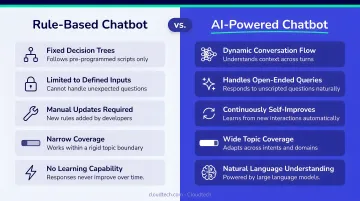
- Rule-based chatbots follow scripted decision trees. They're predictable but rigid, breaking down the moment a user goes off-script
- AI-powered chatbots use NLP and machine learning to understand context, handle varied phrasing, and adapt across conversations. Most enterprise deployments today use this model
The scale of adoption tells its own story. MarketsandMarkets valued the AI for customer service market at $12.06 billion in 2024, projecting growth to $47.82 billion by 2030. On the HR side, SHRM found that 39% of HR functions had adopted AI by late 2025, with 27% specifically using it for recruiting.
Full deployment is still the exception, not the rule — but the gap between early pilots and production use is narrowing fast. The two areas where AI chatbots are landing hardest: customer service and HR hiring.
How AI Chatbots Are Reshaping Customer Service
What Chatbots Handle Well
AI chatbots perform best on high-volume, low-complexity interactions: order tracking, password resets, account FAQs, appointment scheduling, basic troubleshooting. These aren't edge cases — they represent the majority of inbound support volume at most organizations.
Gartner projects that agentic AI will autonomously resolve 80% of common customer-service issues without human intervention by 2029, alongside a 30% reduction in operational costs. The projection tracks with what's happening now — the more repetitive the query, the more value a chatbot delivers.
The Agent Assist Model
AI's impact on customer service goes beyond replacing agents on simple tasks. The "agent assist" model — where AI surfaces real-time suggestions, auto-fills case notes, and handles post-call summarization — is where some of the clearest productivity evidence lives.
A NBER working paper, Generative AI at Work, found that AI assistance increased issues resolved per hour by 14% on average. A NBER working paper, Generative AI at Work, found that AI assistance increased issues resolved per hour by 14% on average — and 34% for novice or low-skill agents.
That last number matters most for workforce planning. New hires supported by AI reach competency faster, and agents handling more complex work report higher satisfaction than those managing high volumes of repetitive queries.
The Klarna Lesson
Klarna's 2024 AI deployment is the case study every operator should know. The company's AI assistant handled two-thirds of all customer service chats in its first month — equivalent to the output of 700 full-time agents — and cut average resolution time from 11 minutes to under 2 minutes.
By May 2025, Klarna was recruiting human agents again.
The company didn't abandon AI — its chatbot still handles the majority of interactions. But efficiency metrics don't capture everything: customers noticed the difference. Gartner found that 64% of customers would prefer companies didn't use AI for customer service — a preference that carries real weight when loyalty and lifetime value are on the line.
What AI Still Cannot Do
No current chatbot reliably handles:
- Emotional situations (complaints, grief, frustration, escalations)
- Ambiguous problems that require judgment rather than lookup
- Trust-building over multiple interactions
- High-stakes decisions where errors carry real consequences
AI covers a large share of inbound volume well. What it can't do is replace the judgment and empathy that keep customers loyal. The deployments that hold up over time use chatbots to handle the routine work — and keep humans available for everything else.
How AI Is Transforming HR Hiring and People Management
AI Across the Hiring Funnel
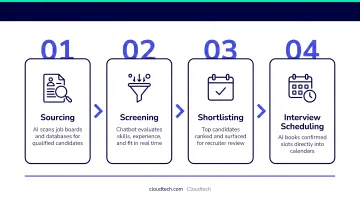
AI chatbots now appear at nearly every stage of hiring:
- Sourcing: Scanning candidate databases for keyword matches
- Screening: Pre-qualifying applicants through scored Q&A before a recruiter sees the file
- Communication: Answering applicant questions about role requirements, timelines, and process
- Scheduling: Automatically coordinating interview slots between candidates and hiring managers
SHRM Labs reports that AI recruitment tools can reduce cost-per-hire by as much as 30% — driven primarily by reducing the manual hours recruiters spend on early-stage screening and coordination.
Onboarding and the Employee Lifecycle
IBM's internal AskHR system automates more than 80 HR tasks and handles over 2.1 million employee interactions. It covers the full administrative layer of HR: benefits questions, leave balances, onboarding paperwork, policy lookups, and more.
The results IBM reports are worth noting:
- 30% reduction in administrative task time
- 25% increase in employee satisfaction with HR services
The mechanism is direct: employees get answers immediately rather than waiting for a human to respond to a ticket.
A Deloitte case study documented a global financial institution deploying an AI-powered virtual assistant in Microsoft Teams. Integrated with ServiceNow and Workday, the system resolved common HR queries with no human routing required. For mid-sized organizations running similar tech stacks, this level of integration is increasingly the starting point, not the end goal.
Shifting HR's Strategic Focus
When administrative tasks migrate to AI, HR professionals gain back time for work that actually requires human judgment: culture-building, difficult conversations, workforce planning, and employee development.
IBM's 2024 CEO study found that 57% of CEOs believe cultural change is more important than overcoming technical challenges in becoming a data-driven organization. HR is central to that cultural work — and it only happens when HR teams aren't buried in benefits administration.
Where Human Oversight Remains Non-Negotiable
AI in HR should not be the decision-maker for:
- Terminations or disciplinary actions
- Mental health or conflict resolution conversations
- Final hiring decisions and offer negotiations
- Performance evaluations that carry promotion or compensation implications
- Strategic workforce planning requiring organizational context
These aren't just best practices. U.S. employment law — including EEOC guidance on algorithmic screening tools — increasingly holds employers accountable for AI-driven decisions that affect protected classes. The legal exposure is real, and human review at key decision points is one of the primary ways organizations manage it.
The Risks and Limitations of AI Chatbots in the Workplace
Algorithmic Bias
AI hiring tools are only as fair as the data they're trained on. Amazon's internal AI recruiting tool, scrapped before deployment, showed bias against women because it was trained on historically male-dominated hiring patterns. That was 2018. The problem hasn't disappeared.
The EEOC has been explicit: employers retain liability for discriminatory outcomes even when those outcomes arise from third-party software or automated tools. The agency settled its first AI discrimination case — against iTutorGroup — for $365,000 after the company's application software automatically rejected female applicants aged 55 and older and male applicants aged 60 and older.
The legal exposure is real. So is the reputational risk.
Data Privacy and Compliance
Chatbots collect large amounts of employee and candidate data. That data requires governance — clear retention policies, access controls, and audit trails. A patchwork of state-level regulations now applies:
| Jurisdiction | Key Requirement |
|---|---|
| Illinois AI Video Interview Act | Employers must notify applicants and obtain consent before using AI to analyze video interviews |
| Colorado AI Act (SB24-205) | High-risk AI systems, including employment tools, require risk management policies and impact assessments |
| New York City Local Law 144 | Automated employment decision tools require completed bias audits and public disclosure |
| California (effective Oct. 2025) | Civil rights regulations protect against employment discrimination from automated decision systems |
Federal guidance hasn't consolidated yet, but state-level requirements are multiplying. Businesses deploying AI in HR need legal review before and during deployment.
Hallucinations and Over-Reliance
AI chatbots can generate confident, plausible-sounding, wrong answers. In Moffatt v. Air Canada, a British Columbia tribunal found Air Canada liable for inaccurate bereavement fare information provided by its chatbot — the company couldn't disclaim responsibility simply because a bot delivered the misinformation.
In HR and compliance contexts, the stakes are higher. A chatbot that gives an employee incorrect information about leave entitlements or benefits eligibility creates direct legal exposure. Regular quality audits and human review of chatbot outputs are what separate a useful tool from an organizational risk.
The Hybrid Workforce: Why AI and Humans Work Better Together
The case for hybrid isn't sentimental. It's what the data actually shows.
An IJRISS 2025 study found that 64% of respondents envisioned a hybrid human-plus-chatbot future — not full automation. More telling: 85% of service and support leaders are expanding human agent responsibilities even as they deploy AI. The expectation of mass AI layoffs in service roles hasn't materialized — instead, the role is changing.
What Hybrid Looks Like in Practice
Customer service:
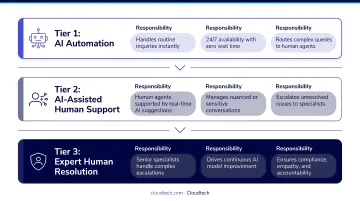
- AI handles Tier 1 — routine queries, FAQs, account lookups, status checks
- Human agents own Tier 2 and above — complex problems, emotionally charged situations, high-value customers
- AI assists human agents in real time with suggestions, summaries, and auto-populated case notes
- Result: faster resolution at Tier 1, better attention at Tier 2, and agents who report more meaningful work
HR:
- AI manages screening, scheduling, onboarding paperwork, and employee self-service queries
- HR professionals own final hiring decisions, performance conversations, conflict resolution, and culture initiatives
- Smaller HR teams can operate at significantly greater scale without sacrificing quality on high-judgment work
The Infrastructure Foundation
Deploying AI chatbots reliably — especially in regulated industries like healthcare or financial services — requires more than selecting a platform. Clean, well-integrated data is what separates a chatbot that's actually useful from one that gives inconsistent or inaccurate responses.
For SMBs, that infrastructure work often gets skipped in the rush to deploy. Cloudtech, an AWS Advanced Tier Partner based in New York, builds the cloud backbone that makes AI deployments dependable — including data pipelines, governance frameworks, and HIPAA-compliant architectures for healthcare and financial services clients.
Cloudtech has deployed generative AI solutions for healthcare SaaS clients using Amazon Bedrock and RAG-based architectures, achieving a 45% reduction in support tickets within two months of launch. For SMBs building toward a similar outcome, starting with clean, well-governed data is what makes that result repeatable.
Frequently Asked Questions
How do AI chatbots affect the customer service industry?
AI chatbots handle a growing share of routine queries — order tracking, account FAQs, basic troubleshooting — improving response times and reducing cost per interaction. Human agents are shifting toward higher-complexity and emotionally sensitive work, resulting in a restructured workforce rather than an eliminated one.
How is AI impacting HR jobs?
AI automates repetitive HR tasks like resume screening, interview scheduling, and benefits FAQs, freeing professionals for higher-value work. Judgment-intensive responsibilities — conflict resolution, coaching, culture-building — remain distinctly human and are becoming more central to the role, not less.
Will AI chatbots fully replace customer service agents?
Evidence points toward a hybrid outcome. Klarna moved toward near-full automation and was recruiting human agents again within a year; Gartner data shows most organizations are expanding human responsibilities even as they deploy AI. Full replacement isn't the direction the industry is moving.
What tasks can HR chatbots automate in the hiring process?
HR chatbots handle resume screening, candidate pre-qualification, interview scheduling, onboarding document collection, and common applicant questions. Final hiring decisions, offer negotiations, and compensation discussions should stay with human recruiters.
What are the biggest risks of using AI chatbots in HR and customer service?
Three risks stand out: algorithmic bias (employers retain legal liability for discriminatory outcomes), data privacy vulnerabilities from large-scale collection of employee and candidate information, and accuracy failures where chatbots produce confident but incorrect answers. All three require ongoing human oversight.
How can small businesses start implementing AI chatbots without overcomplicating it?
Start with one high-volume, low-complexity use case — an HR helpdesk bot or a customer FAQ chatbot. Clean, integrated data is a prerequisite: adding AI on top of fragmented data produces fragmented results. An AWS-compatible platform with proper cloud infrastructure in place before scaling keeps the rollout manageable.