Introduction
Moving data workloads to AWS opens up real analytical power — but without deliberate governance, that data lake becomes a data swamp fast. Inconsistent access controls, unclassified sensitive data, and no clear data ownership don't just slow down analytics. They create serious compliance exposure.
According to IBM's 2025 Cost of a Data Breach Report, the global average breach cost now stands at $4.44 million. For SMBs, that figure is existential, not just expensive.
Closing that exposure gap is exactly what AWS data lake governance addresses. It's the combination of policies, processes, and technical controls that define:
- Who can access what data
- How sensitive data is classified and protected
- How data quality is maintained over time
- How access is monitored and audited
Implemented well, governance keeps your data lake usable, compliant, and trustworthy — without slowing down the teams who depend on it.
This guide covers the core AWS services involved, proven best practices, a step-by-step implementation approach, and the common mistakes that quietly undermine otherwise well-built data lakes.
Key Takeaways
- AWS Lake Formation is the central governance layer — operating above IAM to enforce column, row, and cell-level access control
- LF-Tags enable attribute-based access control that scales with your team without rewriting individual permissions
- Amazon Macie automatically discovers unclassified PII in S3 buckets before it becomes a compliance problem
- CloudTrail is your audit backbone, but S3 data event logging must be explicitly configured for it to work
- Day-one governance costs far less than retrofitting controls after a breach or audit
What Is AWS Data Lake Governance and Why Does It Matter
AWS data lake governance is the discipline of managing how data is stored, accessed, used, and protected across your AWS environment. It covers data ownership, access permissions, data quality, lineage, and regulatory compliance — with a specific focus on policy enforcement and accountability, not just pipelines and storage.
The Cost of Getting It Wrong
Poor governance creates compounding problems:
- Regulatory penalties — Spain's data protection authority fined Carrefour €3.2 million in March 2025 after insufficient security measures contributed to a personal data breach
- Breach exposure — excessive or unreviewed access permissions are a primary attack surface
- Trust failures — low-quality, undocumented data leads to analytics that no one relies on
- Siloed data — without cataloging and ownership, cross-functional teams can't find or use what they need
These risks don't shrink as your data lake scales — they multiply. Which is why the cloud environment itself makes governance harder to maintain.
Why Cloud Makes Governance Harder
On-premises environments grow slowly. AWS data lakes can onboard new data sources, users, and workloads in days. That velocity is the point — but it means permissions drift, unclassified data accumulates, and quality standards erode unless you build governance in from the start. Retrofitting it later costs significantly more and never fully closes the gaps.
Core AWS Services That Power Data Lake Governance
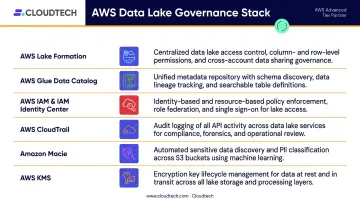
No single service handles governance end to end. These six form an integrated stack — each covering a distinct control plane:
| Service | Governance Role |
|---|---|
| AWS Lake Formation | Fine-grained data access control (column, row, cell) |
| AWS Glue Data Catalog | Central metadata repository |
| AWS IAM & IAM Identity Center | Identity foundation and federated access |
| AWS CloudTrail | Audit logging for all API calls |
| Amazon Macie | Automated sensitive data discovery in S3 |
| AWS KMS | Encryption key authorization |
AWS Lake Formation
Lake Formation is the primary governance layer — it sits on top of IAM and provides fine-grained permissions at the database, table, column, and row level for data stored in S3. Those permissions propagate automatically to integrated services: Athena, Redshift Spectrum, EMR, and QuickSight all honor Lake Formation grants without separate configuration per service.
AWS uses a combined permission model: IAM controls access to Lake Formation and Glue APIs, while Lake Formation controls the actual data and catalog resources. Every request must pass both checks.
AWS Glue Data Catalog
The Glue Data Catalog is the metadata backbone — storing table definitions, schema information, and partition details for all data lake assets. Without a well-maintained catalog, data becomes undiscoverable: users can't find it, compliance auditors can't assess it, and data owners can't track lineage.
Glue crawlers detect schema automatically, but auto-discovery alone isn't enough. Catalogs that drift — stale schemas, missing owners, undocumented partitions — create the same governance gaps as having no catalog at all.
AWS IAM and IAM Identity Center
IAM provides the foundational identity layer, while IAM Identity Center enables federated access from external providers — Microsoft Entra ID, Okta, and others. This means users bring their existing enterprise credentials to the data lake, with Lake Formation permissions granted to their IAM roles.
These two services are complementary, not redundant. IAM handles API-level authorization; Lake Formation handles data-level authorization.
AWS CloudTrail
CloudTrail captures all Lake Formation API calls and, when explicitly configured, S3 object-level operations like GetObject, PutObject, and DeleteObject. That distinction matters — S3 data event logging is not on by default and must be activated separately.
Each CloudTrail event record includes the fields you need for compliance reporting and anomaly detection:
userIdentity— who made the requesteventTime— when it occurredsourceIPAddress— originating IPrequestParameters— what was requestedeventID— unique identifier for the event
Amazon Macie
Macie uses machine learning and pattern matching to scan S3 objects and surface sensitive data — AWS secret access keys, financial records, PHI, and PII — across buckets that might otherwise go unmonitored. Its managed data identifiers handle the classification automatically. Findings publish to AWS Security Hub, feeding directly into your security operations workflow.
AWS Data Lake Governance Best Practices
Implement Fine-Grained Access Control with LF-Tags
LF-Tags (Lake Formation Tag-Based Access Control) assign attribute labels — such as data_classification: HighlyRestricted — to databases, tables, and columns. Access is then granted based on those tags rather than managing permissions object by object.
AWS recommends LF-TBAC specifically for data lakes with large numbers of Data Catalog resources because it scales without proportional management overhead. When a new table is created and tagged correctly, appropriate principals automatically receive access without a permission rewrite.
AWS documents support for up to 50 LF-Tags per resource and up to 50 LF-Tag expressions per principal — sufficient for most SMB governance taxonomies.
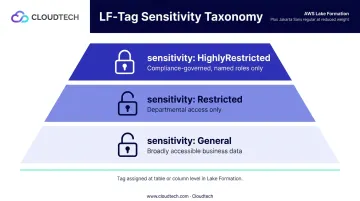
A practical starting taxonomy:
sensitivity: General— broadly accessible business datasensitivity: Restricted— departmental access onlysensitivity: HighlyRestricted— compliance-governed, named roles only
Enforce Data Encryption at Rest and in Transit
Since January 2023, S3 automatically encrypts every new object with SSE-S3 as the baseline. For regulated workloads, SSE-KMS provides stronger key management:
- At rest: SSE-S3 (default), SSE-KMS (compliance-required), or SSE-C (customer-managed keys)
- In transit: Enforce HTTPS by testing
aws:SecureTransportin bucket policies; AWS recommends TLS 1.2 or later for Lake Formation API clients - KMS integration: The Lake Formation registration role must have explicit KMS encrypt/decrypt authorization — this is separate from Lake Formation data permissions and a common configuration gap
Build Regulatory Compliance into Governance Design
GDPR, CCPA, and HIPAA each impose specific requirements on data lakes. Rather than mapping regulations to controls after the fact, design for them upfront:
- Use surrogate IDs instead of direct PII wherever possible
- Apply data cell filters in Lake Formation to enforce row-level access by regulatory zone
- Use compliance LF-Tags to automatically restrict access to data tagged as GDPR-subject or HIPAA-covered
- For right-to-erasure compliance: standard Parquet-based lakes make record-level deletes expensive. Open table formats — Apache Iceberg (supported in AWS Glue 3.0+ and Athena) and Apache Hudi — support efficient record-level deletes that make erasure requests operationally feasible
AWS Lake Formation is on the HIPAA Eligible Services list, though eligibility doesn't replace a Business Associate Addendum or proper configuration.
Maintain a Healthy and Enriched Data Catalog
A catalog populated only with technical schema is underused. Best practice means enriching entries with:
- Business definitions and plain-language descriptions
- Data owners and stewardship contacts
- Data lineage (source system → transformations → consumption)
- Quality scores and sensitivity classifications
Keeping that catalog current requires automation. Use Glue crawlers with S3 event notifications for schema detection — event-driven crawlers list only subfolders associated with received events after the initial full crawl, keeping overhead low. Pair automated crawling with a manual review process for critical tables to catch breaking schema changes before they reach downstream consumers.
Apply Data Quality Controls as Part of Governance
Data quality is a governance concern. Low-quality data that's widely accessible creates trust failures and poor decisions.
AWS Glue Data Quality calculates quality scores that can be mapped to LF-Tags via a Glue job — an AWS-published implementation pattern where only data meeting a defined completeness threshold (such as 90%) is accessible to general business users, while data engineers retain access to raw feeds.
AWS Glue DataBrew provides visual data profiling and ruleset validation for teams that prefer a lower-code quality review workflow.
Establish Continuous Audit and Monitoring
Governance monitoring needs to be operational, not periodic:
- Create automated alerts for anomalous CloudTrail patterns — a user querying tables outside their typical scope at 2 AM is worth flagging
- Configure AWS Config rules to detect drift, such as S3 buckets with Lake Formation governance disabled
- Run quarterly permission audits to surface over-privileged roles and orphaned access grants
- Store audit logs in a separate, locked S3 bucket with Object Lock enabled — one that even administrators cannot delete
How to Implement AWS Data Lake Governance: A Step-by-Step Overview
Step 1 — Assess Your Current State
Before touching governance tooling, inventory existing data sources, map current access patterns, identify regulatory obligations, and classify data by sensitivity.
This is where Amazon Macie scans tend to surface the most urgent problems. Unclassified PII sitting in S3 buckets with no access controls is a common finding in organizations that built their lake quickly and added governance later.
Step 2 — Design Your Governance Architecture
Define your LF-Tag taxonomy before writing a single permission grant. Establish data ownership roles:
- Data Lake Administrator — manages Lake Formation configuration
- Data Producers — responsible for data quality and cataloging
- Data Consumers — query access only within their tag scope
- Auditors — read-only visibility into logs and catalog metadata
Map access control policies to job functions using your tag structure. A well-designed taxonomy prevents having to rebuild permissions from scratch as your team grows.
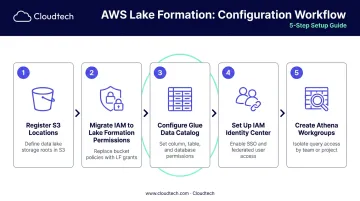
Step 3 — Configure Lake Formation as Your Central Control Plane
- Register S3 locations with Lake Formation
- Migrate from IAM-only permission management to Lake Formation-managed permissions
- Configure the Glue Data Catalog with appropriate database and table permissions
- Set up IAM Identity Center if federated access from Okta, Entra ID, or another IdP is required
- Create Athena workgroups aligned with user groups to add a secondary access boundary
Cloudtech's data modernization engagements typically pair Lake Formation setup with an S3 medallion architecture (bronze, silver, gold tiers) and Apache Iceberg for ACID transactions, so governance is wired into the storage layer from the start rather than retrofitted.
Step 4 — Implement Encryption, Auditing, and Compliance Controls
- Enable SSE-KMS on all data lake S3 buckets
- Enforce TLS on all service endpoints
- Activate CloudTrail data event logging for S3 and Lake Formation API calls (remember: this must be configured explicitly)
- Configure Macie for scheduled sensitive data discovery
- Route CloudTrail logs to a centralized logging account with defined retention policies for regulated industries
Step 5 — Keep Governance Running
Governance drifts without a regular operational cadence. Build in:
- Quarterly permission audits to catch access creep before it becomes a compliance issue
- Schema change reviews before critical table updates reach production
- Permission policies as code — define them in CloudFormation or Terraform so every change is reviewed, tracked, and reversible
SMBs without a dedicated data engineering team can hand off the full stack to Cloudtech. Engagements cover Lake Formation configuration, LF-Tag taxonomy design, CloudTrail setup, and compliance controls — structured as a fixed-fee assessment followed by milestone-based execution.
Common Mistakes to Avoid
Relying solely on IAM for data lake access control. AWS explicitly treats IAM-only Data Catalog access as a backward-compatibility mode. With IAMAllowedPrincipals holding Super, access defaults to IAM rather than Lake Formation — meaning you lose column-level, row-level, and tag-based controls entirely. IAM is necessary; it's not sufficient.
Skipping the data catalog or treating it as optional. A data lake without a maintained Glue Data Catalog is a black box. Users can't find data, owners can't track lineage, and auditors can't verify where sensitive data lives. Catalog management is a first-class operational responsibility, not an afterthought.
Deprioritizing governance after initial setup. This is the most common failure pattern. Teams invest in governance tooling during the initial build, then shift focus to analytics as the lake grows. Over time, permissions drift, orphaned access grants accumulate, and compliance posture erodes without anyone noticing.
Governance requires a sustained operational cadence — scheduled reviews, automated alerting, and clear ownership of the governance function.
Frequently Asked Questions
What is the difference between AWS Lake Formation and IAM for data lake governance?
IAM manages identity and broad AWS service-level access — it controls who can call which APIs. Lake Formation provides fine-grained data-level access control at the column, row, and cell level for data stored in the lake. They work together: every request must pass both IAM and Lake Formation permission checks.
What AWS services are used for data lake governance?
The core AWS governance stack includes:
- Lake Formation — fine-grained access control
- Glue Data Catalog — metadata management
- Amazon S3 — encrypted storage
- IAM and IAM Identity Center — identity and federation
- CloudTrail — audit logging
- Amazon Macie — sensitive data discovery
- AWS KMS — encryption key management underneath it all
How does AWS Lake Formation enforce fine-grained access control?
Lake Formation uses a permissions model layered over the Glue Data Catalog, controlling access at the database, table, column, and row level. LF-Tag-based access control (LF-TBAC) adds attribute-driven permissions that extend automatically to integrated services like Athena and Redshift Spectrum — no separate grants required per service.
How can I ensure HIPAA or GDPR compliance with an AWS data lake?
Start with these controls:
- Encrypt data at rest with KMS and in transit with TLS
- Apply row- and column-level restrictions via Lake Formation data cell filters
- Activate CloudTrail for complete audit trails
- Run Macie for automated PII discovery
- Use Apache Iceberg or Hudi for record-level deletes (GDPR right to erasure)
Lake Formation is on the AWS HIPAA Eligible Services list.
What is a data swamp and how does governance prevent it?
A data swamp is an ungoverned data lake where data becomes inconsistent, undiscoverable, untrustworthy, and siloed as it scales. Governance prevents it by enforcing data cataloging, quality standards, clear ownership, access controls, and audit visibility — keeping the lake organized and trustworthy rather than accumulating unmanaged data.
How long does it take to implement AWS data lake governance?
It depends on data volume, regulatory complexity, and your existing AWS environment. Foundational governance — Lake Formation, catalog setup, encryption, and CloudTrail — is typically operational in weeks using AWS-native tooling. Cloudtech's engagements use a fixed-fee assessment followed by milestone-based implementation to keep timelines predictable.