Introduction
Enterprise communication has shifted in a way that makes the old "chatbot" label feel almost quaint. What began as scripted FAQ widgets has become a core operational layer — handling IT support tickets, qualifying sales leads, processing HR requests, and managing contact center volume at scale, without a human ever getting involved.
The numbers back this up. Juniper Research projects conversational AI services will generate $57 billion in revenue globally over the next three years, growing from $14.6 billion in 2025 to over $23 billion by 2027. Separately, Gartner predicts agentic AI will autonomously resolve 80% of common customer service issues without human intervention by 2029, cutting operational costs by 30%.
For enterprise buyers evaluating platforms today, this is a procurement decision with real operational consequences. Choosing the wrong platform now means rearchitecting under pressure later. This guide breaks down the leading conversational AI platforms for 2026 — what they do well, where they fall short, and how to match each to your use case.
Key Takeaways
- Enterprise conversational AI platforms handle multi-turn dialogue across voice, chat, and messaging — while integrating with CRMs and ERPs
- Platform selection hinges on deployment model, integration depth, LLM governance, and total cost of ownership
- AWS-native teams should evaluate Amazon Lex first before defaulting to third-party SaaS
- Top platforms for 2026: Amazon Lex, Rasa, Kore.ai, Google Dialogflow CX, and Cognigy — each suited to a different enterprise profile
- The wrong platform creates operational debt; test against your most complex conversations, not your simplest FAQs
What Is an Enterprise Conversational AI Platform?
Unlike basic chatbots that follow scripted decision trees, enterprise conversational AI platforms interpret user intent using natural language understanding (NLU) and large language models, manage context across multi-turn conversations, connect to backend systems, and take actions — not just answer questions.
Consider a customer asking: "What's the status of my open ticket, and can you escalate it?" The platform must authenticate the user, query the ITSM system, and evaluate escalation rules — then execute the handoff. A keyword-match chatbot cannot do any of that.
The enterprise capability stack separates real platforms from generic tools:
- Natural language understanding (NLU) that handles intent recognition, entity extraction, and ambiguous phrasing
- Context and state management that maintains conversation history across turns and sessions
- Multichannel architecture supporting voice, web chat, SMS, and messaging apps from a unified runtime
- Deep backend integration with CRM, ITSM, ERP, and identity systems — including error handling
- Governance and audit controls for traceable orchestration, version control, and compliance logging
- Analytics covering containment rate, escalation quality, and intent confidence
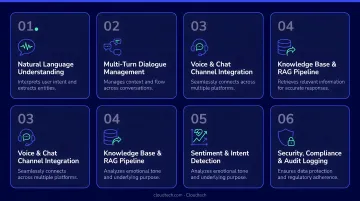
Gartner reports that 85% of customer service leaders will explore or pilot a customer-facing conversational GenAI solution in 2025 — which means the market is flooded with vendors claiming enterprise readiness. Use the capability stack above to separate platforms that can handle real enterprise workflows from those that cannot.
Best Enterprise Conversational AI Platforms for 2026
Platforms were selected based on production readiness, multichannel capability, governance architecture, integration depth, and suitability across regulated and high-volume enterprise environments.
Amazon Lex
Amazon Lex is AWS's managed conversational AI service — built on the same deep learning engine that powers Alexa — enabling teams to build voice and text interfaces that integrate natively with Amazon Connect, Lambda, and the broader AWS service catalog.
Why it stands out for AWS-first enterprises:
- Native integration with Amazon Connect eliminates the telephony glue work required on other platforms
- IAM-based security controls align with existing AWS governance posture
- Pay-per-request pricing scales with actual usage — no upfront platform fees
- Supports 65 locales across Lex V2, far broader than many competitors
The production case data is concrete. WaFd Bank reduced balance-check time by 90% (from 4.5 minutes to 28 seconds) and projected a 30% reduction in agent call volume. TransUnion cut IVR handling time from 2 minutes to 18 seconds and reduced transfer rates by 50%. NAB reported 80% containment for automated or digital channel interactions.
For teams already running on AWS infrastructure, Lex removes the vendor-integration overhead that compounds across third-party SaaS platforms. Cloudtech's AWS-certified team works with organizations to architect and deploy Amazon Lex implementations — from Lambda integration and intent design to Amazon Connect configuration and cost modeling at projected conversation volumes.
| Key Features | Intent recognition, slot filling, multi-turn dialogue, voice + text support, 65 locales, native Lambda integration |
| Deployment & Channels | AWS Cloud; voice (Amazon Connect), web chat, mobile apps, SMS; pay-per-request pricing |
| Best For | AWS-native enterprises, contact center teams using Amazon Connect, developers building custom conversational workflows into existing AWS infrastructure |
Rasa
Rasa is the leading open-source and enterprise conversational AI platform, built around a patented dialogue management system that separates LLM-based understanding from deterministic business logic — making it the preferred choice for regulated industries requiring on-premise deployment and full governance control.
Why it stands out:
- CALM (Conversational AI with Language Models) framework prevents hallucinations through architectural policy enforcement, not just prompt engineering
- Self-hosted deployment means customer data never leaves the client environment
- Single runtime handles both voice and chat — Twilio, Jambonz, AudioCodes, and Genesys connectors are built in
- Autodesk is on track to handle over 200 million user conversations via Rasa by 2026, a credible production-scale proof point
In regulated environments where an auditor asks "why did the AI make that decision," Rasa's Orchestrator provides traceable, deterministic answers. That's an architectural property — one that compliance teams can document and defend, not a configuration setting that shifts with model updates.
| Key Features | CALM framework, patented dialogue management, voice + chat from single runtime, full audit trails, custom NLU pipelines, RAG support |
| Deployment & Channels | Self-hosted, on-premise, private cloud, or hybrid; voice (Twilio, Jambonz, AudioCodes, Genesys), web chat, WhatsApp; Developer Edition free up to 1,000 conversations/month; Enterprise pricing via sales |
| Best For | Enterprises in regulated industries (finance, healthcare, government) requiring on-premise deployment, production-grade LLM governance, and voice-digital channel parity from one platform |
Kore.ai
Kore.ai is a 2025 Gartner Magic Quadrant Leader for conversational AI, offering an Experience Optimization Platform that combines no-code agent building, multi-engine NLP, and pre-built industry agents for banking, healthcare, retail, and HR — covering customer service, employee support, and operations on a single stack.
Why it stands out:
- 100+ pre-built connectors and 9,000+ API actions, including Salesforce, ServiceNow, Microsoft Dynamics, Oracle, Workday, and SAP
- Broad omnichannel coverage: voice, chat, email, social, and in-app
- Agent handoff with full context preservation reduces the friction that typically breaks customer trust
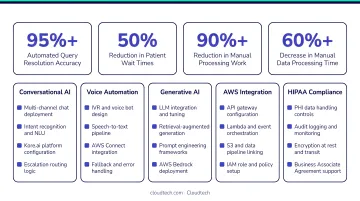
- Eli Lilly's AI agents handle 70% of Tech@Lilly service-desk requests; a Top Ten European Bank resolved 94% of HR queries and cut ticket volume by 83%
One honest trade-off: the no-code builder reduces initial deployment time, but advanced configurations carry a learning curve, and integration complexity can extend timelines on custom enterprise implementations.
| Key Features | Multi-engine NLP, no-code + pro-code builder, pre-built industry agents, omnichannel agent handoff, built-in analytics, 100+ integrations |
| Deployment & Channels | Cloud and on-premises; voice, chat, email, social, in-app; enterprise custom pricing via sales |
| Best For | Large enterprises needing complex workflow automation with pre-built industry agents and a single platform for both customer (CX) and employee (EX) use cases |
Google Dialogflow CX
Google Dialogflow CX is Google Cloud's enterprise conversational AI platform, featuring a visual state-based flow builder, Google's NLU engine, and telephony integration via Contact Center AI (CCAI) — designed for engineering teams that want granular conversational control within the GCP ecosystem.
Why it stands out:
- Strong NLU accuracy across 100+ languages and locales
- Visual flow builder provides genuine improvement in conversation management over the older Dialogflow ES
- CCAI partnerships with Twilio, Genesys, and Avaya (established integrations) for telephony deployment
- Competitive pay-as-you-go pricing: $0.007 per chat request, $0.001 per voice second
Clear trade-offs to flag:
- Google Cloud lock-in is real — no self-hosted deployment option was found in official documentation
- LLM governance controls are limited compared to Rasa's CALM methodology
- Less suited for regulated industries with strict data sovereignty requirements
| Key Features | Visual flow builder, Google NLU, 100+ languages, prebuilt agents, CCAI telephony integration, webhook-based custom integrations |
| Deployment & Channels | Google Cloud only; chat, voice (via CCAI partners), telephony; pay-as-you-go per session/voice second; free tier available |
| Best For | Enterprises already on Google Cloud needing a developer-controlled, visually managed conversational AI platform with strong NLU and telephony integration |
Cognigy
Cognigy is a mature enterprise contact center AI platform built for global organizations running high-volume voice and chat operations. Its Agent Copilot capability assists human agents in real time, delivering live transcription, next-best-action suggestions, call summaries, and post-call automation. That makes it a genuine human-AI orchestration platform — one designed to augment contact center agents, not just replace them.
Why it stands out:
- Lufthansa runs 16 bots handling 16 million+ AI conversations yearly across multiple languages
- Personify Health achieved 40% containment within one month with a 97% intent score
- A Fortune 100 insurer runs one AI agent handling 20 million calls per year, with 95% automation for ID&V and a 1.5-minute reduction in average handle time
- Supports 100+ languages with deep CCaaS, CRM, and ITSM connector library
One practical note: advanced use cases often require JavaScript and API skills, and pricing is enterprise license only through sales — plan discovery time accordingly.
| Key Features | AI voice + chat agents, Agent Copilot (real-time human agent assist), 100+ language support, CCaaS/CRM/ITSM connectors, flow-based dialog designer |
| Deployment & Channels | Cloud and on-premises (Kubernetes-based, compatible with AWS EKS and Azure AKS); voice, chat, in-app, messaging; enterprise license pricing via sales |
| Best For | Large global contact centers needing AI automation alongside human agent augmentation, with high concurrency requirements and deep CCaaS integration needs |
How to Choose the Right Enterprise Conversational AI Platform
The most common enterprise mistake is evaluating platforms on demo-day feature lists rather than production behavior. Most platforms handle the easy 20% of conversations well. The question is what happens to everything else.
Test against your most complex customer journey — the one that requires authentication, a CRM lookup, a conditional escalation path, and a graceful fallback. That's where platforms separate.
Deployment Model as a Hard Filter
Data sovereignty requirements immediately eliminate certain vendors. Healthcare and financial services organizations often cannot legally route customer data through a third-party cloud they don't control.
- On-premise or private cloud required: Rasa (native), Kore.ai (available with vendor support)
- Regional data residency within cloud: Amazon Lex (AWS regions)
- Cloud-only, no self-hosted option: Google Dialogflow CX, and consumer-tier platforms like Intercom/Zendesk
If your compliance team needs data to stay within a specific environment, make this the first question — not an afterthought.
Integration Depth Over Integration Count
A vendor listing 150 integrations matters far less than confirming your five critical integrations work end-to-end under real load. The real test: what happens when a CRM lookup fails mid-conversation? Does the platform recover gracefully, preserve context, and hand off to a live agent with context intact — or does it freeze?
Before signing anything, run a proof-of-concept that validates each of these paths under realistic conditions:
- CRM lookup and write-back (including failure scenarios)
- ITSM ticket creation and status retrieval
- Telephony handoff with conversation context preserved
- Identity/auth flows with session management
LLM Governance and Accountability
Once your integration paths are validated, governance becomes the next hard filter — especially in regulated industries. There's a material difference between architectural policy enforcement and prompt engineering as a guardrail. Rasa's Orchestrator enforces deterministic business rules at the architecture level — you can demonstrate why a specific decision was made. Prompt-tuned guardrails can drift, and when they do, there's no clean audit trail explaining why.
In regulated or high-stakes environments, look for:
- Full audit trails on conversation decisions
- Traceable orchestration with version control
- The ability to show a compliance auditor exactly what the AI did and why
Total Cost of Ownership Modeling
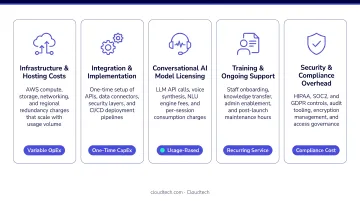
Governance requirements often influence build-vs-buy decisions — which brings the cost picture into focus. Platform license fees are often the smallest line item. Model the full picture before committing:
- Implementation services — intent design, integration builds, testing
- Knowledge base creation — content sourcing, structuring, ongoing maintenance
- Ongoing AI training — retraining as language patterns shift
- Escalation cost — conversations the AI can't resolve still cost money; every 1% improvement in first-call resolution reduces total operating costs by approximately 1%
- Per-session pricing at volume — $0.007 per chat request compounds quickly at millions of monthly conversations
Run a production pilot with defined success metrics — containment rate, CSAT, escalation quality, cost-per-resolution — before signing an enterprise contract. Demos optimize for the easy cases.
Conclusion
The best enterprise conversational AI platform is the one that fits your existing tech stack, governance requirements, and actual conversation complexity — not the one with the most impressive demo or the most recognized brand name.
For organizations already running on AWS, there's a compelling native path through Amazon Lex and Amazon Connect. The integration overhead that plagues third-party SaaS deployments largely disappears when you're building within the ecosystem you already operate. That translates to quicker deployment, tighter security controls, and costs that scale predictably with usage.
Before any broad rollout, run a structured pilot against real customer journeys with defined success metrics. Platforms that hold up over months of real traffic — maintaining containment rates, handling edge cases gracefully, and escalating with context intact — are worth far more than ones that only shine in controlled demos.
If your organization is exploring how to deploy and optimize conversational AI on AWS — from Amazon Lex configuration to integration with your CRM, contact center, and data infrastructure — Cloudtech's AWS-certified team can help you architect the right solution. Reach out at connect@cloudtech.com or visit cloudtech.com to get started.
Frequently Asked Questions
Can enterprise conversational AI platforms operate across voice, chat, and messaging simultaneously?
Yes — leading platforms are built for multichannel deployment. The important distinction is whether voice and chat share a single conversation runtime or are separate platforms bolted together. Rasa currently offers the most complete voice-chat parity from one orchestration layer; platforms like Kore.ai and Cognigy add voice via CCaaS integrations, which works well but adds configuration complexity.
What is the best voice conversational AI for managing enterprise calls?
It depends on your infrastructure. Amazon Lex with Amazon Connect is the natural choice for AWS-based contact centers, offering tight IAM controls and proven production metrics. Rasa with Twilio or Genesys connectors suits regulated enterprises that need self-hosted deployment, while Cognigy's Agent Copilot is a strong fit for global contact centers requiring real-time human agent augmentation.
How do I choose an enterprise conversational AI platform with voice and chat integration?
Confirm whether voice and chat share the same conversation logic and context store, or whether they're separate platforms stitched together. Then test two scenarios: does context survive a chat-to-phone handoff, and what happens when a CRM lookup fails mid-conversation? Those answers tell you more than any feature comparison.
What is the difference between a chatbot and an enterprise conversational AI platform?
A chatbot follows scripted rules and handles simple, single-turn queries — it deflects rather than resolves. Enterprise conversational AI platforms use NLU and LLMs to interpret intent across multi-turn conversations, integrate with backend systems to take actions (not just answer questions), maintain state across sessions, and provide the governance, audit trails, and analytics that regulated enterprise environments require.
How much does an enterprise conversational AI platform cost?
Usage-based platforms like Amazon Lex ($0.00075/text request) and Google Dialogflow CX ($0.007/chat request) are accessible entry points, while Kore.ai and Cognigy are enterprise-license-only through sales. Rasa's Developer Edition is free up to 1,000 conversations per month. Regardless of model, hidden costs — implementation, knowledge base setup, and ongoing training — often exceed the platform license itself.
Do enterprise conversational AI platforms require on-premise deployment for regulated industries?
Not always, but data sovereignty requirements in healthcare, financial services, and government often make cloud-only SaaS platforms a compliance risk. Rasa and Kore.ai both support on-premise or private cloud deployment; Amazon Lex provides regional data residency within AWS. Cloud-only platforms without self-hosted options make compliance sign-off significantly harder in regulated environments.