Introduction
Generative AI has moved past the experimental phase. Gartner found that 29% of organizations had deployed GenAI in production in 2024, and more than 80% of enterprises are projected to use GenAI APIs or deploy GenAI-enabled applications by 2026. The competitive pressure is real: 46% of US executives surveyed by PwC in 2025 worried their company was falling behind competitors on AI agent adoption.
For SMBs and startups, the risk isn't just missing a trend — it's watching competitors automate customer support, accelerate document review, and generate content at a fraction of the previous cost while you're still in planning mode.
This guide covers how generative AI application development actually works — what goes into building a GenAI app, how to structure the process, and how to make smart decisions upfront. No data science background required.
Key Takeaways
- Most SMBs don't need to train their own model — pre-trained APIs make development accessible and fast
- RAG is the fastest path to grounding AI responses in your own business data
- A production-ready GenAI app typically takes one to three months with the right infrastructure decisions upfront
- The biggest risks — hallucinations and data privacy — are manageable with structured development practices
- Starting with one focused use case dramatically increases the odds of a successful first deployment
What Is Generative AI Application Development?
Generative AI application development is the process of building software that uses foundation models — large language models (LLMs) or multimodal models — to generate text, images, code, or structured outputs in response to user inputs.
That separates it from traditional software development in a concrete way. Rule-based systems follow fixed logic. Traditional ML models classify or predict. Generative AI produces new content, handles open-ended instructions, and runs dozens of different tasks from a single pre-trained model — no rebuilding required between use cases.
The Ecosystem Layers
Understanding where application developers fit in matters before you write a line of code:
- Infrastructure — GPUs, cloud compute, networking (handled by AWS, Azure, GCP)
- Foundation models — Pre-trained LLMs like GPT-4o, Claude 3.5 Sonnet, Meta Llama, Amazon Titan
- Developer tools — Frameworks like LangChain and LlamaIndex, RAG pipelines, vector databases
- Applications — The product or workflow your users actually interact with
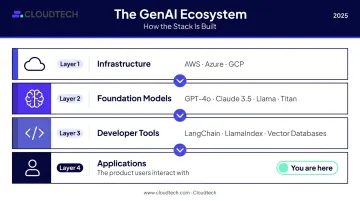
Most SMBs operate at the application layer. You're building on top of existing models using APIs, not training the models themselves. That means a small engineering team can ship production-grade AI features without hiring ML researchers or managing GPU clusters.
Key Components of a Generative AI Application
Foundation Model Selection
For most SMBs, model selection means choosing between:
- Closed-source APIs: OpenAI GPT-4o ($2.50 input / $10 output per 1M tokens, 128K context), Anthropic Claude 3.5 Sonnet ($3 input / $15 output per 1M tokens, 200K context), Amazon Titan via Bedrock
- Open-weight models: Meta Llama 3 (8B and 70B variants), which you can self-host for more control
Key selection factors: cost per token, context window size, latency requirements, data privacy constraints, and task suitability. For healthcare or financial services workloads, privacy and compliance will often narrow the options quickly.
Prompt Engineering Layer
Prompts are the primary interface between your application and the model. A well-designed prompt — including system instructions, task templates, and few-shot examples — can dramatically improve output quality without any model training. Start here before investing in fine-tuning or custom training.
Retrieval-Augmented Generation (RAG)
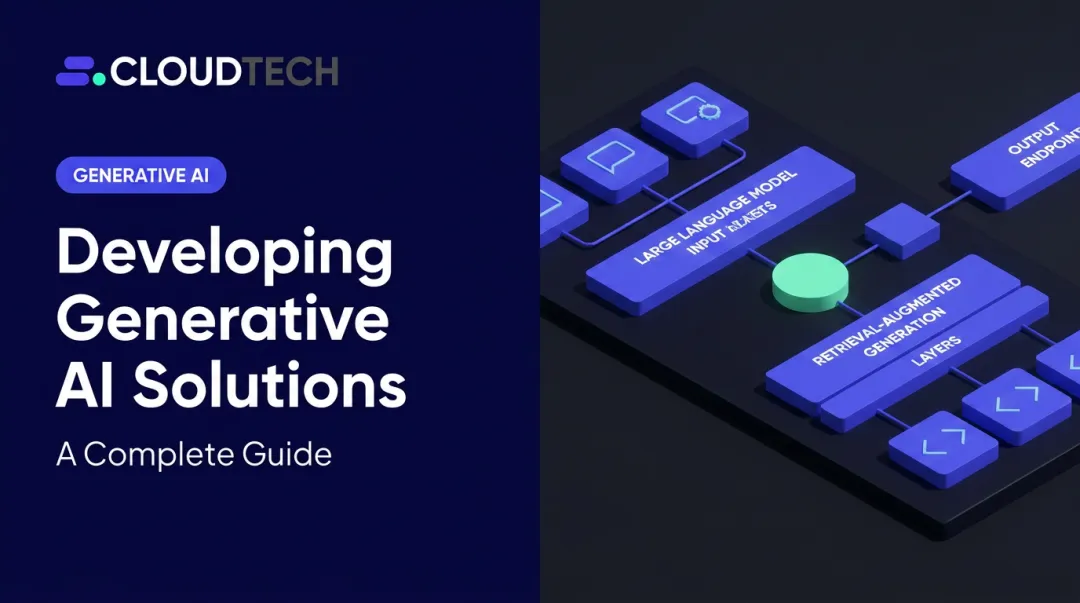
RAG connects the LLM to your own business data — documents, databases, knowledge bases — via a vector database. Instead of relying solely on what the model learned during training, it retrieves relevant context at the moment a user asks a question and feeds that into the response.
The accuracy benefit is measurable. Research on the FRAMES benchmark showed Gemini 1.5 Pro's factual-answer accuracy improving from 0.408 without retrieval to 0.660 with a multi-step retrieval pipeline. That's a meaningful improvement for any knowledge-intensive workload.
For businesses with proprietary data or compliance requirements, RAG is frequently the right starting point.
Orchestration and Business Logic
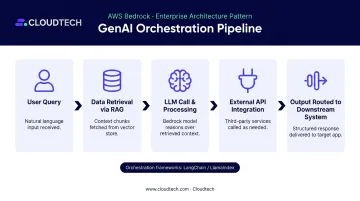
Once you have retrieval working, orchestration is what turns it into a real application. Frameworks like LangChain and LlamaIndex chain together LLM calls, tool integrations, memory, and API connections — enabling agents that take actions, not just generate responses. A multi-step workflow might retrieve data, call an external API, generate a summary, and route the output to a downstream system, all without human intervention at each step.
Cloud Infrastructure and Deployment
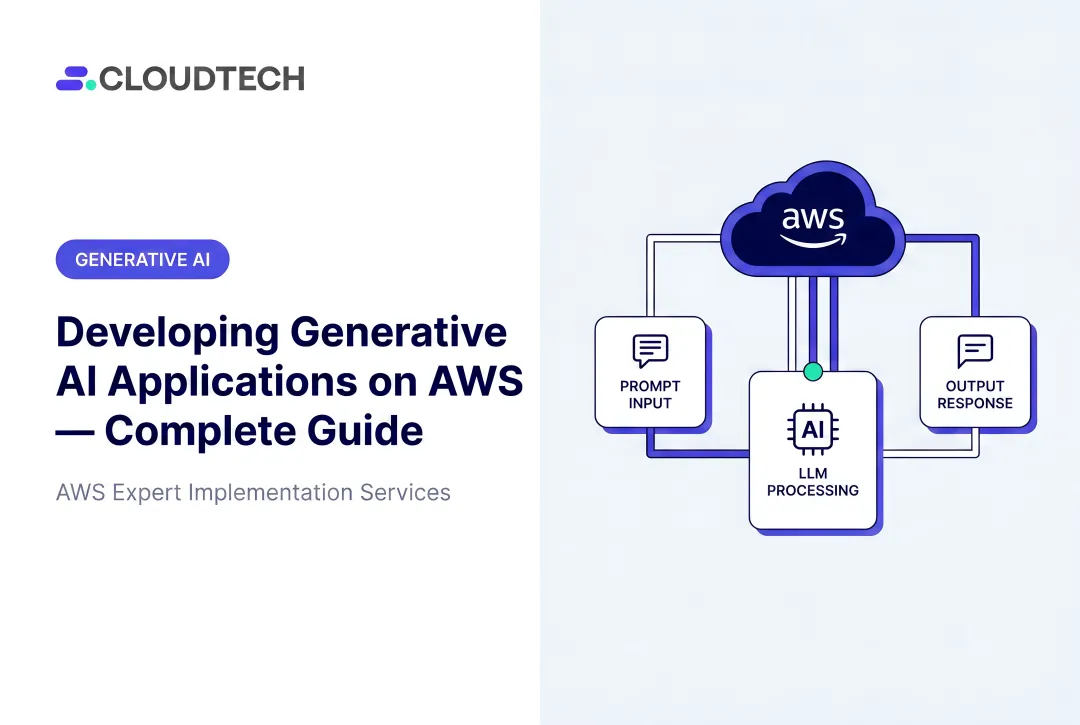
With orchestration defined, the infrastructure layer determines how reliably your application runs at scale. GenAI apps need managed infrastructure for model access, vector search, compute scaling, and monitoring. For teams already in the AWS ecosystem, a standard stack includes:
- Amazon Bedrock: Managed LLM access across multiple model providers
- Amazon OpenSearch: Vector database for RAG pipelines
- AWS Lambda: Serverless orchestration for event-driven workflows
Cloudtech builds production GenAI applications on this stack for SMB clients across healthcare, financial services, and SaaS, typically combining Bedrock Agents with OpenSearch and Amazon Redshift for end-to-end RAG deployments.
The Step-by-Step Development Process
Step 1 — Define the Use Case and Success Criteria
Pick a specific, high-value problem. "Automate customer support" is too broad. "Resolve tier-1 support tickets about account billing without human involvement" is a testable use case. Before development begins, define measurable benchmarks: accuracy targets, acceptable latency, cost per interaction.
Step 2 — Select and Configure the Foundation Model
Evaluate models based on:
- Modality — Text only, or do you need image understanding?
- Context window — How much input does your use case require per query?
- Cost — Token prices vary significantly across providers
- Task suitability — Some models outperform others on coding, summarization, or structured output
Prompt engineering and system instructions are your first customization tools. Test these thoroughly before moving to fine-tuning or other more expensive approaches — most use cases don't need to go further.
Step 3 — Build the Data Layer
Choose RAG when:
- Your app needs domain-specific or frequently updated knowledge
- You have privacy constraints around sending data to third parties
- You need responses grounded in verified, source-attributable content
Choose fine-tuning when:
- You need a consistent tone or output format across thousands of responses
- The task is narrow and repetitive
- You have enough high-quality labeled data
For most SMBs, RAG is the right starting point. It's faster to set up, less expensive, and easier to update than fine-tuning a model on proprietary data. Once your data layer is in place, the next question is whether it's actually working — which is where evaluation comes in.
Step 4 — Evaluate and Iterate
Evaluation isn't a one-time gate — it's ongoing. Common frameworks include:
- RAGAS — Measures retrieval relevance, faithful use of retrieved passages, and generation quality
- TruLens RAG Triad — Evaluates context relevance, groundedness, and answer relevance
- Side-by-side model comparisons — Manual review against a golden dataset
- Adversarial testing — Deliberately probe for harmful, biased, or incorrect outputs
Build evaluation into your development cycle from the start. Without it, failure modes only surface in production — when real users are already affected.
Step 5 — Deploy, Monitor, and Improve
Production deployment requires more than spinning up an API endpoint:
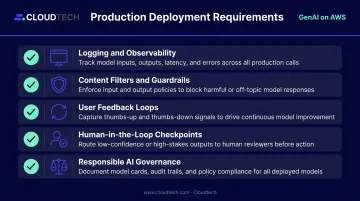
- Set up logging and observability from day one
- Implement content filters and guardrails (Amazon Bedrock Guardrails supports content filters, denied topics, sensitive information filters, and contextual grounding checks)
- Establish feedback loops — real user interactions surface failure modes no test dataset will catch
- Define human-in-the-loop checkpoints for high-stakes decisions (financial, medical, legal)
Real-World Use Cases by Industry
Generative AI is already delivering measurable results across industries — not in pilot programs, but in production. Here's what that looks like in the verticals where Cloudtech builds.
Healthcare
RAG-based GenAI fits healthcare well: grounding responses in verified medical knowledge keeps hallucination risk low, which matters when the output touches clinical decisions. Common deployments include:
- Automated patient query resolution and benefits navigation
- Clinical documentation summarization
- AI-assisted diagnostic report generation
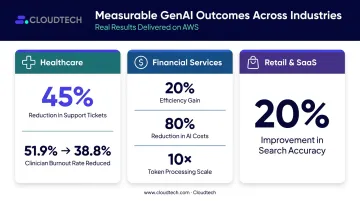
A 2025 multicenter clinical study published in JAMA Network Open found that ambient GenAI scribes reduced clinician burnout from 51.9% to 38.8% after 30 days, with after-hours documentation declining by nearly one hour per week.
Cloudtech has deployed a RAG-based care navigation assistant on Amazon Bedrock for a healthcare SaaS platform, delivering a 45% reduction in support tickets within two months — with complex member queries resolved in seconds.
Financial Services and Manufacturing
In financial services, LLMs automate work that previously required analyst-level effort. In manufacturing, they support operations and compliance documentation at scale:
- Intelligent contract review and clause extraction
- Financial report summarization
- Fraud investigation narrative generation
- Predictive maintenance documentation
Robinhood's Bedrock-based financial crimes agent delivered a 20% cumulative efficiency gain and 80% lower AI costs while scaling daily token processing from 500M to 5B tokens.
Retail, SaaS, and Customer-Facing Businesses
Most retail and SaaS deployments go live in weeks and show ROI before the quarter ends — which is why they're where many SMBs start:
- AI-powered customer support agents
- Semantic search across product catalogs or documentation
- Personalized email and content generation
Adobe reported 20% better search accuracy after using Amazon Bedrock Knowledge Bases for developer support search.
Key Challenges in Generative AI Application Development
Hallucinations and Output Reliability
LLMs can generate confident, plausible-sounding responses that are factually wrong. Stanford researchers measured legal hallucination rates of 69% to 88% for leading LLMs answering specific legal queries — a serious risk for any application where accuracy has real consequences.
Ways to reduce this risk:
- RAG to ground responses in verified source documents
- Output validation layers that check responses against source material
- Confidence scoring on retrieved passages
- Human review checkpoints for consequential outputs
Data Privacy and Security
Hallucinations aren't the only danger — sending proprietary business data to a third-party LLM API introduces its own exposure. Practical controls include:
- Use private model deployments — Amazon Bedrock allows VPC isolation via AWS PrivateLink, keeping your data off the public internet
- Anonymize or redact sensitive fields before they reach the model
- Review model provider data retention policies before deployment (AWS states that model providers cannot access Bedrock deployment accounts, logs, or customer prompts)
Cost Management and Latency
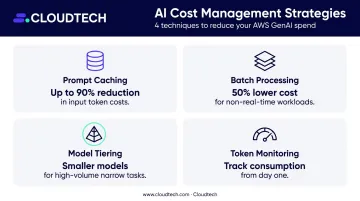
Token-based pricing escalates quickly at scale, and larger models introduce latency. Practical strategies:
- Prompt caching — OpenAI's Prompt Caching can reduce input-token costs by up to 90% for repeated prefixes
- Batch processing — OpenAI's Batch API offers 50% lower cost for non-real-time workloads
- Model tiering — Use smaller, fine-tuned models for narrow, high-volume tasks
- Token monitoring — Track consumption from day one, not after the bill arrives
Responsible AI and Governance
Any application making consequential decisions needs governance controls:
- Content moderation and denied topic filters
- Bias testing across demographic and edge case inputs
- Audit trails for regulatory compliance
- Acceptable use policies defined before deployment
NIST's GenAI Profile (NIST AI 600-1), published in July 2024, gives teams a structured starting point — organized around Govern, Map, Measure, and Manage functions — for building these controls into production systems before regulators ask for them.
How to Get Started with GenAI Application Development
Start narrow. Pick one specific workflow — customer support automation, internal knowledge retrieval, document summarization — where time savings are measurable. A focused proof of concept builds internal confidence and limits risk far better than a broad "AI strategy" initiative.
Assess your options honestly. Three paths exist for SMBs:
| Path | Best for | Trade-off |
|---|---|---|
| Pre-built SaaS AI tools | Very specific, standard use cases | Limited customization |
| Managed platform (AWS Bedrock) | Teams with some technical capacity | Requires architecture decisions |
| AWS consulting partner | Teams without dedicated AI engineers | Fastest path to production |
McKinsey research found that organizations most often needed one to four months to move a GenAI project from start to production. Highly customized or proprietary model builds were 1.5x more likely to require five months or more. Structured methodology and sound infrastructure decisions from day one materially affect that timeline.
Cloudtech's GenAI engagements begin with a fixed-fee 4–8 week Pilot POC that covers:
- Use case prioritization and scoping
- Data readiness assessment
- RAG architecture design
- Model selection across Anthropic Claude, Amazon Titan, and Meta Llama on Bedrock
- Responsible AI guardrails
AWS MAP/IMR funding is available for qualifying workloads. For SMBs without dedicated AI engineers, that structured starting point replaces months of trial-and-error.
Frequently Asked Questions
Do you need to train your own model to build a generative AI application?
No. Most businesses use pre-trained foundation models via APIs — such as Amazon Bedrock or OpenAI — and customize behavior through prompt engineering, RAG, or fine-tuning on smaller datasets. Training a foundation model from scratch requires resources well beyond what most SMBs have available.
What is the difference between RAG and fine-tuning in generative AI development?
RAG retrieves external data at inference time to ground responses — best for dynamic or proprietary knowledge that changes frequently. Fine-tuning trains the model on additional data to adjust its behavior or output style — best for narrow, repetitive tasks where consistent format matters more than real-time knowledge.
How much does it cost to build a generative AI application?
Costs vary based on model choice, query volume, and infrastructure. API-based models charge per token — GPT-4o runs $2.50 per million input tokens, Claude 3.5 Sonnet at $3 — making early prototypes relatively affordable. Production-scale costs scale with query volume, context window usage, and retrieval and guardrail infrastructure.
How long does it take to develop a generative AI application?
A simple prototype using existing APIs can be ready in days to weeks. A production-ready build with RAG, evaluation pipelines, and deployment infrastructure typically takes one to three months — more complex, highly customized builds often run five months or longer.
What programming languages are commonly used for generative AI application development?
Python is the dominant language, used by 57.9% of developers in Stack Overflow's 2025 survey, with a rich ecosystem including LangChain, LlamaIndex, and Hugging Face. Major model providers also support JavaScript/TypeScript, Java, Go, C#, and others — so the application layer can be built in most languages.
What is the biggest risk in generative AI application development for businesses?
Hallucinations and data privacy are the top two. A structured process — RAG to ground outputs in verified data, output validation layers, VPC-isolated deployments, and human-in-the-loop checkpoints for high-stakes decisions — significantly reduces both risks in production.