This guide is written for data engineers, IT decision-makers, and business leaders at SMBs evaluating cloud data infrastructure. You'll learn how each pipeline stage works, which AWS services power each step, what drives performance and cost, and how to avoid the mistakes that turn a clean architectural diagram into an operational headache.
Key Takeaways
- AWS ETL pipelines automate data movement through three stages: Extract, Transform, and Load—eliminating manual preparation overhead
- AWS Glue handles serverless ETL; Lambda covers event-driven micro-transformations; EMR fits large-scale, complex workloads
- Poor data quality costs organizations at least $12.9M annually, per Gartner—making pipeline design a financial decision, not just a technical one
- ETL suits compliance-heavy use cases; ELT (load first, transform inside the warehouse) fits exploratory, high-volume workloads
- Choosing the wrong service for your latency and scale requirements is the most expensive mistake teams make
What Is an AWS ETL Pipeline?
An AWS ETL pipeline is a repeatable, automated data integration process that pulls data from one or more sources, applies structured transformations, and delivers it to a target system—typically Amazon Redshift, S3, or another analytical datastore.
The goal is converting raw, inconsistent, multi-format data into a clean, consolidated dataset that supports business intelligence, reporting, and machine learning. Without that process, your analytics are only as reliable as whatever landed in the source system—and inconsistent source data produces unreliable analytics.
ETL vs. ELT: ETL transforms data before it reaches the destination; ELT loads raw data into the target first and transforms it there using the warehouse's compute power. AWS supports both paradigms, and the right choice depends on your use case—both are addressed later in this guide.
Why AWS ETL Pipelines Matter for Modern Data Workflows
Organizations across healthcare, financial services, manufacturing, and retail generate data from dozens of disconnected systems—CRMs, IoT sensors, transactional databases, SaaS platforms. None of it arrives in a form ready for analysis.
The cost of ignoring that reality is measurable. According to Anaconda's 2020 State of Data Science survey, data professionals spend 45% of their time loading and cleansing data, leaving less than half their hours for actual analysis or decision-making.
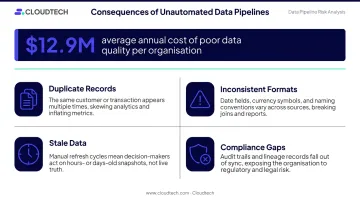
When pipelines don't catch data quality problems, the downstream cost compounds fast. Gartner reports that poor data quality costs organizations at least $12.9M per year on average.
What breaks without automated ETL
- Duplicate records accumulating across systems with no reconciliation logic
- Inconsistent formats for dates, currencies, and identifiers across source systems
- Stale data arriving too late for time-sensitive decisions (end-of-day reports, fraud alerts)
- Compliance gaps from uncontrolled data flows; in healthcare and financial services, missing audit trails carry direct regulatory consequences
AWS ETL pipelines address each of these by applying transformation logic, validation checks, and controlled data movement at every stage. For regulated industries, they're operational infrastructure that directly supports audit readiness, data governance, and reporting accuracy.
How an AWS ETL Pipeline Works
At a high level: data moves from a source (database, API, file, stream) through a processing layer where transformations are applied, then lands in a destination system. Pipelines can run on a schedule (batch), in response to an event trigger, or continuously (streaming).
Most production pipelines are defined as code or visual jobs—for example, in AWS Glue Studio—orchestrated by a scheduler or event trigger, and monitored through Amazon CloudWatch. A staging area in Amazon S3 is commonly used between extract and load to decouple pipeline stages. This separation supports error recovery and reprocessing without re-pulling data from the source.
Here's how each stage works in practice.
Step 1: Extract
Extraction means reading raw data from one or more source systems. In AWS, that includes:
- Amazon RDS or DynamoDB for relational and NoSQL databases
- AWS Database Migration Service (DMS) for on-premises or legacy databases
- Amazon Kinesis for real-time streaming data
- Third-party APIs via custom Lambda functions or connectors
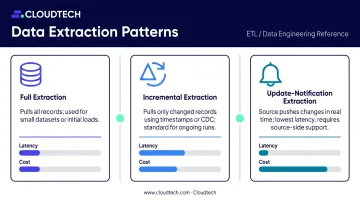
Three extraction patterns cover most use cases:
- Full extraction — pulls all records; used for small datasets or initial loads
- Incremental extraction — pulls only records changed since the last run, using timestamps or change data capture (CDC); the standard for ongoing pipeline runs
- Update-notification-based extraction — the source system pushes changes in real time; lowest latency but requires source-side support
Step 2: Transform
Transformation shapes raw data into something usable. Depending on the pipeline's requirements, raw data is:
- Cleaned — nulls removed, errors corrected, invalid records flagged
- Deduplicated — duplicate records across sources identified and resolved
- Reformatted — date formats, currencies, and identifiers standardized
- Enriched — new calculated fields derived from business rules
- Joined — data merged across multiple source datasets
- Masked — PII encrypted or tokenized for compliance
In AWS, teams typically write transformations in PySpark or Python within AWS Glue jobs, or handle them via SQL in Amazon Athena or Redshift. AWS Glue DataBrew offers a no-code interface with 250+ prebuilt transformations for analysts who aren't writing Spark code directly.
Step 3: Load
Loading delivers transformed data into the target system. Two loading patterns apply:
| Load Type | When to Use |
|---|---|
| Full load | Initial migrations, small reference tables, complete dataset replacement |
| Incremental load | Ongoing pipeline runs—only new or changed records appended to minimize compute cost |
For most AWS architectures, the target is Amazon Redshift (data warehouse), S3 (data lake), or both. When Glue loads into Redshift, it routes data through S3 using Redshift's COPY command for throughput efficiency.
Key AWS Services for Building ETL Pipelines
Core ETL Services
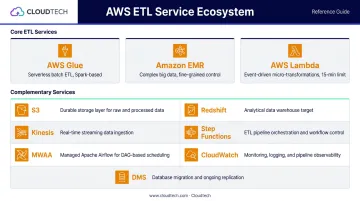
AWS Glue is the primary, fully managed, serverless ETL service. It runs Apache Spark under the hood, supports PySpark and Scala, includes the Glue Data Catalog for metadata management, and integrates natively with S3, Redshift, RDS, Athena, and Lake Formation. Best suited for batch ETL at scale without infrastructure management overhead. Glue Spark jobs are billed at $0.44 per DPU-hour in US East (N. Virginia), billed by the second with a one-minute minimum.
Amazon EMR is the choice for organizations needing fine-grained control over large-scale Spark, Hadoop, Hive, or Presto workloads. More flexible than Glue but requires deeper engineering expertise. EMR Serverless removes cluster configuration for teams wanting managed compute without operational overhead.
AWS Lambda handles lightweight, event-driven transformations within a pipeline, such as triggering a cleansing function when a new file lands in S3, or filtering records from a Kinesis stream. Lambda has a hard ceiling of 15 minutes and 10,240 MB per invocation, making it unsuitable for large batch processing. Treat it as one component within a broader pipeline, not a standalone replacement for Glue or EMR.
Complementary Services
| Service | Role |
|---|---|
| Amazon S3 | Staging area, data lake storage, source and destination |
| Amazon Redshift | Target data warehouse; supports ELT via SQL |
| Amazon Kinesis | Real-time streaming ingestion (sub-second propagation latency) |
| AWS Step Functions | Orchestrates multi-service pipeline workflows |
| Amazon MWAA | Managed Apache Airflow for complex scheduling |
| Amazon CloudWatch | Monitoring, logging, and alerting |
| AWS DMS | Migrates data from on-premises or legacy databases |
For SMBs without a dedicated data engineering team, a focused stack of S3, AWS Glue, Lambda, Step Functions, and Redshift handles most pipeline needs while sidestepping EMR's infrastructure complexity. One Cloudtech financial services engagement used exactly this pattern: an event-driven pipeline built on EventBridge, Lambda, Glue, and Athena, with CloudWatch and SNS for monitoring. The client's VP of Engineering called it "the backbone of our timely and accurate investment advice."
Selecting the right service combination, configuring IAM permissions correctly, and tuning DPU allocation are where many teams lose time. An AWS-certified consulting partner like Cloudtech can shorten that process significantly, and AWS Partner Funding is often available to offset implementation costs.
Key Factors That Affect Pipeline Performance
Data Volume, Velocity, and Transformation Complexity
Three variables determine your service selection and compute configuration:
- Data volume and velocity — batch workloads running nightly versus continuous streams hitting Kinesis require completely different architectures
- Transformation complexity — simple type casting is cheap; multi-dataset joins and aggregations consume significantly more compute
- Run frequency — real-time pipelines need sub-second latency (Kinesis, Lambda); daily batch jobs can tolerate Glue's default 100-second streaming window
Glue streaming processes data in 100-second windows by default—not sub-second. Kinesis, by contrast, achieves typical propagation delays below 1 second with recommended polling. Route latency-sensitive workloads to Kinesis; use Glue where micro-batch latency is acceptable.
Schema Evolution and Data Quality
If upstream source systems change their schema without notice—new columns added, fields renamed, data types changed—downstream pipelines break silently. AWS Glue Crawlers detect schema changes by connecting to data stores and updating the Glue Data Catalog automatically.
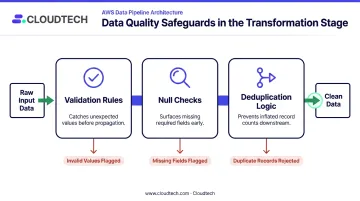
Crawlers alone aren't enough, though. Build these safeguards directly into the transformation stage:
- Explicit validation rules to catch unexpected values before they propagate
- Null checks to surface missing required fields early
- Deduplication logic to prevent inflated record counts downstream
Cost and Compliance as Design Constraints
Cost is a function of configuration. Glue jobs billed by DPU-hour become expensive when worker count is misconfigured or data is poorly partitioned. AWS's own cost-optimization guidance emphasizes monitoring DPU consumption, right-sizing workers, and addressing data skew before it shows up on your bill.
Compliance is your responsibility, not AWS's. AWS provides HIPAA-eligible services and a Business Associate Agreement (BAA), along with GDPR and CCPA resources—but customers retain full responsibility for configuration and data governance. Running on AWS does not make a pipeline compliant. Design these controls in from day one:
- Encryption at rest and in transit for all data in motion and storage
- IAM access controls scoped to least-privilege principles
- Audit logging to maintain a tamper-evident record of data access and changes
ETL vs. ELT on AWS: When to Choose Which
How ELT Works on AWS
ELT loads raw data directly into Amazon Redshift or S3 and applies transformations using Redshift SQL, Athena queries, or dbt models running inside the warehouse. AWS documents dbt transformation models executing against Amazon Redshift, making this a well-supported production pattern—not just a theoretical option.
Decision Framework
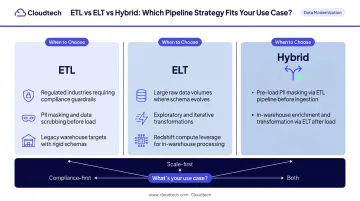
Choose ETL when:
- Data must be masked or cleansed before it touches the destination (regulated industries: healthcare, financial services)
- Loading into a legacy warehouse that lacks in-warehouse transformation capability
- High data quality standards are required before any data lands in the target
Choose ELT when:
- Working with large volumes of raw data where transformation requirements are exploratory or frequently changing
- The destination warehouse (Redshift) has sufficient compute to handle transformation at scale
- Minimizing data movement and pipeline complexity is a priority
Consider a hybrid approach when:
- Some fields require PII masking or deduplication before loading (apply ETL for those)
- Analytical enrichment—aggregations, joins—can happen inside the warehouse (apply ELT there)
Cloudtech implemented this hybrid pattern for a nonprofit healthcare insurer migrating off Oracle Exadata. Raw data landed in Amazon S3 first; dbt handled transformations inside the warehouse layer; Redshift Spectrum queried S3 directly—eliminating the need to stage full datasets into Redshift before analysis.
The outcome was meaningful: query latency dropped to near real-time, storage costs fell as S3 replaced Redshift for raw data retention, and the team avoided rebuilding three separate staging pipelines.
Common Mistakes in AWS ETL Implementation
Three patterns account for most of the failures Cloudtech observes when onboarding new clients:
Using Glue for Every Workload
Glue's cold-start behavior and 100-second default streaming window make it a poor fit for sub-second latency requirements or lightweight micro-tasks. Lambda is faster to invoke; Kinesis handles true real-time ingestion. Match the service to the workload, not the other way around.
Treating ETL as a One-Time Setup
Pipelines require ongoing maintenance as source schemas evolve, business logic changes, and data volumes grow. Teams that under-invest in monitoring and alerting typically discover broken pipelines only when downstream reports show incorrect numbers — often days after the failure occurred.
Mistaking Pipeline Success for Data Quality
A pipeline that runs without errors is not the same as a pipeline that delivers trustworthy data. Transformation logic must include:
- Explicit validation rules that catch schema drift early
- Null checks to flag incomplete or missing records
- Deduplication logic to prevent redundant data from reaching the warehouse
Without these, "clean" data may contain silent errors that corrupt analytics for weeks before anyone notices.
Conclusion
An AWS ETL pipeline does more than move data—it determines whether your analytics and machine learning outputs reflect reality or reinforce bad decisions. Understanding how extract, transform, and load each work, which AWS services fit which workloads, and when ELT or a hybrid approach outperforms traditional ETL is what separates pipelines that deliver business value from ones that become maintenance burdens.
The decisions that matter most happen before you write a single line of code: service selection, data quality strategy, compliance architecture, and monitoring design. Getting those choices wrong creates technical debt that compounds quickly.
For SMBs and mid-market teams navigating these decisions without a dedicated data engineering team, working with an AWS-certified partner can shorten the path considerably. Cloudtech — built primarily by former AWS engineers — helps companies design and deploy pipelines that are cost-efficient, compliant, and sized to grow with the business.
Frequently Asked Questions
What is ETL (extract, transform, load)?
ETL is the process of pulling data from one or more source systems, transforming it to clean and standardize it, then loading it into a destination such as a data warehouse. The result is a reliable foundation for analytics and business intelligence.
What is the difference between ELT and ETL?
ETL transforms data before it reaches the destination—better for compliance-heavy or legacy environments where raw data cannot touch the target system. ELT loads raw data into the destination first and transforms it there using the warehouse's compute power, making it better for large-scale, exploratory workloads on modern platforms like Amazon Redshift.
Which AWS service is used for ETL processing?
AWS Glue is the primary managed ETL service, handling batch and streaming workloads through serverless Spark execution. Amazon EMR serves complex big data workloads requiring more infrastructure control. AWS Lambda handles event-driven micro-transformations within a broader pipeline. For most SMBs starting out, AWS Glue is the practical default—EMR and Lambda come into play as volume and complexity grow.
Is AWS Glue an ETL or ELT service?
AWS Glue is primarily an ETL service—it transforms data before loading it into the destination. However, it can support ELT patterns when paired with Amazon Redshift: Glue handles extraction and loading while Redshift handles transformation via SQL or dbt models running inside the warehouse.
Can AWS Lambda be used as part of an ETL pipeline?
Lambda is not a full ETL engine, but it is widely used for lightweight, event-driven tasks—processing a file on S3 upload or filtering records from a Kinesis stream. It works best as one component in a broader pipeline orchestrated by Step Functions or MWAA.
When should I use ETL instead of ELT on AWS?
ETL is the better choice when data must be masked, cleansed, or validated before reaching the destination—common in healthcare, financial services, and other regulated industries. It also applies when loading into a legacy warehouse that cannot handle in-warehouse transformation.