That growth creates a real strategic risk. Generative AI and agentic AI are not the same thing. Deploying the wrong type for the wrong task doesn't just waste budget — in a regulated industry, it can create compliance exposure, explainability gaps, and operational failures that are difficult to reverse.
This article breaks down exactly what each technology does, where each one delivers value in financial services, and how to choose — or combine — them effectively.
Key Takeaways
- Generative AI reacts to prompts and produces content; agentic AI plans and executes multi-step tasks autonomously.
- In financial services, generative AI excels at drafting, summarization, and research; agentic AI handles fraud detection, compliance monitoring, and workflow execution.
- 88% of financial institutions now use AI/ML in production, with 100% increasing investment in 2024.
- The strongest deployments combine both: agentic AI as the executor, generative AI as the content engine.
- Governance — including audit trails, explainability, and human override controls — is non-negotiable in regulated environments.
Agentic AI vs. Generative AI: Quick Comparison
| Factor | Generative AI | Agentic AI |
|---|---|---|
| Primary Function | Generate content from prompts | Plan and execute multi-step tasks |
| Input Type | Text prompts, documents, queries | Real-time data, system signals, goals |
| Autonomy Level | Reactive — requires human initiation | Proactive — acts with minimal human input |
| Output Type | Text, summaries, reports, code | Actions, decisions, workflow completions |
| Planning Capability | None — single-step response | Multi-step reasoning and sequencing |
| Memory & Feedback Loop | Limited to session context | Persistent memory, adapts from outcomes |
| Use of External Tools/APIs | Limited | Core to its operation |
| Human Oversight Required | Moderate — review before acting | High — especially for regulated decisions |
| Regulatory Risk Level | Lower (output reviewed before use) | Higher (acts autonomously on live data) |
| Primary FS Use Cases | Compliance drafting, research, customer comms | Fraud detection, KYC/AML, portfolio monitoring |
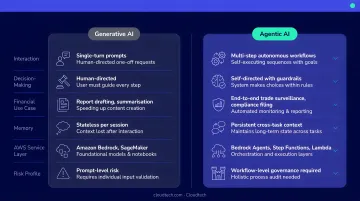
In practice, most modern financial AI platforms blend both approaches. The more useful question isn't which one to pick — it's which should lead in a given workflow, and what governance controls apply at each decision point.
What Is Generative AI in Financial Services?
Generative AI uses large language models trained on vast datasets to produce original content — text, summaries, structured reports, or code — in response to a user prompt. It is reactive by design: it doesn't initiate anything, and it doesn't follow through beyond that single output.
In financial services, the use pattern is straightforward. A compliance officer prompts it to summarize a 200-page regulatory filing. A loan officer uses it to draft a client-facing denial letter. A research analyst asks it to pull key metrics from a stack of earnings call transcripts.
The AI responds, but it doesn't check whether the letter was sent, the filing was filed, or the analyst acted on the summary. That's a design characteristic, not a flaw — and it makes generative AI well-suited for content-heavy, human-reviewed workflows.
Three operational benefits that matter most in financial services:
- Generates thousands of personalized customer notices without proportional headcount increases
- Condenses hours of document review into minutes through automated research synthesis
- Produces first drafts of regulatory documentation, policy interpretations, and audit summaries
Key Use Cases
Current production deployments include:
- Morgan Stanley launched AI @ Morgan Stanley Debrief, an OpenAI-powered tool that generates advisor meeting notes with client consent — a direct productivity gain in a compliance-sensitive context
- NatWest deployed Cora+, a generative AI upgrade to its retail banking digital assistant
- Moody's Research Assistant helps credit analysts navigate and synthesize research; Moody's reports users consume 60% more research while cutting task completion time by 30%, based on analysis of more than 100,000 user interactions
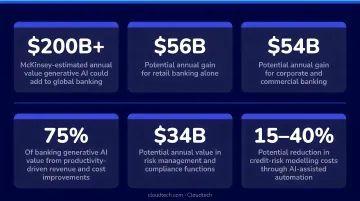
McKinsey estimates generative AI could add $200B–$340B annually to banking — roughly 9%–15% of operating profits. One reported example: a leading bank reduced investment brief production from 9 hours to 30 minutes.
The IIF-EY 2024 survey found that 80% of generative AI deployment in financial services is internal — non-customer-facing tasks like employee productivity, research, and compliance documentation. That concentration matters when comparing it to agentic AI, where the operational model — and the risk profile — shifts considerably.
What Is Agentic AI in Financial Services?
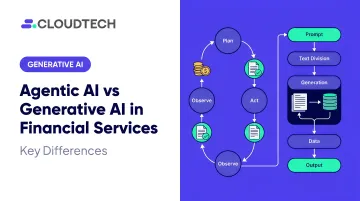
Agentic AI goes further than generating content. It perceives its environment, plans a sequence of actions, executes those actions across systems and APIs, and adapts based on what happens — all with minimal human intervention. The operating loop is: perceive → plan → act → learn.
IBM defines agentic AI as a system that can accomplish a specific goal with limited supervision, using AI agents that mimic human decision-making to solve multi-step problems. The key word is accomplish — not just describe or summarize.
The difference is clearest in action. When a suspicious transaction pattern is flagged, a generative AI system might produce a well-written alert. An agentic system goes further.
It cross-references transaction history, queries external risk databases, scores the risk autonomously, and freezes the account pending review — all within seconds, without a human initiating each step. That speed and autonomy is exactly why agentic AI carries more governance weight than generative AI.
What Agentic AI Actually Requires
Deploying agentic AI in financial services isn't just a model selection decision. It requires:
- Real-time data pipelines that feed current information into the agent's decision loop
- Secure API integrations with core banking systems, risk databases, and compliance tools
- Governance controls that define autonomy limits, escalation paths, and audit logging
- Infrastructure that can handle continuous operation at scale without performance degradation
The cloud foundation underneath these requirements is what determines whether an agentic system runs reliably or becomes a compliance liability. Cloudtech's AWS-certified architects work with financial services firms to build that infrastructure — the AWS landing zones, security controls, and data pipelines that agentic AI workloads depend on to operate within regulatory boundaries.
Key Use Cases
McKinsey identifies the highest-impact agentic AI applications in financial services as:
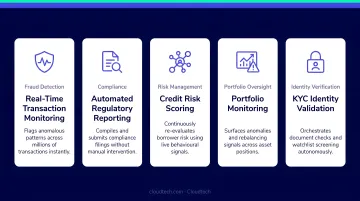
- Autonomous fraud detection — flagging, scoring, and acting on suspicious activity in real time
- Continuous KYC/AML compliance — running ongoing transaction monitoring and alert triage without manual queue management
- Real-time portfolio monitoring — watching positions against defined parameters and initiating rebalancing workflows
- Automated loan underwriting workflows — pulling applicant data across sources and routing applications based on risk scores
- Proactive customer outreach — alerting customers before an overdraft occurs, not after
Bank of England/FCA data puts that in perspective: automated decision-making appears in 55% of financial services AI use cases today, but only 2% are fully autonomous. Agentic AI is directionally where the industry is heading — full autonomy remains rare, and regulators intend to keep it that way.
Which Is Right for Your Financial Institution?
The choice isn't binary, but the decision factors are specific.
Four Questions That Drive the Choice
1. Task complexity — Is this a single-step content task, or a multi-step workflow requiring real-world action across systems? Single-step: generative AI. Multi-step with external execution: agentic AI.
2. Regulatory scrutiny — Does the output need human review before anything happens? If yes, generative AI with a human-in-the-loop is the lower-risk path. If the decision can be governed by pre-approved rules and still requires speed, agentic AI may be appropriate.
3. Data sensitivity — Does the workflow touch PII, trading data, or protected financial records? Both types of AI can handle sensitive data with proper controls, but agentic AI requires more granular access management because it acts on that data, not just reads it.
4. Required speed — Is real-time autonomous execution critical, or is human-in-the-loop acceptable? Fraud detection and compliance monitoring often need sub-second responses. Research synthesis and compliance drafting usually don't.
Situational Recommendations
| Scenario | Right Choice |
|---|---|
| Drafting customer communications at scale | Generative AI |
| Summarizing regulatory filings or earnings calls | Generative AI |
| KYC document generation and first-pass review | Generative AI |
| Real-time fraud detection with account action | Agentic AI |
| Continuous transaction monitoring and alert triage | Agentic AI |
| Automated loan underwriting across data sources | Agentic AI |
| Research synthesis before human decision | Generative AI |
| Portfolio rebalancing against defined risk rules | Agentic AI |
The Case for Combining Both
The most effective financial services AI architectures don't choose one — they sequence them. Consider loan underwriting: an agentic system detects an anomaly in an application, pulls credit history and financial records from multiple sources, and scores the risk against defined parameters. Generative AI then produces a structured underwriter summary that a human reviews before any final decision is made.
The agentic layer handles reasoning, data gathering, and execution. The generative layer handles content and communication. Used together, they cover the full workflow — from autonomous action to human-ready output.
The Governance Requirement
Agentic AI in financial services must be paired with:
- Audit trails that log every action the agent takes and why
- Explainability layers that can satisfy regulatory review for credit, compliance, or customer-impacting decisions
- Human override protocols with defined escalation paths for decisions outside the agent's pre-approved parameters
- Model risk management treatment, consistent with Federal Reserve SR 11-7 and OCC's revised 2026 model risk guidance
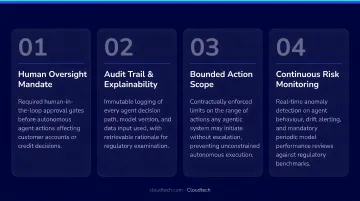
Firms that deploy agentic AI without these controls don't just face operational risk — they face regulatory exposure. The BIS has noted that limited explainability may require enhanced risk management, data governance, and human oversight as compensating measures.
Real-World Applications and Outcomes
The Moody's Research Assistant result — 60% more research consumed, 30% faster task completion — is the clearest published benchmark for what generative AI delivers in an investment research workflow. It's also an indicator of where agentic AI takes the next step: instead of helping an analyst find and synthesize research faster, an agentic system could monitor a portfolio continuously, flag when a credit event triggers a review threshold, and initiate the research pull automatically.
On the fraud and financial crime side, several major institutions have moved the needle with AI-assisted controls:
- Mastercard reports its generative AI can double detection speed for potentially compromised cards
- J.P. Morgan cut account validation rejection rates by 15%–20% through AI-assisted payment controls
- HSBC's Dynamic Risk Assessment applies AI internally for financial crime screening
These are AI-assisted workflows — not fully autonomous agents — but they show the direction the industry is heading.
Across these examples, the distinction holds: generative AI delivers immediate, measurable value in knowledge-intensive tasks. Agentic AI delivers compounding value in process-intensive tasks. Scaling either beyond pilot programs requires a cloud foundation built for production — not just experimentation.
For financial institutions moving from AI experimentation into production-grade deployment, the infrastructure layer — real-time pipelines, API integrations, governance controls, security architecture — is where readiness is decided.
Cloudtech works with financial services firms to assess and build that AWS foundation. If your organization is evaluating its readiness for AI workloads, connect with Cloudtech's team to start with an infrastructure assessment.
Conclusion
The choice between generative and agentic AI comes down to what your institution is ready to act on. Generative AI fits when financial professionals need intelligent assistance at scale — drafting, summarizing, synthesizing — with human review before anything is acted upon. Agentic AI fits when the institution is ready to automate multi-step decisions within governed parameters, at a speed humans can't match.
The right starting point depends on where your infrastructure actually stands. Firms with strong data quality, governance frameworks, and cloud architecture can move to agentic deployments with confidence. Firms still building those foundations will extract more value, and carry less risk, starting with generative AI for internal workflows.
The institutions gaining the most from AI aren't treating it as a single tool. They're building a layered architecture with each component serving a distinct purpose:
- Generative AI — the intelligence layer for content, drafting, and synthesis
- Agentic AI — the execution layer for automated, multi-step decisions
- Secure cloud infrastructure — the foundation that makes both viable at scale
Frequently Asked Questions
Which AI is best for financial services?
There's no single answer. Generative AI is best for content-heavy, research, and communication workflows where human review precedes action. Agentic AI is better suited for autonomous, multi-step operational tasks like fraud detection or continuous KYC monitoring. Most institutions with mature AI programs are deploying both.
What is the difference between generative AI and agentic AI in banking?
Generative AI reacts to prompts to produce content — summaries, reports, customer messages. Agentic AI proactively plans and executes tasks across systems with minimal human input. The core difference is agency: one produces output, the other takes action.
How does agentic AI affect financial services?
Agentic AI shifts financial services from rule-based automation to adaptive decision execution. It enables real-time fraud response, continuous compliance monitoring, and autonomous workflow management that previously required significant analyst time and manual coordination.
Can generative AI and agentic AI work together in financial services?
Yes, and they're highly complementary. Agentic AI handles reasoning, planning, and execution across systems while generative AI handles content production within those workflows. A common pattern: an agentic system completes the data gathering, and generative AI drafts the structured summary for human review.
What are the main risks of deploying agentic AI in banking?
The key risks include:
- Lack of explainability for regulatory audits
- Model drift as market conditions change
- Data privacy concerns when agents access sensitive customer records
- Over-automation without adequate human-in-the-loop controls
Governance frameworks need to address all four areas — and they should be built before deployment, not retrofitted after an incident.