Enterprise AI chatbots close that gap. Not as a technology experiment, but as an operational layer that handles thousands of simultaneous interactions, integrates with existing business systems, and delivers measurable reductions in cost-per-interaction and resolution time.
This article breaks down what enterprise AI chatbots actually are, the advantages that drive real business outcomes, and the use cases generating the clearest return.
Key Takeaways
- Enterprise AI chatbots automate high-volume interactions and connect to CRMs, ERPs, and knowledge bases to take real action, not just answer questions
- Enterprise-grade solutions handle complex multi-turn conversations across channels with security and compliance controls built in
- Documented deployments show containment rates of 57–80%, with wait times cut from hours to seconds
- Core use cases include customer support, employee self-service, sales enablement, and industry-specific workflows in healthcare and financial services
- ROI scales with volume: the more interactions, geographies, and complexity involved, the faster the payback
What Is an Enterprise AI Chatbot?
An enterprise AI chatbot is a conversational system designed to handle large volumes of customer or employee interactions at scale — while connecting directly to business systems to take action on those interactions. It doesn't just answer questions; it retrieves live account data, triggers workflows, books appointments, and escalates to human agents with full context already populated.
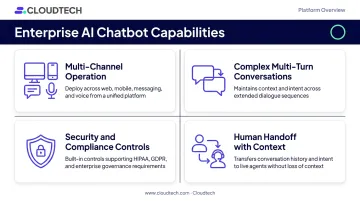
Enterprise-grade chatbots differ from basic ones across four key capabilities:
- Multi-channel operation across web, mobile, messaging apps, and voice simultaneously
- Complex multi-turn conversations that maintain context across a session, not just single Q&A exchanges
- Security and compliance controls meeting requirements like HIPAA and GDPR from the architecture up
- Human handoff with context so escalated cases don't start over from scratch
The result is an operational layer between users and your business systems — one that lets employees and customers get things done through conversation, without switching between portals or waiting for an available agent.
Key Advantages of Enterprise AI Chatbots
Each advantage below ties to a measurable outcome. The impact compounds as interaction volume, geographic complexity, and business scale increase.
24/7 Availability at Scale
Enterprise AI chatbots operate continuously across time zones, channels, and languages. A single deployment can handle thousands of simultaneous conversations — maintaining the same response quality at 3 AM on a holiday weekend as during peak business hours.
This matters because availability gaps are directly costly. Customers who can't get answers don't wait patiently — they churn. For global organizations, always-on availability also eliminates the cost and complexity of regional support hubs.
KPIs impacted: First response time, after-hours resolution rate, CSAT, cost-per-interaction
When it matters most:
- Healthcare organizations fielding patient inquiries outside clinical hours
- Financial services firms managing account questions across time zones
- Retail and e-commerce businesses absorbing seasonal volume spikes
- Any organization operating across multiple regions
Ryanair's Amazon Lex deployment handled 3 million conversations across five languages — the kind of volume that no staffed support model could absorb at comparable cost.
Operational Efficiency and Cost Reduction
Enterprise AI chatbots generate savings by automating the high-volume, repetitive requests that consume most agent time, freeing human capacity for complex cases that actually require judgment.
Password resets, account balance inquiries, order status checks, benefits questions, PTO requests: these interactions resolve in seconds without tickets or queue wait times. The production numbers below show what that looks like at scale.
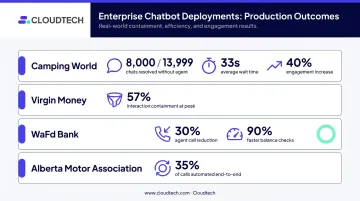
Documented outcomes from production deployments:
- Camping World resolved 8,000 of 13,999 retail chats without agent transfer, cutting wait times to 33 seconds and increasing engagement by 40%
- Virgin Money's Redi virtual assistant contained 57% of customer interactions at peak
- WaFd Bank reduced agent call volume by 30% and cut balance-check time by 90% using Amazon Lex
- Alberta Motor Association automated 35% of calls end-to-end with Amazon Lex
KPIs impacted: Cost-per-contact, containment rate, agent handle time, headcount per interaction volume
Consistent, Personalized Experiences Across Every Channel
When responses vary by channel, agent, or time of day, customers notice — and it erodes trust. In regulated industries, off-script responses aren't just a customer experience problem; they're a compliance liability.
Enterprise AI chatbots solve this by pulling from centralized knowledge bases, CRM data, and defined business rules to deliver the same accurate, policy-compliant response regardless of where or when the interaction happens.
79% of customers expect consistent interactions across departments, yet 55% say interactions feel like they're dealing with separate companies. That gap is particularly high-stakes in financial services, where FINRA's Rule 2210 communication standards apply whether content is produced by a human or an AI system — meaning inconsistent AI-generated responses carry the same regulatory weight as inconsistent agent responses.
KPIs impacted: CSAT, NPS, escalation rate, cross-channel resolution consistency, compliance audit outcomes
When it matters most:
- Enterprises operating across multiple regions or languages
- Healthcare and financial services organizations where policy consistency is non-negotiable
- Businesses managing omnichannel support across web, social, and voice
Enterprise AI Chatbot Use Cases by Function
Customer Support Automation
Chatbots handle first-contact resolution for account inquiries, order status, billing questions, and troubleshooting, escalating complex cases to human agents with full conversation context already populated. This reduces average handle time on escalated cases and eliminates queue wait for routine ones.
Gartner's research shows only 14% of customer service issues are currently fully resolved through self-service. Enterprise AI chatbots push that number significantly higher. The Camping World and Virgin Money deployments cited above show 57–80% containment is achievable in production environments.
Employee Self-Service for HR and IT
Internally deployed chatbots handle the questions that consume disproportionate IT and HR team time:
- Benefits questions and PTO requests
- Company policy lookups
- Password resets and software access requests
- Onboarding guidance and new hire FAQs
IBM's internal AskHR deployment handles 80+ HR tasks and manages more than 2.1 million employee conversations annually, with 94% containment for common inquiries and a 75% reduction in support tickets since 2016. That ROI profile — measurable containment gains with no headcount increase — is exactly why internal self-service has become one of the fastest-growing chatbot deployment categories.
Sales Enablement and Lead Qualification
Sales-focused chatbots engage website visitors around the clock: asking qualifying questions, surfacing relevant product information, and booking meetings directly into sales rep calendars. Leads arrive with conversation summaries already captured, so reps start informed, not cold.
For SMBs without round-the-clock sales coverage, this matters. A chatbot captures and qualifies a 2 a.m. website visitor the same way it handles a midday one — no leads lost to after-hours gaps.
Industry-Specific Workflows
Healthcare: Chatbots automate appointment scheduling, patient intake, symptom triage guidance, and routine query resolution. Cloudtech's HealCall platform documents 95%+ accuracy in automated patient query resolution and a 50% reduction in patient wait times through AI-powered automation integrated with EHR systems. Cloudtech has also deployed HIPAA-compliant AI voice agents handling 2,500–5,000 calls per month for healthcare BPO clients, with intelligent escalation to clinical staff for complex cases.
Financial Services: Chatbots handle account balance inquiries, password resets, portfolio holdings, and compliance-driven disclosures. FINRA documents firms using NLP-based tools for basic account queries and client message classification, with the caveat that Rule 3110 supervision requirements and books-and-records obligations apply to AI-generated communications.
Manufacturing: Internal chatbots support operations queries, supply chain lookups, vendor communication, and equipment troubleshooting. One common deployment pattern: a single internal bot handling shift-change handoffs, parts lookup, and maintenance ticket creation — functions that previously required manual coordination across multiple systems. The result is less administrative drag on operations staff without adding headcount.
How to Get the Most Value from Enterprise AI Chatbots
Start Narrow, Then Expand
The deployments with the clearest ROI begin with a specific, bounded use case — billing inquiry automation, IT password reset flows, appointment scheduling — with defined success metrics before expanding scope. Containment rate, CSAT for automated interactions, and cost-per-contact are the three metrics that matter most in early deployments.
Vague deployment goals produce vague results. Pick one workflow, measure it precisely, and expand from there.
Integrate Deeply from Day One
A chatbot that doesn't connect to your CRM, ERP, or knowledge base can only answer generic questions. The value multiplies when the chatbot can retrieve real data, trigger workflows, and personalize responses based on what it already knows about the user.
That requires upfront integration planning — not post-deployment patching. Organizations that treat integration as an afterthought end up with a sophisticated FAQ bot instead of an operational layer.
Build on Infrastructure That Scales Securely
For organizations building on AWS, deploying chatbot infrastructure through Amazon Lex and Amazon Bedrock within a well-architected cloud environment ensures the solution scales securely and connects cleanly with other business systems. Bedrock's Knowledge Bases capability supports RAG-based architectures that ground chatbot responses in verified enterprise data — a critical requirement for accuracy and compliance in regulated industries like healthcare and financial services.
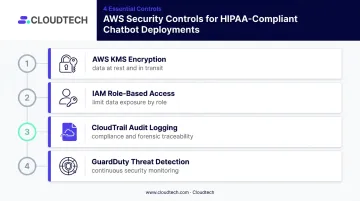
HIPAA-compliant deployments on this stack typically incorporate security controls such as:
- AWS KMS encryption for data at rest and in transit
- IAM role-based access to limit data exposure by user role
- CloudTrail audit logging for compliance and forensic traceability
- GuardDuty threat detection for continuous security monitoring
Working with an AWS Advanced Tier Partner ensures these controls are architected correctly from the start, not retrofitted after go-live.
Conclusion
Enterprise AI chatbots deliver compounding operational value when deployed against specific use cases, measured with the right KPIs, and integrated with the business systems that give them real context to act on. The result: lower costs, faster response times, and more consistent customer experiences across every touchpoint.
The organizations seeing the strongest results treat enterprise AI chatbots as an evolving system, not a one-time deployment. They refine flows, expand use cases, and extend coverage as business needs change. The initial go-live matters, but the ROI builds through ongoing iteration — refining what works, retiring what doesn't, and expanding scope as confidence grows.
Frequently Asked Questions
What are enterprise AI solutions?
Enterprise AI solutions are advanced systems designed to automate complex processes, analyze data at scale, and support decision-making across large organizations. They span tools like AI chatbots, predictive analytics, and automation workflows — all built to integrate with existing infrastructure and meet enterprise security and compliance standards.
What are the best enterprise conversational AI platforms?
The best platform depends on your use case, deployment model, and existing tech stack. AWS-native options like Amazon Lex and Bedrock suit teams already on AWS, while platforms like Kore.ai, Cognigy, and Rasa serve enterprises needing deep customization or on-premise deployment. Integration capability and security compliance matter more than feature lists .
What is the difference between a standard chatbot and an enterprise AI chatbot?
Standard chatbots follow simple scripts and handle limited, single-channel tasks. Enterprise AI chatbots use NLP and machine learning to manage complex multi-turn conversations, integrate with backend systems, operate across multiple channels simultaneously, and meet strict security and compliance requirements that basic tools were never designed to address.
What industries benefit most from enterprise AI chatbots?
Healthcare, financial services, retail and e-commerce, and manufacturing see the strongest results. These industries share a common driver: high interaction volume, strict compliance requirements, or the need for 24/7 service coverage that human teams alone can't sustain.
How do enterprise AI chatbots integrate with existing business systems?
Enterprise AI chatbots connect to CRMs, ERPs, HR platforms, knowledge bases, and ticketing tools through APIs and data connectors — enabling real-time data retrieval, workflow triggering, and personalized responses. Integration depth is what separates enterprise chatbots from basic automation — without it, the tool can answer questions but can't act on them.
How much does it cost to implement an enterprise AI chatbot?
Costs vary based on platform choice, deployment model, integration complexity, and maintenance needs. Cloud-based options on AWS are typically priced per interaction volume, while custom-built solutions require more upfront investment. Factor in total cost of ownership — setup, integration, and ongoing maintenance — not just the platform license.