Introduction
Healthcare organizations are under pressure from every direction. The AAMC projects a shortage of up to 86,000 physicians by 2036, while HRSA forecasts deficits of over 100,000 registered nurses by 2038. Patient volumes keep climbing. Expectations for round-the-clock responsiveness haven't budged.
Conversational AI is stepping into this gap. It's handling appointment bookings at 2 a.m., answering billing questions before staff arrive, and following up with patients after discharge — not perfectly, and not without risk, but at a scale that's impossible to match with headcount alone.
This article covers where conversational AI creates genuine value in healthcare, what derails deployments, and what responsible implementation actually requires.
What Is Conversational AI in Healthcare?
Conversational AI enables machines to hold natural dialogue using natural language processing (NLP), machine learning (ML), and large language models (LLMs). Unlike older rule-based chatbots — which follow rigid, pre-scripted decision trees — these systems interpret context, intent, and nuance, and get better with use.
In healthcare, that capability has to meet a much higher standard. These systems must:
- Interpret clinical language accurately
- Connect to sensitive patient data systems (EHRs, scheduling platforms, billing systems)
- Operate under strict regulatory requirements including HIPAA
- Escalate appropriately when queries exceed their capability or confidence
It's also useful to separate conversational AI from agentic AI. Conversational AI handles dialogue and communication; agentic AI can autonomously plan and execute multi-step tasks. The two often work in tandem — a conversational interface that collects patient intake data and triggers downstream scheduling workflows is one practical example — but they carry different risk profiles and require different governance frameworks.
Key Opportunities: Where Conversational AI Is Transforming Care
Healthcare has more to gain from conversational AI than most industries. The combination of high communication volume, severe administrative overload, and time-sensitive patient engagement makes it one of the clearest use cases for AI — provided implementation is deliberate.
Scheduling and Administrative Workflows
Appointment no-show rates average 5% to 7% across U.S. practices, representing significant revenue loss and wasted clinical capacity. Automated systems address this through:
- Automated appointment booking, confirmation, and rescheduling available 24/7
- Proactive reminder sequences that reduce no-show rates
- Inbound call handling for routine requests without staff involvement
- Billing questions, insurance inquiries, and intake forms handled through AI-powered chat
One academic medical center reported a 65% reduction in operator call volume after deploying AI voice routing, with over 123,000 staff hours freed annually. These are vendor-reported figures, not industry benchmarks — but they reflect the direction of the opportunity.
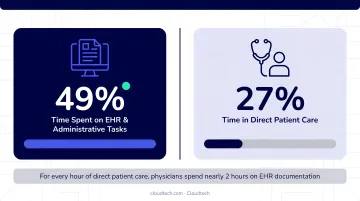
The administrative time drain is real: physicians in ambulatory settings spend nearly 50% of their time on EHR and desk work, compared to 27% on direct patient care. Any system that absorbs routine communication tasks moves those percentages in the right direction.
Symptom Triage and Clinical Decision Support
AI-driven triage tools guide patients through structured symptom assessments and route them to appropriate next steps — self-care, a virtual consult, or an in-person visit. Up to 60% of ED visits are considered non-urgent, which means there's a real opportunity to redirect patients before they reach the emergency department.
A 2025 review found that machine-learning triage tools reduced mis-triage rates by 0.3% to 8.9%. One symptom assessment app showed 94.7% agreement with the Manchester Triage System — but also an 8.9% undertriage rate. That undertriage figure matters: in clinical contexts, it's not just an accuracy problem, it's a safety problem.
The practical implication: triage AI must be protocol-driven, validated, and paired with clear escalation paths to licensed clinical staff. Relying on LLM-generated responses alone for symptom assessment is not a defensible approach.
Post-Visit Follow-Up and Chronic Care Management
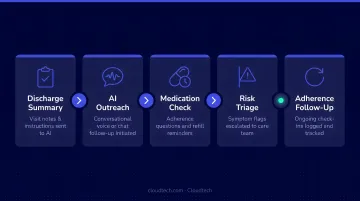
Medication non-adherence costs the U.S. healthcare system an estimated $949 to $44,190 per person annually, depending on the condition. Automated follow-up creates a scalable channel for tasks that would otherwise consume clinical staff time:
- Automated medication reminders
- Recovery check-ins after procedures
- Care plan adherence prompts
- Preventive health nudges tailored to the patient's history
When AI assistants pull directly from EHR data, follow-up messages reflect the patient's specific conditions, recent visit context, and care plan — making outreach more relevant without adding clinical staff time.
Mental Health Support and Language Accessibility
40% of the U.S. population — roughly 137 million people — lives in a Mental Health Professional Shortage Area, according to HRSA. Between clinical visits, AI-powered tools can provide mood check-ins, guided self-care prompts, and crisis pathway routing — supplementing care without replacing it.
A 2023 meta-analysis in Nature Digital Medicine covering 15 randomized trials found AI conversational agents significantly reduced depression (g=0.33) and anxiety (g=0.31). Worth noting: only 15 of 35 included studies had safety assessments or crisis identification measures. The evidence base is growing — but deployment requires defined safety protocols, crisis escalation workflows, and ongoing monitoring to be clinically defensible.
Multilingual capability is a related opportunity. With 25.7 million people in the U.S. having limited English proficiency, AI tools that support real-time language translation can expand access for underserved populations — addressing both a clinical gap and a health equity gap simultaneously.
Key Challenges of Conversational AI in Healthcare
Conversational AI in healthcare carries real promise — and real risk. Understanding where implementations fail is how you avoid becoming a cautionary example.
Accuracy and Hallucination Risk
A 2025 study in npj Digital Medicine analyzing nearly 13,000 clinician-annotated sentences found 1.47% hallucination and 3.45% omission rates in LLM-generated clinical summaries. More concerning: 44% of hallucinations were categorized as major, meaning they could affect diagnosis or management if left uncorrected.
In most industries, a 1.47% hallucination rate is manageable. In healthcare, it's a patient safety issue. Systems must include:
- Validated clinical content rather than open-ended generative responses for high-stakes interactions
- Human review workflows for clinical-adjacent content
- Clear escalation paths when AI confidence falls below defined thresholds
Data Privacy and Security
Any conversational AI system that handles, stores, or transmits protected health information (PHI) must meet HIPAA requirements. HHS reported 742 breach reports through its HIPAA Breach Web Portal in 2024. The global average cost of a data breach reached $4.4 million in 2025 according to IBM.
Three compliance requirements are most often missed in AI deployments:
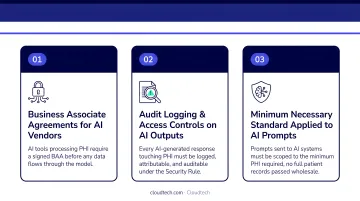
- Signed BAAs: Every vendor that touches PHI needs a Business Associate Agreement — no exceptions
- ePHI scope awareness: HHS guidance is explicit that cloud providers maintaining ePHI are business associates even without the decryption key
- Audit logging: Conversational AI interactions involving PHI must be traceable and retrievable for compliance review
Health Equity and Algorithmic Bias
AI trained on non-representative data produces inaccurate or generalized responses that disproportionately affect patients with limited digital literacy, non-English speakers, and underserved populations. HHS Section 1557 applies nondiscrimination principles to patient care decision support tools — meaning algorithmic bias in clinical contexts carries regulatory exposure, not just ethical concern.
NIST SP 1270 identifies three categories of AI bias (systemic, statistical, and human) and recommends a socio-technical approach to managing them. Inclusive dataset design and ongoing content oversight are not optional for healthcare deployments.
Integration Complexity and Staff Adoption
91% of office-based physicians have adopted certified EHRs, but AI readiness is another matter. A 2024 HIMSS/Medscape report found that 86% of respondents already use AI in medical operations — but only 24% say their staff have the necessary AI skills.
Poorly integrated AI tools create the problems they're supposed to solve: data silos, contradictory information, and workflow friction.
Staff adoption challenges typically trace back to unclear role boundaries, insufficient training, and low trust in AI outputs. The concern that AI will replace clinical roles is legitimate — and it doesn't go away on its own. Addressing it requires explicit role definitions, documented escalation paths, and early wins that demonstrate value without threatening existing workflows.
HIPAA Compliance and Data Security in Conversational AI Deployments
HIPAA compliance for conversational AI means more than checking a box. Technically, compliant deployments require:
- Encryption of ePHI in transit and at rest
- Access controls with role-based permissions
- Audit logs that trace every AI decision — what input was received, what action was taken, and why
- Signed BAA with every vendor in the data chain
The cloud versus on-premises question matters here. Cloud deployments offer scalability and reliability, but healthcare organizations need full visibility into data residency, model inference, and log access. Hybrid models can balance these requirements — and AWS offers 150+ HIPAA-eligible services including Amazon Bedrock, Comprehend Medical, HealthLake, and Amazon Connect, which can support compliant conversational AI architectures when configured correctly.
Access to HIPAA-eligible services doesn't make a deployment HIPAA-compliant. The architecture, access controls, logging, and vendor agreements all have to be in place — this is where the technical decisions separate compliant deployments from ones that merely look compliant on paper.
Working with an AWS-certified partner like Cloudtech makes a material difference here. Cloudtech builds conversational AI voice and chat solutions (including autonomous inbound call handling and AI-powered chat agents) directly within the client's own AWS environment, keeping PHI in-house and ensuring compliance requirements are addressed at the infrastructure level rather than as an afterthought.
Beyond HIPAA, responsible deployment requires:
- Curated training data with documented provenance
- Configurable data retention and deletion policies
- Role-based access controls down to the individual use case
- Mechanisms to detect and correct bias in AI outputs over time
Audit trail transparency is non-negotiable: compliance, clinical, and engineering teams need to be able to review AI behavior, not just trust that it's working correctly.
Getting Started: Implementation Considerations for Healthcare Organizations
For healthcare SMBs, the most practical path into conversational AI follows a clear sequence.
Start with Low-Risk, High-Volume Use Cases
Before deploying AI in clinical triage or diagnostic support, start with:
- Appointment scheduling and rescheduling
- Automated reminders and no-show follow-up
- FAQ handling (hours, locations, insurance coverage)
- Post-visit care plan reminders
These use cases generate measurable ROI data, build organizational confidence, and create the infrastructure foundation that clinical use cases will eventually require. The gap between "we have an AI chatbot" and "we have a validated, HIPAA-compliant AI system integrated with our EHR" is significant.
What to Evaluate in a Conversational AI Solution
When assessing platforms, these criteria matter most in healthcare:
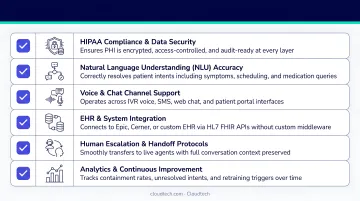
- HIPAA compliance and BAA availability — confirm before any PHI touches the system
- EHR integration capabilities — API-level integration, not surface-level workarounds
- Deployment flexibility — cloud, hybrid, or on-premises depending on your environment
- Auditability — can you trace every AI decision and output?
- Multilingual support — essential for diverse patient populations
- Vendor transparency — avoid black-box platforms where the AI's logic cannot be inspected or governed
The Infrastructure Foundation
Conversational AI in healthcare is only as secure and scalable as the cloud architecture beneath it. Healthcare SMBs — which often lack dedicated cloud engineering resources — benefit from working with an AWS consulting partner to ensure AI workloads run on properly configured, HIPAA-eligible infrastructure rather than piecing together patchwork solutions independently.
Cloudtech's conversational AI voice agents — built on Amazon Connect, Amazon Transcribe, and Amazon Bedrock — handle inbound calls with human handoff in under two seconds when confidence drops below a defined threshold. Every deployment runs within the client's own AWS environment, not a shared SaaS platform. That distinction matters directly for HIPAA compliance and long-term data governance.
Healthcare organizations beginning this evaluation can work with Cloudtech's team to scope an implementation plan aligned to existing systems, compliance requirements, and patient volume.
Frequently Asked Questions
Is ChatGPT for healthcare HIPAA compliant?
ChatGPT in its standard consumer form is not HIPAA compliant. OpenAI offers BAAs for eligible ChatGPT Enterprise and API customers, but a BAA alone is not sufficient — compliance requires the right deployment configuration, data access controls, and technical safeguards.
What are some examples of conversational AI in healthcare?
Common examples include AI-powered appointment scheduling bots, symptom triage chatbots, automated post-visit follow-up messaging, medication reminder assistants, multilingual patient intake tools, and AI voice agents that handle inbound calls and route callers to appropriate staff.
What kind of AI is being used in healthcare?
The main categories in use are conversational AI (chatbots, virtual assistants), predictive analytics, diagnostic AI (imaging and pattern recognition), and clinical decision support tools. Conversational AI is growing fastest, driven by its direct patient-facing applications and wide administrative use.
Can conversational AI replace doctors or nurses?
No. Conversational AI handles routine communication and administrative tasks so clinical staff can focus on complex, judgment-intensive care. The AAMC projects physician shortages of 86,000 by 2036; the goal is to extend clinical capacity, not replace it.
How is conversational AI different from a regular chatbot?
Traditional chatbots follow rigid, pre-scripted decision trees. Conversational AI uses NLP and machine learning to understand context, intent, and nuance , enabling more flexible, human-like interactions that improve over time and handle a wider range of queries without breaking down.
What are the biggest challenges of implementing conversational AI in healthcare?
The top challenges are ensuring HIPAA compliance (including BAA coverage), managing hallucination and accuracy risks in clinical contexts, achieving meaningful EHR integration, addressing algorithmic bias, and driving staff adoption with clear role definitions and sufficient training.