Introduction
Most conversational AI deployments don't fail at the technology layer. They fail at go-live — systems that confidently generate wrong answers, escalation paths that trap users in loops, integrations that break within weeks. The gap between what was promised and what actually shipped tends to be wide.
The numbers back this up. Gartner forecast that at least 30% of generative AI projects would be abandoned after proof of concept by the end of 2025, citing poor data quality, inadequate risk controls, and unclear business value as the leading causes. For conversational AI specifically, the pattern is consistent: most failures aren't technological — they're operational.
What follows is a practical breakdown of where implementations go wrong, what separates deployments that hold up from those that don't, and how to measure whether your system is actually working once it's live.
Key Takeaways
- Implementation failures cluster into three categories: technical, operational, and organizational — rarely just one
- GDPR, HIPAA, and CCPA compliance must be built into the architecture before deployment, not retrofitted later
- Start narrow: train on high-quality, structured data and expand through deliberate feedback loops
- Cloud infrastructure choices determine whether your system scales reliably or collapses under load
- Track resolution quality, CSAT, and escalation accuracy alongside (not instead of) deflection rate
The Top Challenges in Implementing Conversational AI
The most damaging challenges rarely show up during vendor demos. They surface after launch, when real users interact with the system in ways the demo never anticipated. These challenges group into three categories: technical, operational, and organizational.
NLP Accuracy and Hallucination Risks
Conversational AI models predict statistically likely responses — they don't verify facts. This is why hallucinations happen. An unconstrained AI will generate plausible-sounding answers with full confidence, even when those answers are wrong.
McKinsey found that 44% of organizations reported at least one negative consequence from generative AI use, with inaccuracy cited as the most common risk. Once a customer receives a confidently wrong answer, trust erodes quickly.
The solution is architectural, not cosmetic. Retrieval-augmented generation (RAG) constrains the AI to a verified, curated knowledge base rather than relying on open-ended model outputs. This isn't a prompt engineering fix — it's a foundational design decision that must be made before development begins.
Knowledge Base Decay and Fragmented Documentation
Even a well-designed system degrades if its source material does. "Knowledge base rot" happens gradually: new documents get added, old ones stay live, policies conflict, and the AI starts returning inconsistent answers — not because the model worsened, but because its inputs did.
Best practices to prevent this:
- Designate a single authoritative source for each content domain
- Archive outdated material on a defined schedule rather than leaving it accessible
- Establish update cadences — weekly minor reviews and quarterly audits validated by subject matter experts
- Tag content by expiration date so stale material gets flagged automatically
Poor Escalation Design and Human Handoff Failures
The most common chatbot failure isn't a wrong answer — it's a user trapped in a loop with no exit. When customers type "HUMAN" and nothing happens, brand trust collapses. This happens when teams optimize purely for deflection and treat escalation as an afterthought.
Effective escalation logic requires:
- Confidence-based thresholds that trigger immediate handoff when the AI's certainty drops below a defined level
- Full context passing so the human agent receives the complete conversation history without the customer repeating themselves
- A visible, always-accessible escape route at every point in the conversation — not buried in a menu
Data Privacy and Compliance Requirements
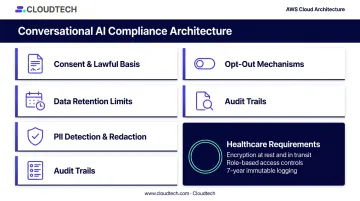
Conversational AI systems process sensitive customer data by design, which triggers obligations under GDPR, CCPA, and HIPAA. The key requirements aren't optional:
- Explicit consent or a documented lawful basis for data processing
- Clear opt-out mechanisms for consumers
- Defined data retention limits with enforcement at the system level
- PII detection and redaction protocols built into the pipeline
- Audit trails for all conversations involving sensitive data
Healthcare and financial services organizations face the highest exposure. Healthcare deployments, for example, typically require encryption at rest and in transit, role-based access controls, and immutable audit logging retained for seven or more years — none of which can be retrofitted cheaply after launch. Embedding these controls at the architecture phase is the difference between a compliant system and an expensive remediation project.
User Adoption Resistance
Internal support teams often resist AI when it creates rework rather than reducing it. Agents need to see the system absorbing repetitive volume before they trust it — an operational problem with an operational fix. Start with high-frequency, low-complexity queries that demonstrate clear capacity relief before expanding scope.
Customer trust follows a different logic. It depends on transparency — the system identifies itself as AI — and predictable behavior: smooth handoffs, no dead ends, no simulation of human empathy the system can't actually deliver.
Why Infrastructure and Systems Integration Can Make or Break Your Implementation
Conversational AI doesn't operate in isolation. It must connect to CRMs, ticketing systems, databases, and communication channels. When those connections are poorly designed, the experience fragments: agents receive no context, customers repeat themselves, and data gets siloed across systems.
MuleSoft's 2025 Connectivity Benchmark report found that 95% of IT leaders identified integration as a hurdle to implementing AI effectively. That's unsurprising: most enterprise systems were never designed to support AI-driven workflows at this level of complexity.
Legacy System Integration
Legacy systems create specific problems. The AI must do more than answer questions — it needs to retrieve account data, update records, and route inquiries. That requires reliable API connectivity across systems that were never designed to expose those endpoints cleanly.
Common failure points:
- Missing or undocumented APIs that require custom middleware
- Authentication protocols that block programmatic access
- Data formats that don't map cleanly to AI input requirements
- Rate limits that create latency under load
AWS-Native Architecture for SMBs
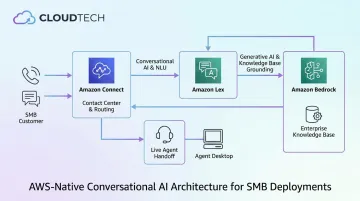
For SMBs building on AWS, three services form a well-architected foundation:
| AWS Service | Role in Conversational AI |
|---|---|
| Amazon Lex | Conversational interface using speech recognition and natural language understanding |
| Amazon Bedrock | Foundation model access and managed RAG over enterprise knowledge bases |
| Amazon Connect | Cloud contact center with native Lex integration for voice and chat routing |
Bedrock's Knowledge Bases can return generated answers with source citations — reducing hallucination risk by grounding answers in verified source documents. Lex integrates natively with Connect, so conversation flows hand off between automated and live-agent interactions without losing context. SMBs working with an AWS Advanced Tier Partner can access pre-configured architecture patterns across these services, reducing setup complexity without needing a large internal engineering team.
Scalability Under Variable Load
Traffic spikes from peak seasons, marketing campaigns, or viral moments can overwhelm on-premise or underprovisioned deployments. Cloud-native architectures absorb that variability through auto-scaling — but plan for it in advance:
- Identify expected peak concurrency before selecting service tiers
- Evaluate Amazon Lex runtime quotas against projected peak volume
- Request quota increases ahead of go-live, not after the first surge
Best Practices for Overcoming Conversational AI Implementation Challenges
Successful implementations share one operating principle: start narrow, validate thoroughly, and expand deliberately.
Define Clear Goals and Map to Measurable KPIs Before Building
A generic chatbot is almost always the wrong starting point. Define the primary use case first — support deflection, lead qualification, transactional processing, or appointment scheduling. Each requires different training data, different escalation logic, and different success metrics.
Connect every use case to a measurable outcome:
- Support deflection → resolution rate, repeat contact reduction
- Lead qualification → meeting-booked rate, handoff accuracy
- Transactional flows → completion rate, abandonment rate
- Appointment scheduling → booking rate, no-show reduction
Establish baseline metrics before launch. Without pre-deployment benchmarks, before/after comparisons are meaningless.
Train on High-Quality, Structured Data — Not Everything You Have
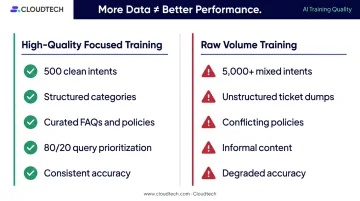
Apply the 80/20 rule: identify the top 20% of queries that drive 80% of support volume and train on those first. Organize content into clear intent categories — Billing, Returns, Account Changes — using FAQs, decision trees, and structured policies with if/then rules.
More data does not mean better performance. Training on conflicting policies, informal Slack threads, or outdated PDFs introduces noise that degrades accuracy. A 500-intent model built on clean, categorized data will outperform a 5,000-intent model trained on raw ticket dumps.
Use Phased Rollouts with A/B Testing Before Full Deployment
Roll out to 5–10% of users first. Test intent recognition accuracy, escalation trigger accuracy, and response quality before expanding. A failure affecting 5% of users is recoverable — one affecting 100% at launch causes reputational damage that's far harder to walk back.
A/B testing during phased rollouts also generates real behavioral data that demo environments never provide. Don't skip this step because the sandbox looked clean.
Design for Empathy, Not Just Efficiency
The AI should open every interaction by identifying itself as AI and stating clearly what it can and cannot help with. When it hits its limits, use language that acknowledges the situation: "I understand this is frustrating — let me connect you with someone who can help" lands differently than a generic error message.
Apply progressive disclosure throughout:
- Start with simple options, not a wall of menu choices
- Reveal complexity only as the conversation requires it
- Keep the human escalation path visible at all times
Establish Continuous Feedback Loops for Ongoing Improvement
Review every conversation where the AI failed to resolve the issue. These cases reveal specific gaps — missing knowledge, incorrect intent classification, broken escalation routing — that aggregate data alone won't surface.
Build in simple thumbs-up/thumbs-down feedback on responses and review that signal weekly or biweekly. The gaps you find this way — specific failed intents, broken handoffs, missing knowledge — are what separate a stagnant bot from one that actually improves over time:
- Flag every unresolved conversation for manual review
- Track failed-intent rates by category, not just overall
- Schedule model updates on a fixed cycle, not just when complaints spike
Building a Governance and Measurement Framework
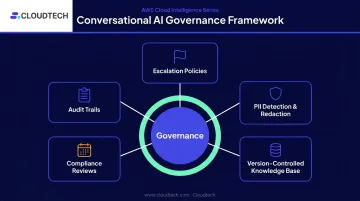
Scaling conversational AI without governance doesn't reduce cost — it multiplies risk. Without documented control over what the system can say, what actions it can take, and when it must escalate, every new deployment adds a new failure point.
A governance framework should include:
- Defined escalation policies with documented confidence thresholds
- PII detection and redaction protocols enforced at the pipeline level
- Version-controlled knowledge base updates with rollback procedures
- Regular compliance reviews tied to regulatory change cycles
- Audit trails for all conversations, especially those involving sensitive data
Measuring Success Beyond Deflection Rate
High deflection with poor resolution is worse than no AI at all. It leaves customers frustrated, still needing human help, with no clear way to get it.
Track these metrics together:
| Metric | What It Measures |
|---|---|
| Automation rate | Conversations completed without human handling |
| Resolution rate | AI-handled conversations with a resolved outcome |
| First contact resolution (FCR) | Issues resolved in a single interaction |
| CSAT | Post-interaction satisfaction scores |
| Repeat contact reduction | Change in repeat contacts versus baseline |
| Escalation success rate | Escalations that reach the right agent with full context |
| False positive rate | Incorrect intent matches or false resolutions |
Automated Testing and Rollback Procedures
Run nightly test suites against known input/output pairs to catch accuracy degradation before it reaches users. A documented rollback procedure ensures that when an update causes issues, recovery is fast and predictable.
At minimum, test suites should cover:
- Correct intent classification across your highest-volume topics
- Edge cases where user phrasing deviates from training data
- Escalation triggers to confirm handoffs fire at the right confidence thresholds
- Regression checks after any knowledge base update
Common Mistakes to Avoid During Conversational AI Implementation
Three patterns consistently derail conversational AI projects — often well after launch.
"Set it and forget it" ownership. Teams that treat deployment as the finish line watch performance erode within weeks as policies shift, products launch, and customer language evolves. Knowledge management, monitoring, and iteration are ongoing operational functions — not one-time project tasks.
Chasing deflection over resolution. A high deflection rate with poor resolution quality produces a worse customer experience than no AI at all. Deflection only adds value when the issues being deflected are actually getting resolved.
Skipping the infrastructure readiness check. Deploying without assessing whether your cloud environment can support conversational AI leads to latency problems, integration failures, and security gaps. Before selecting a platform or starting training, run a technical readiness review covering data architecture, API availability, and compliance posture.
Frequently Asked Questions
What are the most common challenges in implementing conversational AI?
Poor knowledge base quality, weak escalation design, integration complexity with existing systems, and data privacy compliance are the leading causes of failure. Most problems are operational rather than purely technical — a well-built model still fails when its source data is stale or its handoff logic is broken.
How long does it take to implement a conversational AI system?
Well-scoped single-channel deployments typically go live in 4–6 weeks. More complex implementations integrating CRMs, helpdesks, and multiple communication channels generally require 6–12 weeks, with timeline driven primarily by data readiness and integration complexity.
How do you prevent conversational AI from giving incorrect or hallucinated answers?
The most reliable approach is architectural: constrain the AI to a verified knowledge base using retrieval-augmented generation (RAG) rather than relying on open-ended model outputs. Pair this with regular knowledge base audits to prevent accuracy from degrading as source content changes.
What is the best way to design human escalation in conversational AI?
Effective escalation uses confidence-based thresholds to trigger immediate handoff and passes the full conversation context to the receiving agent. Keep an accessible escape route visible to the customer throughout the entire interaction, not only at a designated escalation point.
How do you measure the ROI of a conversational AI implementation?
Measure automation rate, resolution rate, first contact resolution, CSAT, repeat contact reduction, and escalation success rate together. Deflection rate alone is misleading — it can look strong while customers remain unresolved and frustrated.
How do SMBs manage data privacy and compliance when implementing conversational AI?
Choose platforms with native GDPR, HIPAA, and CCPA support. Implement PII detection and redaction from day one, maintain audit trails, and define data retention policies before go-live. Retrofitting compliance after launch is far costlier than building it in from the start.