Introduction
Businesses building AI applications on AWS face a real architectural fork in the road: standard RAG or Agentic RAG. Choose wrong, and you're either over-engineering a simple document search problem or shipping an AI that can't handle what users actually ask it.
Both approaches have expanded rapidly on AWS. Amazon Bedrock Knowledge Bases makes standard RAG accessible for SMBs, while Bedrock Agents opens the door to multi-step, reasoning-driven workflows. But accessible doesn't mean interchangeable — these architectures serve fundamentally different purposes.
Key Takeaways:
- Standard RAG suits structured Q&A and document retrieval; Agentic RAG handles multi-step, action-requiring workflows
- AWS pricing data shows Agentic Retrieval costs 4x more per API call than standard retrieval
- Bedrock Knowledge Bases and Bedrock Agents can be combined incrementally — no need to rearchitect from scratch
- Most SMBs get faster time-to-value starting with standard RAG, then layering in agentic capabilities
- Wrong architecture choice increases latency, inflates costs, and complicates compliance oversight
RAG vs Agentic RAG on AWS: Quick Comparison
Both architectures ground LLM responses in external data — solving hallucination without retraining. The differences show up in how retrieval happens and whether the AI can take action.
| Dimension | Standard RAG | Agentic RAG |
|---|---|---|
| Retrieval approach | Single-pass vector search | Dynamic, multi-step, iterative |
| Action capability | Generates answers only | Calls APIs, triggers tools, updates records |
| Primary AWS services | Bedrock Knowledge Bases | Bedrock Agents + Knowledge Bases |
| Infrastructure complexity | Lower — managed, stateless | Higher — orchestration layer required |
| Cost per query | $1.00 per 1,000 Retrieve API calls | $4.00+ per 1,000 Agentic Retrieve API calls |
| Best fit | Structured Q&A, document search | Complex, multi-turn, action-requiring workflows |
Agentic RAG isn't inherently better — it's just more capable in specific situations. It adds latency and orchestration overhead, which drives up token usage and cost per query. For a healthcare FAQ bot answering insurance coverage questions, that complexity adds cost without adding value. The right choice depends entirely on what your workflow actually requires.
What Is RAG on AWS?
Standard RAG solves a specific, well-defined problem: giving an LLM access to your documents at query time so it generates accurate, grounded answers without hallucinating, without retraining the model.
How Bedrock Knowledge Bases Works
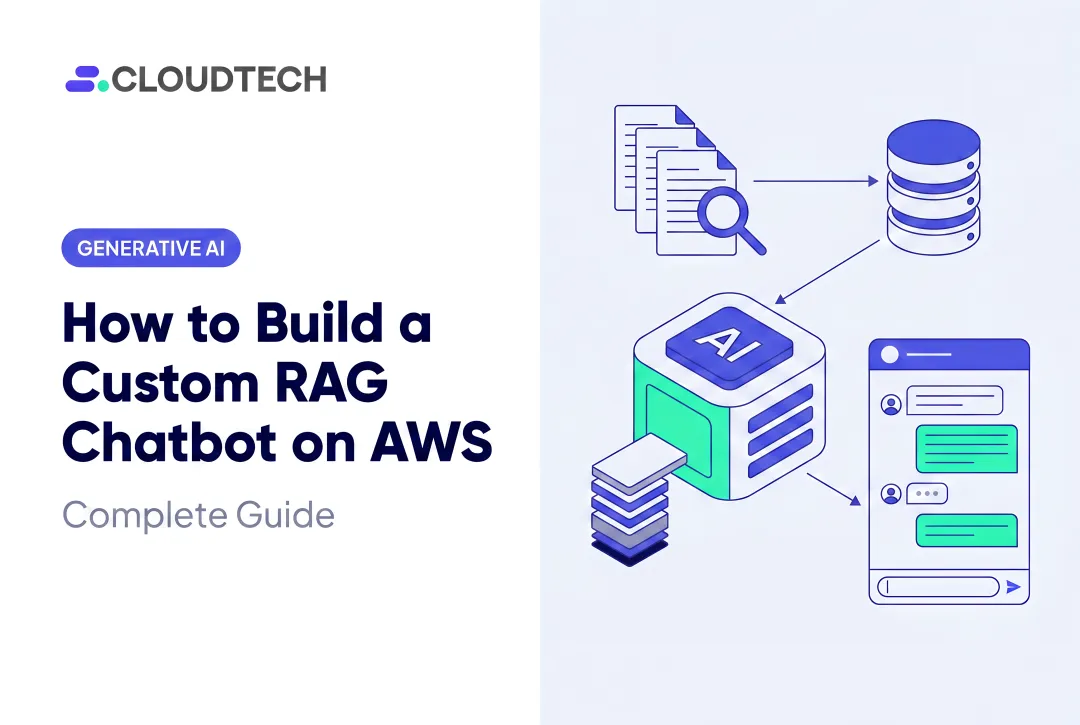
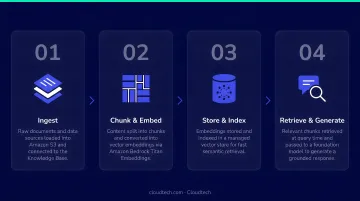
Amazon Bedrock Knowledge Bases is AWS's managed RAG layer. It handles the full pipeline:
- Ingest — documents are pulled from S3 or other sources
- Chunk and embed — text is split into segments and converted to vectors using models like Amazon Titan Text Embeddings V2 or Cohere Embed
- Store — vectors land in a supported store (OpenSearch Serverless, Aurora, S3 Vectors, Pinecone, MongoDB Atlas, and others)
- Retrieve and generate — at query time, the
RetrieveAndGenerateAPI fetches the top-k relevant chunks and passes them to an LLM (such as Claude via Bedrock) for response generation
The entire process is stateless and single-pass: a user submits a query, the system retrieves relevant context, and the LLM generates an answer. There is no multi-step reasoning, no memory between sessions, and no external actions.
Where Standard RAG Fits
Standard RAG performs well when:
- Questions have clear, document-grounded answers
- Your knowledge base is static or slow-moving (updated weekly or monthly, not in real time)
- Response speed matters and latency tolerance is low
- Your team needs simpler governance and audit trails
Strong use cases for SMBs:
- HR policy lookups and employee handbooks
- Product documentation and support FAQs
- Healthcare clinic service information and insurance coverage Q&A
- Financial services compliance document retrieval
- Manufacturing SOP and equipment manual search
These are structured, predictable queries with stable source documents — exactly the conditions where standard RAG excels. Once those requirements grow more complex, a different architecture becomes necessary.
What Is Agentic RAG on AWS?
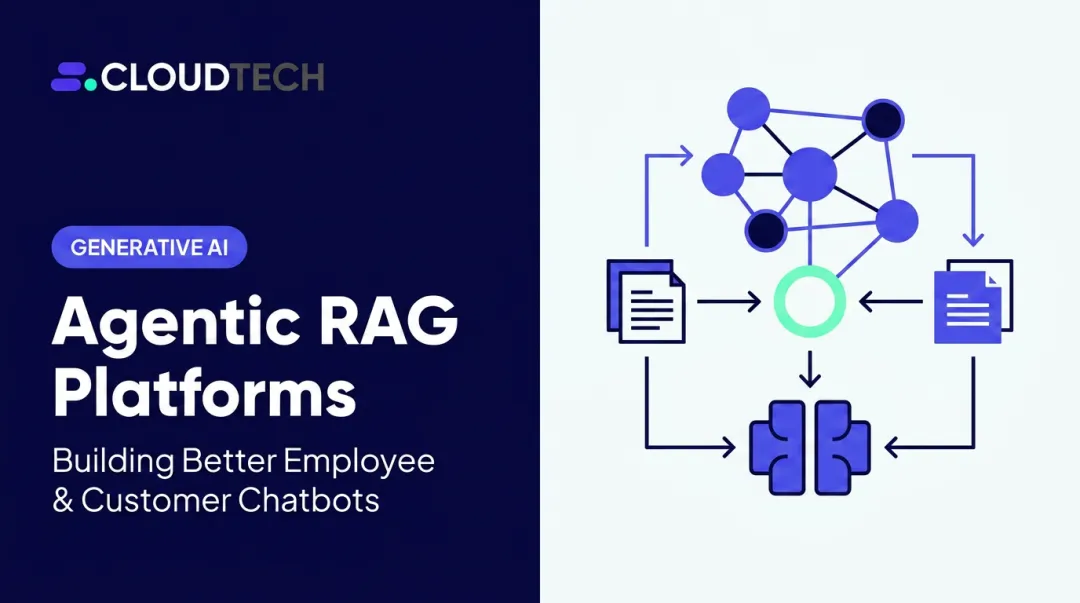
Agentic RAG extends standard retrieval by adding an AI agent that plans before it retrieves. Rather than a single vector search, the agent interprets the query, breaks it into sub-tasks, selects the right tools, and retrieves iteratively — synthesizing a final response and, when needed, asking clarifying questions before answering.
The AWS Implementation
Amazon Bedrock Agents serves as the orchestration layer. During each request, the agent:
- Interprets the user's input and generates a reasoning rationale
- Determines which actions or knowledge base queries to invoke
- Calls AWS Lambda functions or external APIs as needed
- Queries Bedrock Knowledge Bases for document context
- Iterates until the request is fully resolved
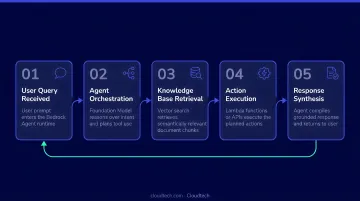
That step-by-step loop is what separates agentic systems from standard retrieval. Memory can persist across sessions for up to 365 days, enabling persistent conversational experiences where the agent recalls prior context.
Building on this, AWS's Agentic Retrieval feature within Knowledge Bases adds another layer. It decomposes complex queries into sub-queries, retrieves across multiple knowledge bases in parallel, and handles multi-hop reasoning — which matters most when the answer is spread across several documents rather than contained in one.
What Makes This Different in Practice
Consider the query: "Compare our Q3 compliance requirements across the Northeast and Southeast regions."
Standard RAG runs one search, retrieves the closest matching chunks, and generates a response — which may be incomplete if the answer spans multiple documents or requires cross-referencing.
An agentic system breaks that query into discrete retrieval tasks, runs them in sequence or parallel, synthesizes the combined results, and can flag when it needs clarification. The result is a response grounded in all relevant context, not just the nearest match.
Key agentic capabilities on AWS:
- Splits multi-part questions into focused sub-queries before searching
- Calls APIs, runs Lambda functions, and queries databases mid-conversation
- Retains context across turns and sessions for follow-up questions
- Runs additional searches automatically when initial results fall short
Where Agentic RAG Fits
Agentic RAG becomes the right choice for:
- Comparative queries spanning multiple documents or data sources
- Workflows that combine information retrieval with real-time actions (booking, record updates, report generation)
- Multi-turn conversations requiring session memory
- Complex enterprise workflows where query intent is often ambiguous
These patterns show up across industries where retrieval alone isn't enough. A few practical examples:
- A healthcare system where patients need clinical information and real-time appointment booking in one conversation
- A financial services firm synthesizing compliance requirements across multiple regulatory documents
- A SaaS platform where the AI retrieves knowledge and triggers downstream workflow actions
RAG vs Agentic RAG: Which Architecture Should You Choose?
Three factors drive this decision.
Factor 1: Query Complexity
Ask what your users are actually asking. If queries follow patterns like "What is our PTO policy?" or "Which products are compatible with X?" — standard RAG handles those cleanly. If queries sound like "Compare pricing tiers across our enterprise contracts and flag any compliance gaps" — that's agentic territory.
Factor 2: Action Requirements
Standard RAG generates responses. Agentic RAG goes further — it can trigger APIs, update records, send confirmations, and invoke business logic. If your use case requires the system to act on information, not just surface it, agents are the path.
Factor 3: Operational Readiness
Agentic RAG introduces real operational overhead:
- Latency — multi-step reasoning adds response time; each additional tool call, Lambda invocation, or retrieval pass compounds this
- Cost — AWS prices Agentic Retrieve at $4.00 per 1,000 API calls versus $1.00 per 1,000 for standard Retrieve, before accounting for additional model tokens and Lambda execution
- Complexity — managing agent state, defining tool schemas, building fallback logic, and debugging orchestration failures requires more ML ops maturity
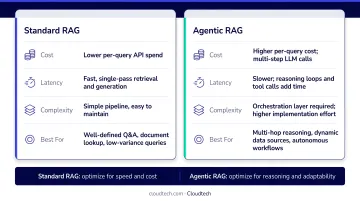
For SMBs with lean engineering teams, that complexity has real consequences. Most SMB teams ship a working RAG product in 2–4 weeks; standing up a full agentic system with proper orchestration and fallback logic typically takes twice that.
The Hybrid Path
Most production systems start with standard RAG and add agentic capabilities only when specific use cases demand it. AWS Bedrock is designed for this progression: teams can begin with Bedrock Knowledge Bases, ship a working product, then layer in Bedrock Agents as requirements grow. No full rearchitecture required.
Decision summary:
| Choose Standard RAG if... | Choose Agentic RAG if... |
|---|---|
| Queries are FAQ-style or document-grounded | Queries are multi-step, comparative, or ambiguous |
| No real-time actions needed | AI must trigger APIs or update systems |
| Low latency is a priority | Multi-turn conversation context is required |
| Team has limited ML ops capacity | Workflows span multiple data sources |
| You want simpler governance and lower cost | Use case justifies the added complexity |
Cloudtech's solutions architects work through this decision with SMBs directly — scoping query complexity, mapping action requirements, and sizing the operational overhead before a single line of architecture is drawn. As an AWS Advanced Tier Partner, Cloudtech also has access to AWS Partner Funding that can reduce out-of-pocket costs for qualifying implementations. Learn more at cloudtech.com/services/generative-ai.
Real-World Use Cases
Healthcare: Standard RAG in Practice
AWS's own drug discovery RAG implementation demonstrates Bedrock Knowledge Bases retrieving and synthesizing clinical trial data — a direct parallel to how healthcare SMBs use standard RAG for structured document Q&A.
For a clinic or health system fielding repetitive patient inquiries about services, accepted insurance plans, or appointment policies, Bedrock Knowledge Bases delivers a reliable, auditable answer layer. The architecture is straightforward: documents live in S3, Knowledge Bases handles ingestion and vector storage, and the LLM generates grounded responses. No agent orchestration required, which keeps governance clean and HIPAA compliance manageable.
Financial Services and Legal: Agentic RAG with Measurable Outcomes
The strongest published outcome for Agentic RAG on AWS comes from an eDiscovery implementation using Bedrock Agents: AWS reports a 60–70% reduction in document review time, with external audit time dropping from 1,000 hours to 300–400 hours and internal audit time from 800 hours to 320–400 hours.
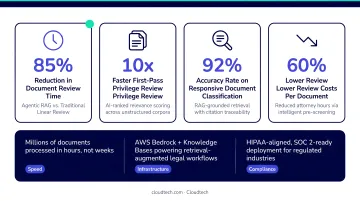
Workflows like this justify the added architectural complexity because the task itself demands it: synthesizing evidence across large document sets, reasoning about relevance across sources, and producing structured outputs that no single retrieval pass can handle. For financial services SMBs comparing policy terms across regulatory documents or running compliance analysis across multiple quarters of data, Agentic RAG's ability to decompose queries and retrieve iteratively is what makes the workflow viable at all.
The takeaway: Across both examples, the teams that matched architecture to problem complexity early avoided costly rework later. For SMBs working through this decision, getting the initial assessment right matters more than moving fast. Cloudtech helps SMBs evaluate and implement the right RAG architecture as an AWS Advanced Tier Partner, with packaged solutions typically delivered in one to four weeks and AWS Partner Funding available to reduce out-of-pocket costs.
Conclusion
Standard RAG is the right starting point for most SMBs building document-grounded AI. It's simpler, faster to deploy, and easier to govern. Agentic RAG becomes the right choice when your use case demands multi-step reasoning, real-time action capability, or the ability to handle complex queries across multiple data sources.
The architecture choice isn't permanent. AWS Bedrock is designed to support incremental evolution, so you're never locked into your first decision. A practical path forward looks like this:
- Start with what your current use case justifies
- Build what your team can realistically operate
- Expand to Agentic RAG as your workflows and data complexity grow
For healthcare, financial services, and manufacturing SMBs, the architecture decision you make early has a direct impact on time-to-value. AWS-certified guidance — like Cloudtech's generative AI implementation services — helps you choose the right pattern, avoid over-engineering, and build toward production on a realistic timeline.
Frequently Asked Questions
What is the main difference between RAG and Agentic RAG on AWS?
Standard RAG retrieves relevant document chunks in a single pass and generates a response, making it stateless and fast. Agentic RAG uses an orchestration layer (Bedrock Agents) to plan multi-step retrieval, invoke external tools, maintain session memory, and reason across multiple sources before generating a response.
When should I use Agentic RAG instead of standard RAG?
Choose Agentic RAG when queries are multi-part, comparative, or require real-time actions like API calls or record updates. For straightforward FAQ-style or document retrieval queries, standard RAG is simpler, faster, and more cost-effective.
What AWS services are used to build RAG and Agentic RAG?
Standard RAG uses Amazon Bedrock Knowledge Bases with a vector store (such as Amazon OpenSearch Serverless or S3 Vectors). Agentic RAG adds Amazon Bedrock Agents for orchestration, which can invoke Lambda functions, external APIs, and Knowledge Bases together.
Is Agentic RAG more expensive than standard RAG on AWS?
Yes. AWS prices Agentic Retrieve at $4.00 per 1,000 API calls versus $1.00 for standard Retrieve, plus additional model tokens for multi-step reasoning, Lambda execution costs, and greater orchestration complexity.
Can small and mid-sized businesses benefit from Agentic RAG on AWS?
Most SMBs see strong ROI starting with standard RAG on Bedrock, then scaling to agentic capabilities as workflows and team maturity grow. The added complexity of Agentic RAG is worth it only when the use case genuinely requires it.
How does Amazon Bedrock support both RAG and Agentic RAG architectures?
Bedrock provides a unified platform: Bedrock Knowledge Bases handles managed RAG with built-in ingestion, embedding, and retrieval, while Bedrock Agents adds the orchestration layer for agentic workflows. Teams can combine and scale both without managing underlying infrastructure.