Introduction
AI support chatbots have moved from novelty to standard operating infrastructure for SMBs across healthcare, financial services, and SaaS. The problem is that every conversation your chatbot handles may contain names, account numbers, medical details, or financial records. Without a clear compliance strategy, you're one data breach away from losing clients, deals, and reputation.
According to IBM's 2025 Cost of a Data Breach Report, 63% of organizations lacked AI governance policies to manage AI or prevent shadow AI deployments. The same report found that 97% of organizations reporting an AI-related security incident lacked proper AI access controls.
Those numbers don't just describe enterprise failures. SMBs face the same exposure with far less capacity to absorb the fallout — no dedicated legal team, no incident response budget, no second chance with enterprise clients.
This guide breaks down what SOC 2 and GDPR actually require for AI chatbot operators and why the stakes are higher than most teams realize. It also walks through a practical five-step framework for deploying compliant AI support in 2026.
Key Takeaways
- SOC 2 audits your vendor's security controls; GDPR legally governs how you handle EU residents' personal data — you need both
- AI chatbots access CRMs, helpdesks, and order systems, creating a much larger data exposure surface than traditional FAQ bots
- GDPR fines reach €20 million or 4% of global annual revenue, whichever is higher
- Compliance starts before vendor selection: map your data flows first, vet vendors second, then configure
- Your AWS infrastructure layer — encryption, access controls, and audit logs — determines whether your compliance posture is defensible or not
SOC 2 and GDPR Explained: What AI Chatbot Operators Need to Know
Neither framework replaces the other. SOC 2 governs how your vendor secures their systems. GDPR governs how your business handles the personal data of EU residents. Both apply simultaneously when you deploy an AI chatbot.
What Is SOC 2?
SOC 2 is an auditing framework from the AICPA that evaluates whether a service provider's internal controls meet defined security standards. When a chatbot vendor claims SOC 2 compliance, they've undergone an independent audit by a licensed CPA firm — not simply declared their own security practices adequate.
The framework covers five Trust Services Criteria:
| Criteria | Relevance to AI Chatbots |
|---|---|
| Security | Protects chat logs and customer data from unauthorized access |
| Availability | Ensures the bot stays online during peak support demand |
| Processing Integrity | Verifies data is processed accurately and completely |
| Confidentiality | Governs protection of sensitive business information |
| Privacy | Addresses collection and use of personal data |
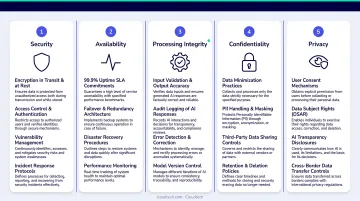
For most chatbot deployments, Security and Confidentiality are the most critical criteria.
Two audit types exist, and the difference is material:
- SOC 2 Type I — Point-in-time: confirms the right controls exist as of a specific date
- SOC 2 Type II — Ongoing: proves those controls operated effectively over a sustained period of 3–12 months
Enterprise buyers and regulated industries — healthcare, financial services — consistently require Type II. Type I confirms controls are in place; Type II proves they held up over time — which is the standard regulated industries actually care about.
What Is GDPR?
GDPR is not a certification or an audit framework. It is EU law. Under GDPR Article 3(2), any business whose chatbot interacts with EU residents must comply — regardless of where the company is headquartered. A US-based SaaS company with European customers is fully within scope.
Three GDPR requirements are most directly relevant to AI chatbots:
- Lawful basis and explicit consent (Article 6) — Data collection requires a valid legal basis before it begins. No pre-checked boxes, no implied consent
- Data minimization (Article 5(1)(c)) — The chatbot should only collect what is strictly necessary for its stated purpose
- User rights (Articles 15–17) — Individuals can request access to, correction of, or deletion of their conversation data. Your business must have a mechanism to fulfill those requests
The penalty for getting this wrong: GDPR Article 83(5) sets maximum fines at €20 million or 4% of total worldwide annual turnover, whichever is higher. Regulators have specifically targeted AI-powered data collection tools — the Italian DPA's 2023 action against ChatGPT and France's CNIL investigations signal where enforcement focus is heading.
Why AI Support Chatbots Create Unique Compliance Challenges in 2026
Today's AI support chatbots aren't scripted FAQ tools. They connect directly to your core business systems — and that integration creates compliance exposure that most SMBs haven't fully mapped.
The Expanded Data Surface
Today's AI chatbots connect to CRMs, helpdesks, order management systems, and knowledge bases. That integration gives them access to:
- Customer account numbers and purchase history
- Support tickets containing sensitive personal details
- Medical histories or insurance information (healthcare deployments)
- Financial records or credit details (financial services)
Most operators underestimate this scope when assessing compliance obligations. The chatbot isn't just a conversation interface — it's a real-time query engine across your most sensitive systems.
AI-Specific Risks SOC 2 and GDPR Weren't Built For
That expanded data access runs headfirst into risks that SOC 2 and GDPR weren't designed to address:
- Prompt injection attacks — Malicious inputs can manipulate LLM-based chatbots into exposing restricted data or behaving in unintended ways, as documented in OWASP's 2025 LLM guidance
- Knowledge base over-exposure — Chatbots configured with broad knowledge base access can surface internal documents, pricing details, or customer data they were never intended to share
- Persistent conversation logs — Chat transcripts containing PII accumulate over time and must be governed, retained appropriately, and eventually deleted under GDPR
What's Changed Heading Into 2026
The EU AI Act (Regulation 2024/1689), now in effect, introduced transparency obligations under Article 50 for AI systems that interact directly with users.
Customer-facing chatbots in healthcare or financial services may also fall under Annex III high-risk categories, triggering additional obligations beyond standard GDPR requirements.
For SMBs specifically:
- Healthcare organizations face HIPAA layered on top of GDPR and SOC 2 for any chatbot handling patient queries
- Financial services firms face additional scrutiny from regulators who treat customer data in AI systems as a systemic risk concern
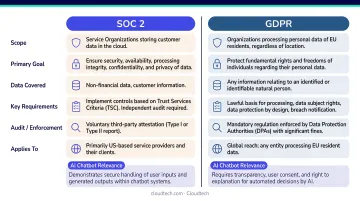
Key Differences Between SOC 2 and GDPR — And Why You Need Both
| Dimension | SOC 2 | GDPR |
|---|---|---|
| What it is | Independent audit framework | Binding EU law |
| Who it applies to | The vendor (service organization) | Any data controller/processor handling EU resident data |
| Primary goal | Prove system security controls exist and work | Protect individual privacy rights |
| Non-compliance consequence | Lost business, damaged reputation, failed vendor audits | Regulatory fines up to €20M or 4% of global revenue |
The Most Common Compliance Trap
Many businesses assume their chatbot vendor's GDPR consent checkbox means they're covered. It doesn't.
Without a SOC 2 Type II report, there's no independent verification that the vendor's infrastructure can actually protect the data being collected. SOC 2 reduces the risk of a breach happening. GDPR governs what happens to data if a breach occurs. Running one without the other leaves a gap that neither framework is designed to close on its own.
Shared Responsibility — And Where It Falls
Compliance responsibility is split between you and your vendor:
Your chatbot vendor must:
- Hold SOC 2 Type II certification
- Provide GDPR-supporting features (data deletion APIs, EU data residency options)
- Supply a signed Data Processing Agreement
Even with a fully compliant vendor, your obligations as the GDPR "data controller" remain separate:
- Obtain valid consent before data collection begins
- Honor user rights requests within the legally required timeframe
- Ensure your chatbot configuration doesn't collect more data than necessary
A vendor can be fully SOC 2 compliant and provide every GDPR feature available — and your deployment can still be non-compliant because of how you configured it.
Practical Steps to Build a Compliant AI Support Chatbot
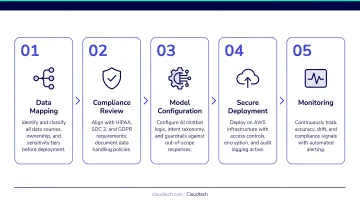
Step 1: Map Your Chatbot's Data Flows
Before selecting a vendor or writing a line of configuration, document exactly what personal data your chatbot will touch. Trace the complete journey:
User types a message → conversation is processed by the AI model → response is generated → transcript is stored in [database X] → synced to [CRM Y] → retained for [Z days] → deleted by [automated policy]
This data flow map determines the scope of both SOC 2 (which systems need to be in scope) and GDPR (what consent, retention, and deletion policies are required). Skipping this step means every subsequent decision rests on an incomplete picture.
Step 2: Vet Your Vendor's Security Credentials
Ask every chatbot vendor these questions before signing anything:
- Can you share your SOC 2 Type II report, including the auditor's name and period covered?
- Is my data used to train your AI models for other customers?
- Where is data physically stored, and do you offer EU data residency?
- What is your process for fulfilling a GDPR data deletion request?
- Can you provide a signed Data Processing Agreement?
Any vendor worth considering answers these directly — not behind a "contact sales" wall. Under GDPR Article 28(3), a DPA is legally required when a vendor processes personal data on your behalf. A vendor unfamiliar with that requirement is a serious red flag.
Step 3: Configure with Privacy by Design
GDPR Article 25 requires data protection by design and by default. That principle has three direct implications for how you configure your chatbot:
- Scope knowledge bases narrowly — the chatbot should read only what it needs to answer support queries, not your entire document library
- Disable unnecessary data fields — if the bot doesn't need a user's date of birth to resolve a ticket, don't collect it
- Set retention periods — align conversation log retention to your documented data retention policy, then automate deletion
A platform can be fully SOC 2-certified while your specific configuration still creates a GDPR exposure. The vendor's compliance posture doesn't transfer to yours automatically.
Step 4: Set Up Consent and User Rights Mechanisms
Before going live, these must be in place:
- A pre-chat consent notice with a clear, unchecked opt-in — not bundled with terms of service
- A documented process for data access and deletion requests, completing them within one month as required by GDPR Article 12(3) (extendable by two months for complex cases)
- An updated privacy policy that specifically reflects chatbot data collection
These obligations fall on your business, not your vendor.
Step 5: Test, Document, and Monitor Ongoing Compliance
Compliance isn't a one-time setup task. Before launch, run structured tests to verify the chatbot doesn't surface information it shouldn't — test prompt injection scenarios, check knowledge base boundaries, and confirm data deletion workflows function correctly.
Post-launch, maintain:
- Review access logs on a monthly cadence, at minimum
- An incident response protocol that explicitly names chatbot data events as in-scope triggers
- Current documentation of all controls, updated whenever configuration changes
SOC 2 Type II auditors look for evidence that controls worked consistently over a defined period — not just that they existed on paper. Even if you're not pursuing certification yourself, maintaining that evidence trail is what separates businesses that survive a data incident from those that face regulatory action after one.
How AWS Infrastructure Supports SOC 2 and GDPR Compliance for AI Chatbots
The cloud infrastructure layer is where SOC 2 and GDPR compliance either holds or breaks down. For AI chatbots deployed on AWS, several native services map directly to compliance requirements:
- AWS IAM — Enforces least-privilege access controls, ensuring only authorized systems and users can interact with chatbot data
- AWS KMS — Provides encryption at rest for conversation logs and customer data, with keys protected by FIPS 140-3 validated hardware
- AWS CloudTrail — Creates the immutable audit logs that SOC 2 auditors look for, recording all API activity across your environment
- AWS EU Regions — Data residency options including Frankfurt, Ireland, Paris, Stockholm, Milan, and Spain support GDPR's data localization requirements
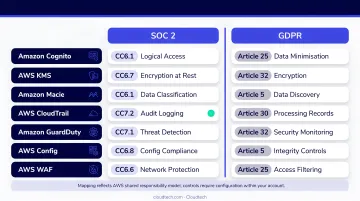
AWS holds SOC 2 Type II certification covering 185 services and supports GDPR compliance through its Data Processing Addendum, which applies automatically when AWS processes customer data. But the AWS Shared Responsibility Model is clear: AWS secures the cloud infrastructure; customers are responsible for how they configure applications on top of it.
Getting that configuration right requires real AWS expertise. For SMBs in healthcare, financial services, and SaaS deploying AI chatbots, Cloudtech's AWS-certified architects handle the infrastructure layer — encryption, access controls, audit logging, and data residency — so the underlying environment meets what SOC 2 auditors and GDPR regulators expect.
That work includes deploying AWS CloudTrail, AWS Config, AWS KMS, and Amazon Macie as part of compliant AI chatbot deployments. Audit-supporting architecture diagrams and documentation come as standard deliverables on every engagement.
How to Evaluate AI Chatbot Vendors for Compliance
Use this checklist when assessing any chatbot vendor:
Security Documentation
- SOC 2 Type II report available, issued by an accredited CPA firm
- Penetration testing conducted and results shareable
- Subprocessor list published and kept current
Data Privacy Features
- EU data residency option available
- Data deletion API or workflow available
- Customer data not used to train models for other customers
- Data Processing Agreement (DPA) provided before contract signing
Operational Transparency
- Clear incident response SLA with defined notification timelines
- Customers have access to audit logs for their own data
- Compliance features available on standard plans — not gated behind enterprise pricing
Once you know what to ask for, you'll quickly run into a common obstacle: vendors that make compliance features hard to access.
The Enterprise Plan Trap
Some vendors hide SOC 2 reports or EU data residency behind custom pricing tiers. For SMBs, this matters directly — you shouldn't need enterprise pricing to access basic compliance features. A vendor that treats compliance as an add-on rather than a foundation has bolted it on after the fact, which creates real exposure during audits.
Request a copy of the DPA before any contract is signed. GDPR Article 28 legally requires it. A vendor that doesn't know what a DPA is — or won't provide one — is not a compliant vendor.
Frequently Asked Questions
Do I need both SOC 2 and GDPR compliance if my business is based in the US?
Yes, if your chatbot interacts with EU residents. GDPR applies based on where your users are located, not where your company is headquartered. SOC 2 is separately relevant for any B2B business that needs to demonstrate security practices to clients — and is increasingly expected in domestic US deals too.
What is the difference between SOC 2 Type I and Type II for AI chatbots?
Type I confirms that the right controls exist as of a specific date. Type II proves those controls operated effectively over a sustained period, typically 3–12 months. For regulated industries and enterprise clients, Type II is the expected standard — Type I alone is rarely sufficient.
What GDPR rights do users have when interacting with an AI chatbot?
Users have the right to access their conversation data, request corrections, request deletion (the "right to be forgotten"), and withdraw consent at any time. The business deploying the chatbot — not the chatbot vendor — is responsible for fulfilling these requests within one month.
How do I know if my AI chatbot vendor is truly SOC 2 compliant?
True compliance means the vendor can share an actual SOC 2 Type II audit report issued by an accredited CPA firm — not a marketing badge or a self-attestation. Ask for the report itself, the auditor's name, and the specific audit period covered.
What are the GDPR penalties for non-compliance when using AI chatbots?
Fines can reach €20 million or 4% of global annual revenue, whichever is higher. Regulatory scrutiny of AI-driven data processing tools has increased significantly as EU data protection authorities respond to the pace of AI adoption.
Can AWS help my business achieve SOC 2 and GDPR compliance for an AI chatbot?
AWS provides core infrastructure capabilities — encryption, access controls, audit logging, and regional data residency — but those services require proper configuration to meet compliance requirements. Working with an AWS-certified partner like Cloudtech ensures both the infrastructure layer and application-layer controls are set up correctly for SOC 2 audits and GDPR obligations.