Introduction
Most conversational AI failures aren't technology failures. The NLP tools exist. The cloud infrastructure is mature. What breaks deployments is implementing NLP without a clear strategy — resulting in bots that misfire on real user input, escalate constantly, and deliver no measurable business value.
NLP in conversational AI isn't a single feature you turn on. It's a pipeline: raw user messages enter, and the system must extract intent, identify entities, track context across turns, and route to the right response. A gap in any stage degrades the whole experience.
This article covers what separates high-performing NLP systems from expensive underperformers — across pipeline design, training data, architecture selection, context management, and post-launch measurement.
Key Takeaways:
- Design intents around business actions, not word choice — it's the most consequential architecture call
- Real customer logs beat synthetic training data; quality always outranks volume
- Multi-turn conversations require explicit context management — skip it and the bot breaks
- Simpler models matched to task complexity consistently outperform over-engineered ones
- Measure task completion and fallback rates, not just offline accuracy
What Makes NLP Work in Conversational AI
NLP in a conversational system isn't a single module. It's a pipeline where each stage feeds the next. Stanford's dialogue systems architecture identifies the core stages: domain classification, intent determination, slot filling, dialogue state tracking, policy selection, and response generation. Weakness at any point degrades everything downstream.
The Two Failure Modes That Kill Deployments
Failure Mode 1: The Demo Gap
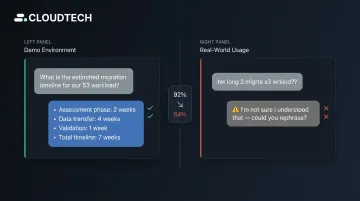
A system trained on polished, consistent test inputs looks impressive in controlled conditions. Put real users in front of it — typing in shorthand, slang, incomplete sentences, or with typos — and performance drops sharply. Research comparing simulated and human evaluation found one system scored 92.3% in simulation but only 84.0% with real users. That gap is where most production failures live.
Failure Mode 2: Single-Turn Understanding
Some bots handle one message at a time perfectly but collapse in multi-turn conversations. Consider a user who asks "schedule an appointment for Tuesday," then follows up with "actually, make it Wednesday." Without conversation memory, the bot treats the correction as a new, standalone request — and misses the context entirely.
Signs your system has this problem:
- Users repeat themselves across turns to get accurate results
- Pronoun references ("it," "that one," "the last option") return wrong results
- Corrections or clarifications trigger a fresh flow instead of updating the previous one
Rules-Based vs. NLP-Powered: Choosing the Right Foundation
| System Type | Strengths | Weaknesses |
|---|---|---|
| Rules-based | Predictable, auditable, no training data required | Brittle when users go off-script |
| NLP-powered | Flexible, handles natural language variation | Requires quality training data and deliberate design |
The choice between them isn't permanent. Many production systems start with rules-based routing for high-stakes paths and layer NLP on top for open-ended inputs — a hybrid approach that limits risk while preserving flexibility.
Building a Reliable NLP Pipeline: Intent, Entities, and Context
Intent Design: The Decision That Matters Most
Intent design is where most NLP architectures succeed or fail. The core rule: define intents by the business action the system should take, not by the words users choose.
Near-duplicate intents are a common trap. "Reset password," "change password," and "forgot password" look like three distinct user phrases — but if all three route to the same workflow, they should be one intent. Creating separate intents for each trains the model to make arbitrary distinctions it can't reliably learn.
AWS recommends providing 10 or more structurally and lexically varied utterances per intent as a starting minimum. The goal isn't volume — it's teaching the model to recognize the same intent expressed differently, including incomplete or informal phrasing.
Amazon Lex V2 returns confidence scores from 0.00 to 1.00, surfaces the top intent plus up to four alternatives, and routes to AMAZON.FallbackIntent when all scores fall below the configured threshold. Calibrate your thresholds against real application data — there's no universal number that works across use cases.
Entity Extraction: Extract What You Actually Need
Getting intent design right makes entity extraction easier — because scoped, well-defined intents naturally limit which entities you need to capture. Entity extraction works best when kept tight:
- Define entities around variable data the bot genuinely needs to complete a task (dates, account IDs, order numbers, product names)
- Set confidence thresholds that trigger clarifying questions when required values are missing or ambiguous
- Avoid extracting entities for every noun the user types — over-extraction creates noise, not precision
- Use Lex's Intent Disambiguation to present 2–5 intent choices when confidence is split across similar intents
Context Management: The Non-Negotiable Layer
Without session state, every message is a fresh request. A user who says "cancel that one" after discussing a specific order gets a bot that has no idea what "that one" refers to.
For most task-completion flows, session-scoped context — the standard in Amazon Lex V2 through session attributes and active contexts — is safe and sufficient. It persists values within the session and clears automatically when the session ends.
Long-term memory introduces privacy and data carryover risks. Use it selectively and clear it intentionally at session end, rather than defaulting to persistence just because it feels more capable.
Fallback and Clarification Design
A poorly designed fallback resets the conversation. A well-designed one asks one precise clarifying question and preserves state. Research on search clarification found that specific questions produce higher user satisfaction than generic ones, and that presenting 3–5 candidate answers outperforms offering only two. In practice, this means your fallback prompt should name what the bot is uncertain about — not just ask the user to rephrase.
Key principles for clarification design:
- Ask one specific question (not "Can you say that differently?")
- Preserve all collected slot values — never force the user to restart
- Offer 3–5 candidate options when the intent is ambiguous, not a binary choice
Training Data Best Practices That Actually Move the Needle
Start With Real User Language
The limiting factor in most NLP deployments isn't model sophistication. It's training data quality. A model trained only on polished, internally generated examples fails when real users type the way they actually communicate.
The most valuable data sources:
- Customer support chat logs — reveal how users actually phrase requests
- Help desk tickets — surface common frustration points and vocabulary
- Search query logs — show natural language patterns without any bot interference
- Call center transcripts — capture spoken language patterns, including interruptions and corrections
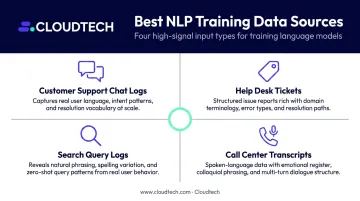
These sources expose the gap between how internal teams assume users will phrase requests and how users actually do.
Labeling Discipline: Where Quality Is Won or Lost
If two annotators label the same query under different intents, the model learns confusion. Intent definitions, entity rules, and edge case examples must be documented before labeling begins — not during.
Standard percentage agreement is insufficient for measuring annotation quality, especially with imbalanced intent distributions. Use one of these stronger metrics instead:
- Cohen's kappa — for two-annotator comparisons
- Fleiss's kappa — when three or more annotators are involved
- Krippendorff's alpha — handles missing data and multiple scale types
High agreement still doesn't prove correctness, so manual inspection of disagreements remains necessary.
What Strong Training Data Looks Like
A well-prepared training set includes:
- Real utterances across all intents with diverse phrasing
- Informal language, abbreviations, and incomplete sentences
- Negative examples — inputs that should not match a given intent
- Representative samples in each language when multi-language support is required
That last point — covering informal language and incomplete sentences — is where teams most often stumble. The instinct to clean everything up actually works against you.
Don't Over-Clean Your Data
Removing typos and informal language seems safe. Often, it damages the model's ability to generalize. Remove noise that adds no value, but resist making the training set unrealistically tidy. A model that has only ever seen clean input will fail the moment a real user types "appnt tmrw 2pm pls."
Selecting the Right NLP Architecture for Your Business
Three Architectures, Three Use Cases
| Architecture | Best For | Key Risk |
|---|---|---|
| Rule-based | Narrow, compliance-sensitive workflows (fraud reporting, appointment booking) | Brittle when users go off-script |
| Retrieval-based | FAQ and policy environments requiring consistent, approved answers | Limited to what's in the knowledge base |
| Generative | Open-ended explanation or drafting tasks | Hallucination without source grounding |
No single architecture fits every use case, which is why most production systems combine them.
The Case for Hybrid Architecture
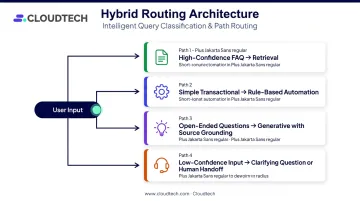
A routing layer is the practical solution for most SMB deployments:
- High-confidence FAQ requests → retrieval (consistent, approved answers)
- Simple transactional requests → rule-based automation (predictable execution)
- Open-ended questions → generation with source grounding
- Low-confidence inputs → clarifying question or human handoff
This structure matches model complexity to task complexity, which directly reduces cost, latency, and maintenance burden.
AWS-Native Services for Production NLP
For SMBs building conversational AI on AWS without a dedicated ML team, three services form the foundation:
- Amazon Lex V2 — intent recognition, entity extraction, confidence scoring, and voice/text interfaces across multiple locales
- Amazon Comprehend — language detection, entity recognition, and sentiment analysis on text
- Amazon Bedrock Knowledge Bases — managed retrieval-augmented generation (RAG) over proprietary content, with citations and reranking
Real deployment results from AWS customers demonstrate what this stack can do: WaFd Bank achieved a 30% reduction in agent call volume and cut balance-check time from 4.5 minutes to 28 seconds using Amazon Lex.
For SMBs without in-house ML expertise, working with an AWS Advanced Tier Partner like Cloudtech accelerates both architecture selection and deployment — their team is primarily former AWS employees, which shortens the ramp time considerably.
Designing for Real Conversations and Measuring What Matters
RAG: The Safest Path for Generative Responses
Retrieval-augmented generation is the right approach for business contexts where accuracy is non-negotiable. The bot retrieves the most relevant approved content first, then generates a response anchored to that material.
Ungrounded generative models are fragile under retrieval pressure — one benchmark found ChatGPT's accuracy dropped from 89% to 9% when retrieved documents contained counterfactual information. Retrieval quality is as important as generation quality.
For compliance-heavy workflows, response templates for escalation messages, ticket confirmations, and policy answers remove generative discretion where exact phrasing matters.
NIST guidance: Fact-check generated content and review sources during both predeployment testing and ongoing monitoring.
Cloudtech's Architectural Pattern in Practice
In healthcare conversational AI deployments, Cloudtech has implemented node-based architectures that manage distinct session states:
- Greeting, identity verification, scheduling, confirmation, and error recovery
- Full context propagated to human agents on escalation in under 2 seconds
Users never repeat information already shared during the AI-managed portion of a call.
The Metrics That Actually Matter
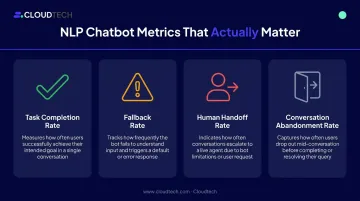
That architecture only holds up if you're measuring the right things. Post-launch, task completion rate tells you more than offline accuracy ever will. Track:
- Task completion rate: did the bot actually resolve the user's issue?
- Fallback rate: how often does the bot fail to match an intent?
- Human handoff rate: is escalation happening at the right frequency?
- Conversation abandonment rate: where are users dropping off?
Amazon Lex categorizes an intent as successful when it reaches Fulfilled or ReadyForFulfillment. Use Lex Analytics to track intent, slot, utterance, and conversation outcomes — and compare confidence scores before and after utterance changes to validate improvements.
A Sustainable Iteration Loop
Post-launch conversation logs are the most valuable NLP improvement data you have. They surface:
- Missed intents users actually triggered
- Failed fallback flows that frustrated users
- Topics the bot doesn't cover but users repeatedly raise
- Abandonment points that reveal where the pipeline breaks
Drive retraining from logged failure patterns, not a fixed calendar schedule. A/B testing of routing thresholds, fallback messages, and prompt variations separates evidence-based improvements from guesswork.
Frequently Asked Questions
What is the difference between a rules-based chatbot and an NLP-powered chatbot?
Rules-based bots follow predefined decision trees and break when users go off-script. NLP-powered bots classify intent and extract entities from natural language, making them more flexible. They do require quality training data and deliberate design, though, to remain accurate in production.
How much data do you need to train an NLP model for a conversational AI system?
There's no universal minimum. Quality and diversity matter more than volume — a few hundred well-labeled, real-world utterances per intent can outperform thousands of synthetic examples. Start with real customer interaction logs wherever they're available.
What AWS services are available for building NLP-powered conversational AI?
Amazon Lex handles intent recognition and entity extraction. Amazon Comprehend covers text analysis and sentiment detection. Amazon Bedrock Knowledge Bases enables retrieval-augmented generation over proprietary content. These three services can be combined into a hybrid architecture suited to most SMB use cases.
What are the most common mistakes businesses make when implementing NLP chatbots?
Training on synthetic rather than real user data, creating too many near-duplicate intents, skipping context management, and failing to monitor conversation logs after launch. These mistakes degrade production performance even when demos appear smooth.
How do you measure whether your NLP chatbot is actually working?
Offline accuracy scores are insufficient. Track task completion rate, fallback rate, human escalation rate, and user abandonment. A model can score well in testing and still frustrate real users by generating confident-sounding wrong answers.
How long does it typically take to implement NLP in a conversational AI system?
Timelines depend on scope and data readiness, but a focused MVP with well-defined intents and real training data can be deployed in weeks using managed AWS services. Using pre-built managed services — rather than building NLP infrastructure from scratch — is the single biggest factor in compressing that timeline.