Introduction
AI chatbots now handle customer interactions across retail, healthcare, financial services, and logistics — processing millions of queries daily at a scale no human team can match. Gartner reported that 54% of organizations were already using chatbots, virtual customer assistants, or conversational AI for customer-facing applications as of 2022, with chatbots forecast to become the primary service channel for roughly a quarter of organizations by 2027.
But widespread adoption hasn't solved everything. Many businesses deploy chatbots for speed and availability, then discover a different problem: inconsistency. Poor knowledge base design, fragmented training data, and inadequate response guardrails cause chatbots to deliver different answers to the same question — eroding exactly the trust they were supposed to build.
This guide focuses on the mechanics behind consistency: how knowledge bases, response guardrails, and training pipelines determine whether your chatbot builds trust or quietly chips away at it.
Key Takeaways
- AI chatbots draw from a single, centralized knowledge base — not individual interpretation — making every response traceable to the same source
- Natural language processing maps different phrasings of the same question to the same answer, no matter how a customer words it
- The same response logic applies across web chat, mobile apps, and messaging platforms — no channel gets a different answer
- Continuous learning updates responses based on real interaction data, without manual updates
- Response consistency directly reduces compliance exposure in regulated industries like healthcare and financial services
What Are AI Customer Service Chatbots?
AI customer service chatbots are software systems that use Natural Language Processing (NLP), machine learning, and — in more advanced deployments — Large Language Models (LLMs) to interpret customer queries and respond in real time.
The distinction from earlier rule-based bots matters practically. Rule-based systems follow rigid if-then scripts: ask anything outside the script and they fail or loop. AI-powered chatbots interpret intent, handle variation in how questions are phrased, and refine their responses as they encounter more real-world queries.
That capability has limits, though. Chatbots are most effective as a first line of response — handling routine, high-volume queries while escalating complex or emotionally sensitive cases to staff who can exercise judgment. They're not a replacement for human agents; they're a filter that lets those agents focus where they're actually needed.
Why Consistent Customer Service Is Hard to Achieve Without AI
The Human Variability Problem
In traditional support teams, response quality depends on individual agent training, experience, and interpretation. Two agents answering the same billing question on the same day can give meaningfully different answers — different in detail, tone, or accuracy. Neither may be wrong exactly, but the gap creates customer confusion and erodes trust in the information itself.
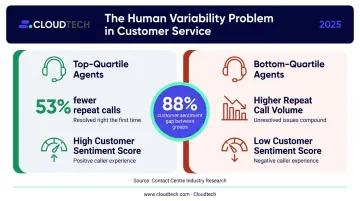
This isn't hypothetical. NiCE's 2025 State of CX analysis, covering billions of conversations across thousands of organizations, found an 88% difference in customer sentiment between top- and bottom-quartile agents. Top performers generated 53% fewer repeat calls — meaning customers of lower-performing agents needed to call back to get the right answer.
That repeat-contact cost is concrete:
- More agent time consumed on the same unresolved issue
- Higher average handle times across the team
- Frustrated customers who lose confidence in your support
- Lower satisfaction scores that compound over time
Why Scale Makes It Worse
Inconsistency compounds as support volume grows. A team of five agents is manageable to align. A team of fifty, spread across shifts, locations, and experience levels, is not. During peak periods — holiday surges, product launches, billing cycles — maintaining uniform responses across a larger, pressured team becomes far harder without a systematic approach. AI chatbots are designed to close exactly that gap.
How AI Chatbots Ensure Consistent Customer Service Responses
AI chatbots don't produce consistent responses by accident. Consistency is engineered through a defined sequence of processes: from the moment a query arrives to the moment a response is delivered.
Intent Recognition
When a customer message arrives, the chatbot uses NLP to parse the text, extract meaning, and classify intent. Is the customer asking about an order status, requesting a refund, or asking a product question? The classification might be triggered by "where's my order," "track my package," or "I haven't received my delivery yet" — different phrasing, same intent.
This classification step is the foundation of consistency. Once the chatbot identifies intent with confidence, it routes the query to a pre-approved response pathway, eliminating the interpretive judgment call that creates variability between human agents. Intent accuracy in production settings varies by system design and dataset complexity, with peer-reviewed benchmarks showing ranges from 72% to 93% depending on training conditions.
Centralized Knowledge Base Access
Once intent is classified, the chatbot queries a single, centralized knowledge base: a repository of approved answers, policies, procedures, and product information maintained by the business.
Unlike a team of agents drawing on their own notes, prior experience, or half-remembered training, the chatbot's knowledge base is the single source of truth. Whether it's Tuesday morning or Saturday night, the information doesn't drift based on who's on shift. That's what makes consistency structural rather than aspirational.
Zendesk reports that consumer robotics company Miko deployed a generative AI self-service program with a centralized knowledge base and reached a 93% self-service solve rate while handling a 12–15x holiday volume spike. The result was attributable to the combination of AI agents and centralized content, not either alone.
For businesses building on AWS, Amazon Bedrock Knowledge Bases provide the retrieval infrastructure for this approach, connecting chatbots to indexed document stores so every response is anchored to verified source material.
Response Generation and Standardization
The chatbot constructs its reply using Natural Language Generation (NLG), converting retrieved information into a coherent, contextually appropriate response. Tone, terminology, and structure stay consistent regardless of channel or how many simultaneous conversations are running.
More advanced systems add response templates and guardrails for sensitive topics: pricing disputes, refund policies, compliance-related disclosures. These guardrails ensure no chatbot response deviates from what's legally or operationally approved, which matters most in regulated industries.
Continuous Learning and Feedback Loops
AI chatbots use machine learning to analyze past conversations, identifying where responses were misunderstood, where customers escalated, and where resolution rates dropped. These signals refine future responses without requiring manual reprogramming.
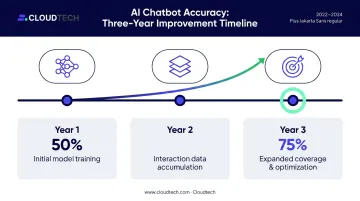
This is what separates AI chatbots from static FAQ pages. A Forrester composite model, based on IBM Watson Assistant deployments, projected effective response rates rising from 50% in Year 1 to 75% in Year 3 as training coverage expandedIn practice, accuracy improves as interaction data accumulates, keeping responses aligned with updated business information and shifting customer expectations.
Omnichannel Consistency
The same chatbot logic, knowledge base, and response standards deploy across all customer touchpoints: website chat, mobile apps, SMS, and messaging platforms. A customer who asks a shipping question on your website and a different customer who asks the same question via a mobile app receive the same answer, drawn from the same source.
Research on omnichannel experience consistency confirms why this matters: a 2021 peer-reviewed study of 265 consumers found that consistency between online and offline customer experiences significantly increased satisfaction, which in turn drove higher repurchase intent and positive word of mouth. Inconsistency between channels had measurable negative effects on both outcomes.
Where AI Chatbot Consistency Delivers the Most Business Value
Consistent chatbot responses have the highest operational impact in three environments:
- High-volume support — e-commerce, SaaS platforms, and financial services where hundreds or thousands of simultaneous queries make human consistency impossible
- Regulated industries — healthcare and banking, where a single inaccurate response can trigger compliance violations, not just customer frustration
- Scaling businesses — companies expanding into new markets or customer segments where maintaining service standards across a growing team is structurally difficult
Where Accuracy Has Real Stakes
Certain query types carry outsized risk when responses vary:
- Policy explanations — incorrect refund or cancellation information leads to disputes and chargebacks
- Billing and dispute responses — the Consumer Financial Protection Bureau (CFPB) has documented cases where financial chatbots gave inaccurate information, failed to open disputes after telling customers they would, and contributed to late fees and adverse credit reporting
- Appointment confirmations — errors create no-shows, operational waste, and patient dissatisfaction
- Product eligibility answers — wrong information in healthcare or financial services creates both reputational and legal exposure
FINRA guidance makes clear that Rule 2210 content standards apply to AI-generated communications the same as human-generated ones — firms must supervise chatbot output for accuracy and compliance, not just deploy and forget.
The AWS Infrastructure Layer
Amazon Lex and Amazon Bedrock provide the infrastructure to build consistent, scalable AI solutions. Bedrock's Knowledge Bases enable RAG (Retrieval-Augmented Generation)-powered retrieval, grounding responses in centralized enterprise content rather than relying on model generation alone. Lex handles intent classification and conversational flow.
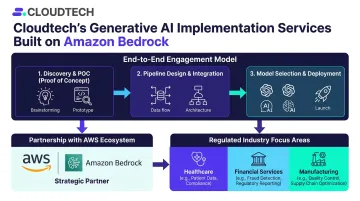
Cloudtech helps SMBs in healthcare, financial services, and manufacturing implement generative AI on Amazon Bedrock — including full RAG pipeline design, model selection across Anthropic Claude, Amazon Titan, and Meta Llama, and guardrails for responsible AI deployment. Key engagement details:
- Funding: AWS MAP and IMR programs can offset a meaningful portion of implementation costs for eligible SMBs
- Timeline: Engagements start with a fixed-fee 4–8 week proof-of-concept (POC) before moving into production build-out
- Scope: Full pipeline design, model selection, and responsible AI guardrails included
Conclusion
AI chatbots deliver consistent customer service through a structured process: centralized knowledge, intent recognition, standardized response generation, and continuous feedback loops. Each stage removes a specific source of variability that makes human-only support inconsistent at scale.
The business outcomes follow directly: faster resolution, stronger customer trust, lower repeat-contact rates, and the ability to scale service quality without a proportional increase in staff. For companies in regulated industries, consistency is also a compliance requirement — not just a service quality metric. Together, these factors make chatbot implementation a decision with clear, measurable returns — one that affects service quality, operational cost, and regulatory standing all at once.
Frequently Asked Questions
How do chatbots help with customer service?
Chatbots handle high-volume, repetitive queries instantly and around the clock, freeing human agents for complex cases. They reduce wait times, improve response speed, and maintain service quality even during peak periods when staffing alone can't keep pace.
How do chatbots give answers?
Chatbots use Natural Language Processing (NLP) to interpret the customer's question, classify intent, and query a centralized knowledge base for approved information — then generate a response using Natural Language Generation (NLG), all within seconds.
Can AI chatbots maintain consistent responses across different channels?
Yes. Because the same knowledge base and response logic deploys across web, mobile, SMS, and messaging platforms, the chatbot delivers uniform answers regardless of which channel the customer uses to reach you.
What happens when an AI chatbot can't answer a question?
Well-designed chatbots recognize the limits of their knowledge base and escalate unresolved queries to human agents — passing along the full conversation context so customers don't need to repeat themselves from the beginning.
How do businesses keep AI chatbot responses accurate over time?
Accuracy is maintained through regular knowledge base updates, performance monitoring (resolution rates, escalation patterns, customer sentiment), and machine learning feedback loops that refine responses based on real interaction data.
Are AI chatbots better than human agents at delivering consistent responses?
Chatbots outperform humans on consistency and speed for routine, well-defined queries. Humans remain superior for nuanced, emotionally complex situations. A hybrid model — chatbots handling volume, humans handling complexity — delivers the best outcomes for both speed and service quality.