Introduction
Domain-specific chatbots in healthcare, finance, and manufacturing face a problem that general-purpose LLMs handle poorly: specialized queries that demand precision. Research shows GPT-4o hallucination rates of 22–24% on medical record tasks, and legal LLMs fare even worse. Retrieval-Augmented Generation (RAG) addresses this by grounding responses in curated knowledge bases, but standard RAG introduces its own cost problem.
A static RAG pipeline retrieves context for every query. Every retrieval triggers a full LLM generation cycle, consuming tokens on follow-up messages like "got it" or "thanks" just as aggressively as complex questions. At scale, that's a genuine budget problem for SMBs paying per token.
Reinforcement learning changes this. Rather than following fixed retrieval rules, an RL-trained policy model learns when retrieval actually improves the answer, and skips it when it doesn't. This article explains how RL optimizes RAG pipelines, covers the key components, and helps technical decision-makers understand when the investment makes sense.
Key Takeaways
- ~31% token savings, no accuracy loss: a BERT-based RL policy + similarity threshold does this automatically
- RL transforms RAG from a static retrieval system into a self-improving decision-making pipeline
- Domain-tuned embeddings (InfoNCE loss) hit 0.97 top-1 accuracy vs. 0.82 for general-purpose models
- Proven in healthcare, finance, and retail — with concrete cost and latency improvements in each
- SMBs can run these pipelines on managed AWS services without a dedicated ML ops team
Why Domain Chatbots Struggle with Traditional RAG
Standard RAG retrieves context using cosine similarity on every single query — so a user typing "ok, thanks" triggers the same retrieval-and-generation cycle as a complex technical question. At GPT-4o mini pricing of $0.15 per million input tokens, that seems trivial until you multiply it across thousands of daily interactions.
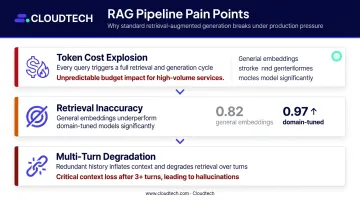
Three Core Pain Points
Token cost explosion: Every query triggers retrieval + context injection + LLM generation. Follow-up queries, acknowledgments, and off-topic messages consume tokens unnecessarily. For SMBs running high-volume support chatbots, this inflates monthly LLM API bills fast.
Retrieval inaccuracy on domain language: General-purpose embedding models struggle with specialized terminology — particularly for non-English or code-mixed queries. In one benchmark, the e5-base-v2 model scored 0.82 top-1 retrieval accuracy on domain queries; a fine-tuned domain model with InfoNCE contrastive loss reached 0.97 on the same test set. That 15-point gap means more wrong documents feeding your LLM — and more hallucinations.
Multi-turn conversation degradation: Passing full conversation history with every query inflates context size and muddies retrieval. CORAL's benchmarking of multi-turn RAG identifies redundant history and topic shifts as direct sources of retrieval and generation degradation.
In high-stakes domains, the cost is concrete. A wrong answer in a healthcare or financial services chatbot erodes user trust and creates compliance exposure — the kind that a smarter retrieval layer is specifically designed to prevent.
How Reinforcement Learning Optimizes RAG Pipelines
Rather than retrieving on every query by default, the system learns which retrieval actions actually produce better answers. The RAG pipeline becomes a decision-making system where actions have measurable consequences.
The Two Actions
The RL policy model controls exactly two actions per query:
- [FETCH] — Execute full RAG retrieval and LLM generation with injected context
- [NO_FETCH] — Skip retrieval; rely on cached context or prior conversation history
[NO_FETCH] is strategically correct for follow-up queries, repeated-topic questions, simple acknowledgments, and out-of-domain queries where retrieval would inject irrelevant context and increase hallucination risk.
How the Reward Model Works
GPT-4 serves as the automated quality judge during training, rating each bot response as Good or Bad. Those ratings convert to numeric rewards:
| Action + Outcome | Reward |
|---|---|
| NO_FETCH + Good answer | +2.0 |
| FETCH (any outcome) | +0.1 |
| NO_FETCH + Bad answer | -1.0 |
This reward structure deliberately incentivizes cost-efficient behavior. The policy learns that skipping retrieval when it's unnecessary is highly rewarded — but it's penalized harshly for skipping retrieval and producing a bad answer. FETCH always gets a small positive reward, ensuring the model never avoids retrieval when it's genuinely needed.
Policy Gradient Training
The policy network samples [FETCH] or [NO_FETCH] actions across training chat sessions, generating (State, Action, Reward) trajectories. It updates itself using policy gradient with entropy regularization:
l_t = -log π_θ(a_t|s_t) G_t - λ H(π_θ(a_t|s_t))
The entropy term (λ = 0.1) promotes exploration during training, preventing the policy from collapsing to always-FETCH or always-NO_FETCH before it has learned meaningful patterns.
Kulkarni et al. trained on just 168 queries across six chat sessions, producing 1,733 state-action-rating tuples — a compact dataset for meaningful policy learning.
The Similarity Threshold (SimThr) Layer
Before the policy model even runs, a similarity threshold check can short-circuit the entire LLM call. When the embedding model's cosine similarity for the top-ranked document exceeds 0.92, the system returns the static FAQ answer directly — no LLM needed.
This only works reliably with a domain-tuned embedding model. General-purpose models don't separate in-domain from OOD queries cleanly enough (similarity scores of 0.84 vs. 0.82 for in-domain vs. OOD). A domain-tuned InfoNCE model produces 0.85 for in-domain vs. 0.56 for OOD — that gap is what makes the threshold meaningful.
Key Components of an RL-Optimized RAG System
Domain-Specific Embedding Model
Fine-tuned with InfoNCE contrastive loss on in-domain query-FAQ pairs. The training objective maximizes similarity for positive pairs while pushing unrelated samples apart. Results from the Kulkarni et al. research:
| Model | English Top-1 | Hinglish Top-1 |
|---|---|---|
| e5-base-v2 (general) | 0.82 | 0.71 |
| Domain model (triplet loss) | 0.90 | 0.84 |
| Domain model (InfoNCE loss) | 0.97 | 0.94 |
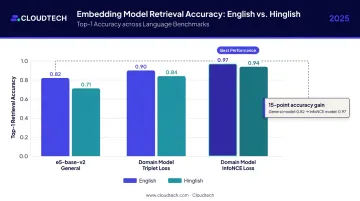
The InfoNCE-tuned model also creates a wide OOD detection gap: in-domain similarity of 0.85 vs. OOD similarity of 0.56. This separation is what enables reliable similarity thresholding.
Policy Network
A language model (BERT or GPT-2) with a classification head maps the current state (current query, previous queries, previous actions) to a probability distribution over [FETCH] / [NO_FETCH].
The in-house domain-pretrained BERT model outperformed public GPT-2 in the paper's limited-data experiment: 115,259 vs. 124,924 tokens consumed on the test set, both at 1.0 accuracy. The authors attribute this to domain pretraining under a constrained training set, a meaningful finding for SMBs who may have limited annotated data available.
Reward Model and OOD Handling
GPT-4 as automated evaluator replaces the need for human-labeled ground truth, making the training loop practical for real deployments. Three design choices define how this reward model shapes policy behavior:
- A correct "do not know" response to an OOD query is rated Good, teaching the policy that graceful refusal is the right behavior
- Hallucinated answers receive negative reward, directly penalizing overconfident responses
- This reward structure protects brand trust in regulated domains (healthcare, financial services) where a wrong answer carries real consequences
Conversation History Management
The policy model receives the last N query-answer-context turns as state input. More history improves multi-turn coherence; too much inflates the token load on every request. The RL policy helps balance this by suppressing unnecessary re-retrieval for follow-up queries that don't require new context.
Real-World Applications Across Industries
Finance and Banking
High-volume financial chatbots field repetitive queries — loan eligibility, fee structures, account policies — where the same context is often relevant across multiple follow-up questions in a session. RL-optimized RAG learns to reuse previously fetched context instead of retrieving on every turn, reducing per-session token costs while keeping responses accurate and compliant.
Amazon Finance Automation's Bedrock RAG Q&A assistant shows what's at stake: initial accuracy sat at 49%, with 14% of errors traced to incomplete context and another 14% to hallucination when no relevant context had been retrieved. Semantic chunking and better embeddings pushed accuracy to 86%. RL-RAG applies those same retrieval improvements adaptively, session by session.
Healthcare
Precise out-of-distribution (OOD) detection is non-negotiable in healthcare. A chatbot that speculates on out-of-scope medical questions risks patient harm and erodes clinical trust. The similarity threshold + InfoNCE embedding combination ensures the system refuses questions outside its knowledge base rather than generating plausible-sounding but incorrect answers.
Cloudtech has worked with healthcare clients including Klamath Health Partnership and a healthcare SaaS platform where a RAG-based care navigation system reduced support tickets by 45% within two months — with HIPAA-compliant orchestration via Amazon Bedrock Agents, Step Functions, and OpenSearch. Healthcare AI deployments require this compliance layer baked into the architecture, not added as an afterthought.
E-Commerce and Customer Support
Common FAQ patterns — order status, return policies, product details — repeat across thousands of daily sessions. RL reduces retrieval load for these high-frequency, low-variance queries by recognizing that FAQ context fetched in turn one stays valid through turns two and three. The practical gains compound quickly:
- Fewer redundant retrieval calls per session
- Higher query throughput without scaling infrastructure
- Lower operational cost per resolved ticket
Measuring the Business Impact
Token Savings
The core experiment from Kulkarni et al. used a 91-query test session containing in-domain, greeting, and OOD queries:
| Retrieval Policy | Tokens Used | Savings vs. All-Fetch | Accuracy |
|---|---|---|---|
| All-Fetch (baseline) | 167,885 | — | 0.989 |
| SimThr only | 147,147 | ~12% | 0.989 |
| SimThr + GPT-2 RL | 124,924 | ~25% | 1.0 |
| SimThr + BERT RL | 115,259 | ~31% | 1.0 |
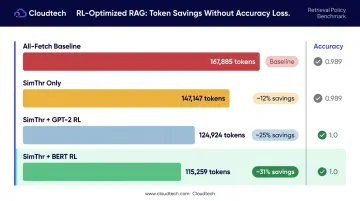
The ~31% token reduction cuts API costs directly. An SMB running 50,000 queries per month through Claude 3.5 Sonnet at $3.00 per million input tokens saves roughly $155/month — without changing a single line of application code.
The Accuracy Finding
RL optimization doesn't just save cost — it slightly improves accuracy. All-Fetch scored 0.989; SimThr + BERT RL scored 1.0. Why? Avoiding irrelevant context injection for acknowledgment queries ("cool," "ok") actually reduces hallucination risk. Injecting mismatched context is worse than injecting no context.
Scalability
The RL policy model trains once and runs as a lightweight external controller. It doesn't require retraining the LLM or embedding model when your knowledge base updates. For SMBs with limited ML operations capacity, that means updating your FAQ corpus without touching the RL layer — no retraining cycle, no downtime.
Deploying RL-Optimized RAG on AWS
AWS provides the managed infrastructure that makes RL-RAG production-ready without requiring a large ML engineering team. The relevant service stack:
- Amazon Bedrock — managed LLM access with Knowledge Bases for retrieval, reranking, and source citations
- Amazon SageMaker — training and hosting the policy network and domain embedding models
- Amazon OpenSearch Serverless — vector indexing and similarity search for the retrieval layer
- AWS Lambda / Step Functions — orchestrating the retrieval pipeline and managing the SimThr + RL policy decision logic
- Amazon S3 — document corpus with near real-time indexing via OpenSearch
Cloudtech architects and deploys these pipelines end-to-end as an AWS Advanced Tier Partner — with a team that includes former AWS employees across solutions architecture, data engineering, and DevOps, so clients don't need to staff a specialized ML team internally.
When RL Optimization Is Worth It
Not every chatbot needs this level of sophistication. RL-optimized RAG makes sense when:
- Token costs are a real budget line item due to high query volumes
- Domain scope is well-defined — a curated FAQ or policy document knowledge base exists
- Multi-turn conversations are a core product requirement, not an edge case
- Out-of-distribution (OOD) query handling is critical — healthcare, finance, and legal contexts where hallucination carries real risk
If none of those conditions apply, a well-tuned static RAG with domain-specific embeddings and a similarity threshold is often the right first step. The SimThr-only configuration already captures ~12% token savings with zero additional training overhead.
Frequently Asked Questions
Can RAG be used in domain chatbots?
Yes. RAG is well-suited for domain chatbots because it grounds LLM responses in a curated knowledge base (FAQs, policy documents, clinical guidelines), reducing hallucinations in specialized fields like healthcare, finance, and customer support.
How can I improve RAG chatbot performance?
Three targeted improvements move the needle: fine-tune your embedding model on domain-specific data using InfoNCE contrastive loss, add a similarity threshold to handle out-of-distribution queries gracefully, and apply reinforcement learning to control retrieval decisions per query. Together, these reduce token waste without sacrificing response quality.
Is reinforcement learning effective for optimizing RAG in domain chatbots?
Yes. Research from Kulkarni et al. shows that an RL-based policy model combined with a similarity threshold achieves approximately 31% token cost reduction compared to a standard all-fetch RAG pipeline, while maintaining or slightly improving answer accuracy in the test evaluation.
What is the difference between standard RAG and RL-optimized RAG?
Standard RAG retrieves context for every query using similarity search. RL-optimized RAG uses a trained policy model to decide per query whether retrieval is actually necessary, skipping it for follow-up questions, repeated topics, or OOD queries to save tokens without sacrificing quality.
How much can RL reduce token costs in RAG chatbots?
The Kulkarni et al. paper reports approximately 31% token savings using SimThr + a BERT-based RL policy compared to an all-fetch baseline on a 91-query test session. The RL component contributes the larger share of those savings beyond what SimThr alone achieves (~12%).
What industries benefit most from RL-optimized RAG chatbots?
Financial services, healthcare, e-commerce customer support, and manufacturing see the greatest gains. These industries combine high query volumes with specialized knowledge bases where accuracy and token efficiency are both operational priorities.