Introduction
A missed compliance signal mid-call. An unaddressed objection that ends a sale. A frustrated customer whose sentiment shift goes unnoticed until after they've hung up. These aren't edge cases — they're what happens when conversation insights arrive too late to matter.
The shift from post-call analysis to real-time voice AI intelligence is reshaping how contact centers and sales teams operate. Gartner projected conversational AI would reduce contact center agent labor costs by $80 billion in 2026, and Deloitte Canada reported a 15% increase in AI adoption in contact centers from 2023 to 2025.
Both figures point to the same conclusion: this category has moved well past early adopter territory.
What's changed is access. Real-time transcription, live sentiment detection, in-call agent coaching, and compliance alerting are no longer reserved for Fortune 500 contact centers. The question now is which platform actually delivers on those capabilities — and which ones just market themselves as real-time.
This guide covers the five best voice AI platforms specifically built for real-time conversation insights in 2026, along with the evaluation criteria that separates platforms worth deploying from those that overpromise.
TL;DR
- Real-time voice AI platforms analyze conversations as they happen, enabling live agent guidance, sentiment tracking, and compliance monitoring before a call ends
- The best platforms combine low-latency transcription, structured insight extraction, and deep CRM/contact center integration
- Top picks for 2026: Cresta, Dialpad, Amazon Connect with Contact Lens, Observe.AI, and AssemblyAI — each suited to a different deployment context and team size
- Evaluate on real-time capability depth, deployment model, integration fit, and production-scale cost, not demo performance
- SMBs and AWS-native teams have strong, purpose-built options that don't require enterprise-level investment
What Is Real-Time Conversation Intelligence in Voice AI?
Real-time conversation intelligence refers to AI systems that process live audio streams to generate transcripts, detect sentiment, flag keywords, deliver next-best-action prompts, and trigger compliance alerts during the call — not after it ends.
The contrast with traditional post-call analysis matters. When insights arrive after a conversation concludes, they're useful for QA and coaching review, but they can't change what happened. A compliance gap already occurred. The objection went unaddressed. The frustrated customer already escalated.
Real-time systems close that gap by putting information in front of the right people at the right moment:
- Agents receive prompts while there's still time to act
- Supervisors get alerts while they can still step in
- Compliance reminders surface before a script deviation becomes a violation
With dozens of platforms claiming real-time capability, the platforms below were selected specifically for proven low-latency performance, structured insight delivery, and actionable integration — verified through documented performance benchmarks, not vendor claims alone.
Best Voice AI Platforms for Real-Time Conversation Insights in 2026
Platforms were evaluated on real-time processing depth, transcription accuracy, CRM and contact center integration, deployment flexibility, coaching capability, and compliance readiness.
Cresta
Cresta targets enterprise contact centers where real-time agent guidance, conversation intelligence, and quality management at scale are the core requirement. It's built for high-volume environments where the difference between a coached agent and an uncoached one shows up directly in revenue.
What sets Cresta apart is its live agent assist capability. Coaching prompts, objection responses, and next-best-action recommendations surface during the call — not buried in a post-call report. For large B2C contact centers in financial services, telecom, and retail, call outcomes are tied directly to what agents do in the moment, not what they learn afterward.
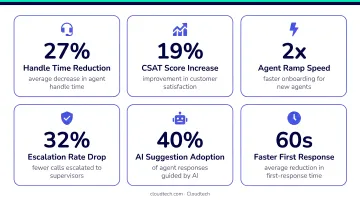
The results from documented customer deployments are specific. Cox Communications reported a 20% revenue increase and a 40% increase in manager span of control. Xanterra achieved a 74% average containment rate and $3.3M in revenue lift. Snap Finance reduced average handle time by 40% and reached 100% Quality Management automation.
| Key Features | Real-time agent assist, live conversation intelligence, QA automation, performance coaching, topic and sentiment detection |
| Best Fit | Enterprise contact centers needing live agent guidance and conversation analytics at high call volume |
| Pricing Model | Module-based custom pricing; contact Cresta for a quote |
Dialpad
Dialpad covers business calling, meetings, and contact center in one platform, with AI-powered transcription and coaching built into a single vendor relationship. For SMB and mid-market teams that want real-time AI insights without standing up a dedicated contact center stack, it's the most accessible entry point on this list.
Its AI delivers live transcripts, real-time sentiment indicators, and in-call coaching alerts through what Dialpad calls AI Live Coach Cards — prompts that trigger during active conversations based on keywords or phrases. The platform is trained on over 6 billion minutes of business conversations, which matters for transcription accuracy across accents and industry-specific vocabulary.
Published seat-based pricing across Support, Sell, and Connect plan families makes budgeting more predictable than fully custom enterprise tools — a real advantage for teams without dedicated procurement resources.
| Key Features | Real-time transcription, live sentiment analysis, in-call coaching alerts, automated post-call summaries, CRM-connected call records |
| Best Fit | SMB and mid-market sales and support teams wanting real-time AI insights without a dedicated contact center platform |
| Pricing Model | Published seat-based plans; advanced AI and contact center features vary by tier |
Amazon Connect with AWS Contact Lens
Amazon Connect is AWS's cloud contact center service. Contact Lens is its native real-time conversation analytics layer, offering transcription, sentiment analysis, keyword detection, and supervisor alerts built directly into the AWS ecosystem — no additional vendor relationship required.
Contact Lens delivers real-time call analytics, live issue detection, and automated call categorization within the infrastructure many SMBs and enterprises already run on. When a keyword or compliance trigger is detected during a call, supervisors receive an immediate alert and can listen in or provide guidance in real time.
PII and PCI redaction from transcripts and recordings is supported natively, and the service can be configured for HIPAA compliance using AWS KMS encryption.
Pricing is usage-based: voice runs at $0.038 per voice minute on the standard model, or $0.018/min base + $0.015/min for conversational analytics on the a la carte model. For teams already on AWS, this avoids the overhead of a separate vendor contract and a new data pipeline.
For SMBs evaluating or already on AWS, Cloudtech's team of AWS-Certified Solutions Architects can help design and deploy Amazon Connect and Contact Lens environments — reducing setup complexity and accelerating time to value without requiring a dedicated internal cloud team.
| Key Features | Real-time transcription and sentiment, live issue detection, supervisor alerts, automated call categorization, PII/PCI redaction, native AWS integration |
| Best Fit | Companies already on AWS infrastructure seeking a cloud-native real-time conversation analytics layer without adding a new vendor |
| Pricing Model | Usage-based pricing per minute of audio processed; tied to Amazon Connect consumption model |
Observe.AI
Observe.AI is a contact center AI platform designed specifically for real-time agent assist and automated quality assurance. Mid-market and enterprise contact centers use it to improve agent performance during calls and close the QA sampling gaps that follow them.
The platform combines live guidance — surfacing relevant knowledge base articles, compliance reminders, and coaching prompts mid-call — with automated QA scoring that evaluates 100% of calls rather than a sampled subset. Traditional QA programs review 1–3% of interactions; Observe.AI eliminates that blind spot entirely.
Documented customer outcomes include:
- 23% reduction in average handle time
- 10% uplift in conversions
- 97% improvement in compliance monitoring
For regulated industries like insurance and financial services, that compliance coverage matters — a single missed step can carry significant penalties, and reviewing 1–3% of calls leaves too much exposure.
| Key Features | Real-time agent guidance, automated QA on 100% of calls, live compliance alerts, post-call coaching workflows, CRM and ticketing integrations |
| Best Fit | Mid-market and enterprise contact centers focused on improving agent performance through real-time coaching and automated quality assurance |
| Pricing Model | Custom pricing; contact Observe.AI sales for a tailored quote based on call volume and features |
AssemblyAI
AssemblyAI takes a different approach: it's a developer-focused Speech AI platform delivering streaming speech-to-text, sentiment analysis, topic detection, and LLM-powered analysis through a single API. Product teams and SaaS vendors use it to build custom conversation intelligence into their own products, not to deploy a packaged contact center solution.
Its Universal-3 Pro Streaming model delivers P50 latency of approximately 150ms and P90 latency of 240ms — well under the sub-300ms threshold that separates usable real-time transcription from perceptibly lagged responses. Speaker diarization, 99+ language support, and an LLM Gateway connecting 25+ models give development teams the infrastructure to build tailored conversation intelligence rather than adapting a packaged SaaS tool to fit their workflow.
Pricing is transparent and usage-based: Universal-Streaming at $0.15/hour, Universal-3 Pro Streaming at $0.45/hour, with add-ons for sentiment analysis (+$0.02/hr), topic detection (+$0.15/hr), and real-time diarization (+$0.12/hr). A free tier with $50 in credits requires no credit card.
| Key Features | Sub-300ms streaming transcription, real-time sentiment and topic detection, LLM Gateway for custom analysis, speaker diarization, 99+ language support |
| Best Fit | Development teams and SaaS vendors building custom real-time conversation intelligence into their own products or workflows |
| Pricing Model | Usage-based API pricing; free tier with $50 in credits, no credit card required |
How We Chose the Best Voice AI Platforms for Real-Time Conversation Insights
The most common evaluation mistake is testing platforms on clean audio, simple queries, and scripted demos. Real contact center calls involve background noise, overlapping speech, off-script conversations, and compliance edge cases. Platforms were assessed on what happens during the call, not just after it.
Core Evaluation Criteria
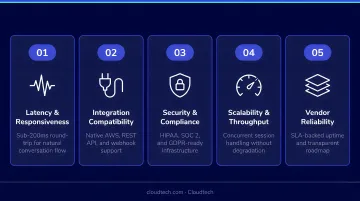
Five criteria drove the evaluation:
- Latency and transcription accuracy — A transcript arriving 2–3 seconds late isn't useful for in-call agent prompts. The practical threshold for actionable guidance is under 300ms. AssemblyAI is the only platform here with publicly verified benchmarks at that level (P50: ~150ms, P90: 240ms).
- Depth of live insight delivery — There's a real gap between platforms that deliver a live transcript and platforms that surface structured insights — coaching prompts, sentiment shifts, compliance triggers, next-best-action recommendations — mid-conversation. Cresta and Observe.AI sit at the structured end; AssemblyAI provides the building blocks for teams defining their own.
- CRM and contact center integration — Insights that never reach agents or managers don't change behavior. All five platforms support CRM connectivity; configuration depth varies by deployment model.
- Compliance capability for regulated industries — HIPAA penalties reach up to $2,134,831 per violation at Tier 4, and FTC Telemarketing Sales Rule violations carry civil penalties up to $53,088 per violation. For healthcare and financial services teams, compliance automation is a core platform requirement, not a nice-to-have.
- Pricing transparency at production scale — Demo pricing and production pricing can diverge sharply at volume. Platforms with published usage-based or seat-based pricing (AssemblyAI, Amazon Connect, Dialpad) give buyers clearer total cost visibility than fully custom-quoted options.
Conclusion
Choosing a voice AI platform comes down to fit — not feature count. The right platform works within your team's existing workflow, meets your compliance requirements, and connects cleanly with the systems agents and managers already use every day.
Before committing to a contract, run a pilot against real conditions — not sanitized demo audio. A few things worth testing before you sign:
- Call volume handling at your actual peak traffic, not a vendor's benchmark scenario
- Latency under your real network and integration stack conditions
- Compliance controls against your specific regulatory requirements (HIPAA, PCI, SOC 2)
The shift from post-call to real-time intelligence is an infrastructure decision. Its consequences show up in every call your team handles.
For teams operating on AWS — or evaluating Amazon Connect and Contact Lens as their contact center foundation — Cloudtech's AWS-certified solutions architects help small and mid-sized businesses design and deploy contact center environments on AWS — from initial architecture through production go-live. As an AWS Advanced Tier Partner, Cloudtech delivers that implementation without the timelines or costs of a large integrator. Contact the Cloudtech team to talk through your contact center setup.
Frequently Asked Questions
What is the best voice conversational AI?
There's no single answer — the right choice depends on use case. Enterprise contact centers should evaluate Cresta or Observe.AI; SMBs can start with Dialpad; AWS-native teams benefit from Amazon Connect with Contact Lens; developers building custom solutions should explore AssemblyAI. Match platform to workflow, not brand recognition.
Which AI is best for analyzing conversations?
For live conversation insights, Cresta, Observe.AI, and Amazon Contact Lens lead the field — each combining low-latency transcription with real-time extraction of sentiment, topics, and compliance signals. Post-call tools like Gong or Chorus serve different use cases where in-call intervention isn't needed.
What are the key trends in voice AI for 2026?
The clearest shift is from post-call to real-time conversation intelligence. Supporting that trend: deeper CRM integration, compliance automation driving adoption in healthcare and financial services, and multimodal AI pipelines that combine voice, sentiment, and intent in a single pass.
What is the difference between real-time and post-call conversation intelligence?
Post-call intelligence analyzes transcripts after a call ends — useful for QA review and coaching. Real-time intelligence processes audio live during the conversation, enabling in-call agent prompts, live compliance alerts, and supervisor intervention before the call concludes. The business value of real-time is the ability to act while the outcome can still be influenced.
How does voice AI improve customer experience?
Voice AI delivers real-time agent guidance, flags customer frustration before it escalates, enforces compliance scripts, and cuts handle time through live knowledge retrieval. The result is faster resolutions and more consistent service quality across every call — not just the ones a supervisor happened to review.
Can small businesses use voice AI platforms for real-time conversation insights?
Yes. Dialpad offers accessible seat-based pricing for SMBs, and Amazon Connect with Contact Lens scales affordably on a usage-based model. SMBs working with an AWS consulting partner like Cloudtech can deploy these solutions without a dedicated internal cloud team, getting to production faster and with fewer configuration risks.