Key Takeaways
- Conversational AI goes beyond chatbots: it understands intent, adapts over time, and resolves issues without agent handoff
- Top use cases include customer support, identity verification, self-service transactions, agent assist, and fraud alerts
- Real deployments show measurable results: 80% IVR containment, 90% faster balance checks, 40%+ cost savings
- Compliance is non-negotiable. The CFPB actively monitors AI chatbot deployments and holds institutions accountable
- Amazon Lex and Amazon Connect give financial services SMBs enterprise-grade AI capabilities without enterprise-level cost
Introduction
Financial institutions are caught between two realities. Customers want instant answers at any hour: 78% of banking customers who prefer chatbots over human agents cite quick responses as the reason, according to Deloitte's 2025 survey. Meanwhile, the operational side of banking still runs on limited staffing windows, legacy infrastructure, and compliance obligations that leave little room for error.
Conversational AI is how institutions are bridging that gap, and it's no longer a pilot program or a future roadmap item. About 98 million U.S. consumers, roughly 37% of the population, interacted with a bank chatbot in 2022, per the CFPB.
Every one of the top 10 largest U.S. commercial banks had already deployed chatbots by then.
This guide covers:
- What conversational AI actually is in a financial services context
- Where it delivers the most value
- What risks demand attention
- How to implement it without creating new compliance headaches
What Is Conversational AI in Financial Services?
Beyond the FAQ Bot
Conversational AI uses Natural Language Processing (NLP) and Machine Learning (ML) to understand, interpret, and respond to human language in real time, across voice and text channels. That distinction matters more than it might seem.
Traditional rule-based chatbots follow scripts. Ask something outside the predefined menu and you hit a dead end. Conversational AI interprets intent, not just keywords. A customer typing "I think someone used my card" and one typing "unauthorized transaction" are asking the same thing, but a rule-based bot may only recognize one of them.
The Technology Stack in Plain Terms
Three layers make modern conversational AI work:
- NLP interprets what the customer actually means, including sentiment and context
- ML enables the system to improve with every interaction: it learns from what worked and what didn't
- Generative AI produces flexible, context-aware responses rather than pulling from a fixed answer library
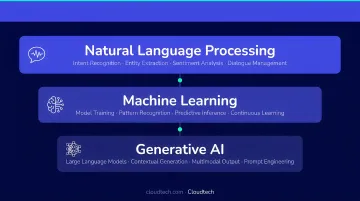
Critically, modern systems connect to live backend banking systems. When a customer asks about their balance, the AI retrieves the actual figure; it doesn't reference a static FAQ. That live connection is what makes the difference between an AI that informs and one that actually acts.
From Scripts to Agentic AI
Those three technology layers (NLP, ML, and generative AI) are what made the leap from routing to resolution possible. Early chatbots directed customers to the right department. Today's agentic AI systems resolve issues: completing transactions, verifying identities, processing payments, and escalating when needed.
The global conversational AI market reached $15 billion in 2024, with banking and financial services accounting for over 55% of that total, according to P&S Market Research.
Key Use Cases of Conversational AI in Financial Services
Conversational AI isn't a single solution; it addresses friction across the entire customer journey. The most successful implementations start narrow and expand, targeting high-volume, lower-complexity use cases before moving into higher-stakes areas like fraud detection or lending decisions.
Customer Support and FAQ Resolution
AI agents handle the bulk of routine inquiries (account balances, transaction history, branch hours, product questions) without any human involvement. When a customer's issue exceeds the AI's defined scope, it transfers to a human agent with the full conversation context intact. The customer never has to repeat themselves.
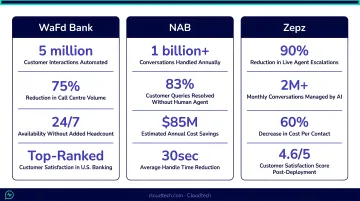
The numbers from real deployments are striking. WaFd Bank used Amazon Lex to reduce account balance check time by 90%, from 4.5 minutes down to 28 seconds, while projecting a 30% reduction in agent call volume. National Australia Bank achieved 80% IVR containment using the same platform. Zepz resolved 67% of customer inquiries instantly through self-service via Amazon Connect.
Identity Verification and Onboarding
KYC and account opening consume more than 40% of total time spent onboarding a new corporate banking client, according to McKinsey, with some processes stretching to 100 days. Conversational AI compresses that timeline by guiding customers through document uploads, identity verification, and backend application steps within a single chat or voice session: no branch visit, no scheduled call required.
Self-Service Transactions and Payment Processing
Customers can complete common transactions through natural language commands: no nested app menus, no hold queues. Supported actions include:
- Initiating fund transfers and bill payments
- Setting up or modifying recurring payments
- Activating cards or freezing accounts instantly
Beyond transactions, the system can act proactively. AI sends payment reminders via SMS or WhatsApp, and customers can respond and pay within the same thread. That reduces late payments and cuts inbound "did my payment go through?" calls simultaneously.
Agent Assist for Human Teams
During live calls and chat sessions, AI surfaces the right information exactly when agents need it:
- Surface relevant knowledge base articles in real time
- Suggest response options based on what the customer just said
- Pre-summarize conversation context before handoffs
- Provide multilingual translation support for non-English-speaking customers
Empower, a financial services firm, used Amazon Connect to scale quality assurance coverage by 20x, reviewing thousands of call transcripts daily and cutting QA review time from days to minutes. That kind of throughput is impossible with manual review alone.
Fraud Alerts and Proactive Engagement
AI systems monitor transactions continuously and alert customers about suspicious activity through their preferred channel, and let them confirm or block a charge immediately. This closes the loop in minutes, well before a customer would catch it on their own.
The broader shift here is from reactive to advisory. AI that proactively flags unusual spending patterns, reminds customers about rate changes, or surfaces relevant product offers based on actual behavior changes the nature of the bank-customer relationship, without requiring more staff.
Benefits of Conversational AI in Financial Services
Conversational AI does reduce costs, but framing it purely as a cost-cutting tool undersells what the technology actually delivers.
24/7 Availability Without Scaling Headcount
BAI's 2024 Banking Outlook found that 24/7 customer service ranked as the top way to improve digital banking experience across all generations. AI delivers it. Whether a customer needs to check a balance at midnight or dispute a transaction on a Sunday, the response is immediate.
Operational Efficiency and Cost Reduction
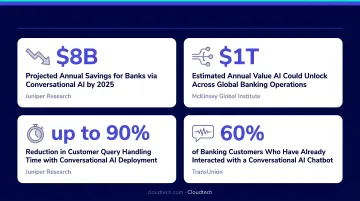
Juniper Research projected that banking chatbots would deliver $7.3 billion in global operational cost savings by 2023, equal to 862 million hours saved. More recently, McKinsey documented an Asian bank that reduced service interactions by 40–50% and cut cost-to-serve by more than 20% through AI-powered intent recognition. TransUnion achieved over 40% annual cost savings using AI automation and Amazon Connect, while cutting IVR time from 2 minutes to 18 seconds.
Personalization at Scale
62% of consumers say they would immediately try AI-driven personalized account alerts to help avoid fees, according to an ABA Banking Journal survey. When conversational AI connects to CRM and account data, it tailors every interaction using:
- Recent transaction history
- Current products held
- Stated customer preferences
That's the kind of attentiveness customers associate with a private banker, delivered to every customer, not just high-value accounts.
Compliance and Auditability
Every AI conversation is automatically logged and transcribed. For a regulated industry, that's not a minor feature; it's an audit trail for every interaction, supporting compliance reporting, dispute resolution, and quality assurance without additional overhead.
For financial services SMBs, Cloudtech builds conversational AI solutions on AWS-native tools including Amazon Lex and Amazon Connect, with compliance-ready architecture embedded from the start, not retrofitted after the fact.
Risks, Compliance Challenges, and How to Mitigate Them
Conversational AI in financial services carries real risks. Glossing over them doesn't make them smaller; it just means encountering them at the worst possible moment.
The "Doom Loop" Problem
The CFPB's 2023 chatbot report includes documented consumer complaints: "I ran into loop after loop of the same questions," "the virtual assistant kept sending me in circles." These aren't edge cases. They're predictable failure modes when AI is deployed without a clear escalation design.
Mitigation: Define exactly what the AI is authorized to handle. Build smooth escalation paths to human agents that always work. Monitor transcripts regularly for patterns that indicate the AI is failing to resolve common issues.
Data Privacy and Security
AI systems handling account numbers, PII, and payment details create new attack surfaces. Impersonation chatbots, phishing via chat, and insecure chat log storage are all documented threats.
64% of consumers surveyed by ABA Banking Journal said AI in financial services puts them at somewhat greater risk for fraud or security breaches.
Mitigation:
- Implement PII redaction in chat logs and use encrypted communication channels
- Conduct security audits of every third-party AI component
- Align with GDPR where applicable and confirm data residency requirements are met
For institutions with strict data residency obligations, Cloudtech deploys AI inside the client's own AWS environment, keeping data in-house rather than passing it through external systems.
Regulatory Compliance Is Not Optional
The CFPB is explicit: financial institutions remain responsible for ensuring their chatbots comply with all applicable federal consumer financial laws, including the Truth in Lending Act, FCRA, ECOA, and the Military Lending Act.
A chatbot cannot serve as a workaround to legal disclosure requirements or dispute recognition obligations. Institutions that let AI sidestep these requirements face direct legal exposure.
Mitigation:
- Involve legal and compliance teams throughout the build, not just at launch review
- Pull AI responses from verified, compliance-reviewed knowledge bases
- Never let generative AI produce improvised answers about credit terms, dispute rights, or account fees
Consumer Trust
Only 27% of consumers trust AI for financial information and advice, per ABA Banking Journal. That's a low starting point that demands transparency.
Mitigation: Tell customers they're talking to AI. Make it easy to reach a human. Communicate data use policies plainly, not buried in terms and conditions.
How to Implement Conversational AI in Financial Services
Step 1: Start With High-Impact, Lower-Risk Use Cases
Before automating anything customer-facing, map where AI will reduce the most friction with the least implementation complexity. Common starting points:
- FAQ handling and basic account inquiries
- Balance checks and transaction lookups
- Payment reminders and confirmations
- Agent assist tools (internal-facing, lower regulatory exposure)
Starting with agent assist is particularly effective: it delivers measurable productivity gains for human teams while the organization builds familiarity with the technology before it faces customers directly.
Step 2: Choose Secure, Compliant Infrastructure and Integrate Deeply
Surface-level AI that doesn't connect to core banking systems, CRM, or identity management isn't genuinely useful. It functions as little more than a FAQ page with a chat interface. Deep backend integration is what makes conversational AI actually resolve issues.
For financial services SMBs, AWS-native tools like Amazon Lex and Amazon Connect provide SOC 2, PCI DSS, and HIPAA-aligned security with proven financial services deployments, removing the overhead of building a custom stack. NatWest implemented over 30 new self-serve journeys in three weeks using Amazon Connect, compared to a prior process that took six months, and improved customer sentiment scores by up to 22%.
Cloudtech's AWS-certified team (including engineers with direct AWS backgrounds) designs and deploys these solutions inside the client's own environment, keeping data in-house and compliance controls embedded from day one rather than added after.
Step 3: Monitor, Measure, and Iterate
Define KPIs before launch, not after:
- Deflection rate: what percentage of contacts AI resolves without escalation
- Average handle time: how AI impacts total interaction duration
- Escalation rate: how often customers need a human, and why
- CSAT scores: customer satisfaction with AI interactions specifically
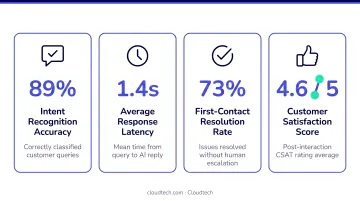
Review conversation transcripts regularly. Retrain the AI when new patterns emerge. Adjust escalation triggers when failure modes appear. Conversational AI that isn't actively maintained degrades over time as customer language and product offerings evolve.
Frequently Asked Questions
What is the difference between a chatbot and conversational AI in financial services?
Rule-based chatbots follow rigid, predefined scripts and only respond to queries that exactly match their programmed options. Conversational AI uses NLP to understand intent and context, holds genuine back-and-forth dialogue, and improves over time through machine learning. The result is a system capable of handling far more varied and complex customer interactions.
How does conversational AI handle compliance and data security in banking?
AI systems must comply with all applicable federal consumer financial laws. The institution deploying them remains legally responsible. Reputable platforms use encryption and PII redaction, and all conversations are logged for audit purposes. Deploying within your own AWS environment keeps sensitive data in-house and avoids third-party data-sharing exposure.
What are the most common use cases for conversational AI in financial services?
The five highest-value applications are customer support and FAQ resolution, identity verification and digital onboarding, self-service transactions and payment processing, agent assist for human teams, and proactive fraud alerts and payment reminders.
Can small and mid-sized financial services firms benefit from conversational AI?
Yes: cloud-based, AWS-native platforms make conversational AI accessible without requiring a large internal IT team or significant upfront capital. AWS Partner Funding options can further reduce initial costs, and ROI often arrives quickly through reduced support volume and faster resolution times.
Does conversational AI replace human customer service agents in financial services?
No. Conversational AI handles routine, high-volume tasks so human agents can focus on complex issues, disputes, and high-empathy interactions that genuinely require a person. It always escalates (with full conversation context) when a customer's situation exceeds its defined scope.
How long does it take to implement conversational AI in a financial institution?
Timeline depends on scope, integration complexity, and infrastructure maturity. Well-scoped deployments with an experienced implementation partner can launch in weeks: NatWest deployed 30 self-serve journeys in three weeks on Amazon Connect. Core banking integrations take longer, usually paced by compliance and data readiness work.