Introduction
Legacy applications rarely fail all at once. They degrade slowly, through patched-over bugs, undocumented dependencies, and infrastructure nobody fully understands anymore. Before you migrate or refactor anything, you need to know exactly what you're working with.
An AWS application modernization assessment is the step most teams skip, and it's often why migration timelines slip and budgets balloon. Without it, you risk lifting a monolith's problems straight into the cloud instead of fixing them.
This checklist walks through what to gather, which methods to use, and how to interpret the results so your plan is grounded in data, not guesswork. You will cover:
- Code and dependency analysis
- Operational readiness and runtime risk
- The 7 Rs framework AWS uses to categorize legacy workloads
Key Takeaways
- Map dependencies with AWS Application Discovery Service before any architecture decisions
- Assess apps through three lenses: code/architecture, operational fit, and 7 Rs scoring
- Tier findings as cloud-ready, minor remediation, or full-refactor debt
- Secure access and validate posture before discovery agents touch production
What You Need for an AWS Application Modernization Assessment
A modernization assessment is only as good as the data behind it. You need runtime metrics, architectural documentation, business KPIs, and the right discovery tools, all gathered before you start making decisions about rehosting versus refactoring.
Skipping this stage is how teams end up re-platforming an application only to discover a hardcoded dependency three weeks into the project.
Tools and Indicators Required
Start with automated discovery. AWS Application Discovery Service collects CPU, memory, disk, and network usage from on-premises servers while mapping dependencies between applications, giving you a factual baseline instead of relying on outdated architecture diagrams.
Pair it with AWS Systems Manager Inventory to map software stacks and traffic flows across your environment.
For code-level analysis, add:
- Static analysis tools and software composition analysis (SCA) scanners for code quality and license risk
- AWS Schema Conversion Tool (SCT) for database schema compatibility
- Distributed tracing platforms like AWS X-Ray combined with CloudWatch Logs to catch runtime behavior that static documentation misses
On the business side, capture your current baseline metrics:
- Total Cost of Ownership (TCO)
- Runtime resource utilization
- Deployment frequency
- Mean time to recovery (MTTR)
These "before" numbers are what you measure modernization results against when leadership asks what the work delivered.
Preconditions and Setup
Before discovery agents go anywhere near production, confirm a few things:
- Access conditions - read-only infrastructure permissions, source repository access, and CMDB data pulled in advance
- Environment baseline - capture production or representative staging environments under both normal and peak load, not just a quiet Tuesday afternoon
- Stakeholder alignment - assemble application owners, lead developers, database administrators, and security leads into one working group
Many SMB teams don't have the bandwidth to run this cross-functional process internally while keeping daily operations running. That's where an AWS Partner like Cloudtech fits.
Cloudtech's certified solutions architects—many of them former AWS employees—handle discovery and dependency mapping, and identify AWS Partner funding that can offset assessment costs before any migration decision is made.
Methods to Assess Applications for AWS Modernization
Engineering teams typically assess legacy portfolios for AWS readiness in three passes—portfolio scoring first, then architecture and dependencies, then database specifics. Most organizations use all three in sequence.
Method 1: Automated Architectural and Dependency Mapping
This method evaluates component coupling, shared state, data access patterns, and runtime communication to determine whether microservices extraction is even feasible.
Tools needed: AWS Application Discovery Service, dynamic tracing agents, runtime dependency graphs, static code analyzers.
Steps:
- Deploy discovery agents or agentless collectors to capture active network connections, process calls, and background jobs
- Analyze codebase coupling to find shared libraries, monolith boundaries, and database locks across functional domains
- Map dependency clusters against target cloud services, isolating domains suitable for decoupled microservices or serverless functions
This is how one Cloudtech healthcare client found an old on-premises SQL Server connection buried inside a patient scheduling system—nobody on the current team knew it existed. Re-architecting that flow on Amazon RDS before cutover avoided a critical outage.
Pros: Deep technical accuracy; surfaces hidden dependencies. Cons: Needs full environment access and hands-on time reviewing legacy codebases.
Method 2: The 7 Rs Migration and Modernization Strategy Scoring
This method scores each application against business value, operational risk, and technical effort, then sorts it into one of AWS's seven migration strategies: Rehost, Replatform, Refactor, Repurchase, Retain, Retire, or Relocate.
Tools needed: AWS Migration Hub Strategy Recommendations, technical debt scoring rubrics, business agility impact matrices.
Steps:
- Score applications on business criticality, regulatory constraints (HIPAA, PCI, GDPR), development velocity, and end-of-life framework dependencies
- Weigh target architectures: rehosting to Amazon EC2, replatforming to Amazon ECS/EKS, or refactoring to AWS Lambda
- Prioritize applications into migration waves, tackling the highest-impact, lowest-complexity wins first

Cloudtech applies this lens routinely for SMB clients. One manufacturing client moved an on-premises Oracle database to Amazon RDS for PostgreSQL, cutting licensing costs while adding automated backups and patching.
Pros: Gives executives a clear portfolio roadmap. Cons: Can miss low-level code anomalies if you skip code inspection.
Method 3: Database and Data Persistence Assessment
After strategy scoring, legacy databases often still carry more risk than the application code above them. This method evaluates schema complexity, stored procedure logic, and licensing dependencies.
Tools needed: AWS Schema Conversion Tool (SCT), AWS Database Migration Service (DMS), query performance profilers.
Steps:
- Run automated schema assessments on relational databases (Oracle, SQL Server) for compatibility with Amazon RDS or Amazon Aurora
- Evaluate access patterns to decide whether workloads belong in a relational engine or a NoSQL option like Amazon DynamoDB
- Flag legacy dependencies such as hardcoded ETL pipelines, proprietary extensions, and distributed transactions needing re-engineering
Pros: Quickly exposes database lock-in and licensing costs. Cons: Complex stored procedures may need substantial rewriting during modernization.
How to Interpret Modernization Assessment Results
Running the assessment is half the job. Misreading the results is how budgets blow past estimates and dependencies break mid-migration. Assume a workload is cloud-ready when it isn't, and those failures show up fast.
Sort every application into one of three tiers:
| Tier | Signs | Recommended Next Step |
|---|---|---|
| Cloud-ready | Modular code, RESTful interfaces, stateless services, supported runtimes | Move directly to containerization on Amazon ECS/EKS or managed services |
| Minor remediation | Modest configuration coupling, outdated framework patches, non-cloud file storage | Light replatforming, externalize session state, update dependencies |
| High modernization debt | Tightly coupled monoliths, business logic embedded in database triggers, unsupported frameworks, single points of failure | Phased refactoring using the Strangler Fig pattern |
That third tier deserves a closer look. The Strangler Fig pattern, a concept Martin Fowler described back in 2004, involves gradually building new functionality around the edges of the old system instead of attempting a risky, all-at-once cutover.
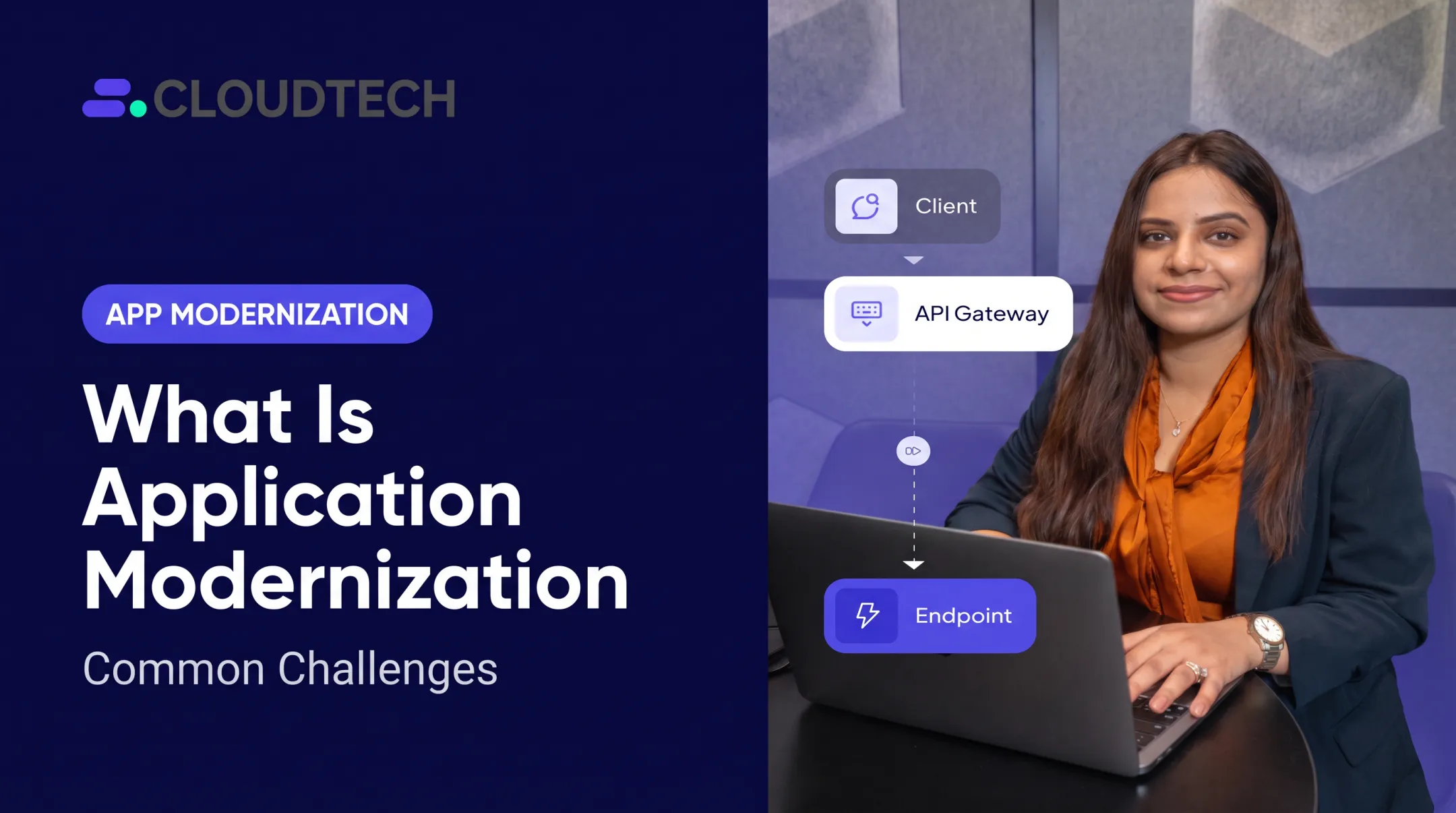
AWS implements this by routing traffic through a proxy, often Amazon API Gateway, directing requests to the legacy app until new services are ready to take over piece by piece.

Don't treat this tiering as a one-time exercise. Applications drift between tiers as frameworks age out of support, so revisit the categorization at least annually.
Common Errors in Application Modernization Assessments
Even experienced teams run into the same handful of mistakes. Here's what derails modernization timelines most often:
- Overlooking hidden runtime dependencies - asynchronous background jobs and cron tasks rarely show up in static architecture diagrams
- Fixating on code while ignoring data gravity - schema coupling and database migration hurdles often outweigh application-layer complexity
- Skipping baseline metrics - without pre-assessment TCO and performance figures, nobody can prove the modernization actually worked
- Defaulting to lift-and-shift - rehosting a monolith without evaluating alternatives just moves technical debt onto a more expensive cloud bill
- Relying on stakeholder interviews alone - people misremember and underestimate; automated telemetry doesn't
Most of these mistakes share one root cause: incomplete visibility into dependencies, data, costs, and runtime behavior. Cloudtech benchmarks operational efficiency and cost before and after modernization so finance teams can point to hard numbers, not just a feeling that things got faster.
Security, Governance, and Assessment Best Practices
Discovery tools touching production systems need guardrails. A rushed assessment that trips an outage or exposes sensitive data defeats the purpose.
Lock down access:
- Use strict read-only access and least-privilege IAM roles for every discovery scanner
- Disable root-account access for daily operations and enforce MFA on all console logins
- Review permissions quarterly to revoke anything no longer in use
Protect sensitive data:
- Sanitize PII and HIPAA-regulated records before they touch code analysis logs
- Apply data masking to any staging environment used for load testing
- Encrypt assessment artifacts at rest and in transit, and set short retention windows
Access locks and data controls are only half the job. Plan governance early, not after migration.
AWS Control Tower sets up a landing zone with built-in guardrails and ties in AWS Organizations, AWS Config, and CloudTrail for consistent auditing. Pair it with an AWS Well-Architected Framework review covering operational excellence, security, reliability, performance, and cost. Together they give you a governance baseline before workloads move.

Forrester's research on cloud migration points to structured planning and governance as consistent differentiators between successful and failed cloud projects. Teams that assess before they migrate make fewer costly mistakes than teams that don't.
Conclusion
A structured assessment is what separates a modernization project that delivers measurable ROI from one that just moves old problems to a new, more expensive address. Mapped dependencies, honest 7 Rs categorization, and a clear modernization blueprint keep timelines and budgets intact.
Cloudtech's AWS Architecture Assessment delivers exactly that: an infrastructure review, a tailored problem-area report, and remediation recommendations your team can act on immediately. For SMBs juggling modernization alongside daily operations, partnering with AWS-certified specialists who've already run this process dozens of times compresses months of trial and error into weeks.
Frequently Asked Questions
What is 3-tier architecture in AWS?
A 3-tier architecture splits an application into a presentation layer (CloudFront, S3, or an Application Load Balancer), a logic layer (EC2, ECS, or Lambda), and a database layer (Amazon RDS or DynamoDB). This separation improves modularity and makes it easier to secure and scale each layer independently.
What are the key stages of an AWS application modernization assessment?
The core stages are portfolio discovery, dependency and code analysis, strategy selection using the 7 Rs framework, and building a modernization roadmap. Each stage feeds the next, so skipping discovery usually means redoing work later.
What is the difference between AWS migration and AWS modernization?
Migration moves existing workloads to AWS with minimal changes, often just a rehost. Modernization goes further, restructuring the application to use cloud-native services like containers or serverless functions for better scalability and cost efficiency.
When should an application be containerized versus refactored to serverless?
Containers (ECS/EKS) suit predictable, steady workloads and complex legacy applications that aren't ready for a full rewrite. Serverless (Lambda) fits event-driven, microservices-based applications with variable or unpredictable traffic patterns.
How can AWS funding programs offset the cost of an application assessment?
Programs like the AWS Migration Acceleration Program (MAP) offer credits tied to a Migration Plan, calculated against eligible spend growth on migrated workloads. AWS Partners like Cloudtech can help identify and apply for funding qualifying SMBs can access.
What tools does AWS offer to automate application assessments?
Key tools include AWS Application Discovery Service for dependency mapping, Migration Hub Strategy Recommendations for portfolio scoring, and the AWS Schema Conversion Tool for database compatibility analysis. Each targets a different layer of the assessment process.