But aging applications eventually collide with real business needs: tighter security requirements, customers who expect instant updates, and competitors shipping features twice as fast. Application modernization is how companies close that gap.
It's broader than "move it to the cloud." This article defines what modernization actually involves, breaks down the decision framework known as the 7 Rs, and walks through the technical, financial, and organizational challenges that trip up most modernization efforts.
Key Takeaways
- Modernization can mean new infrastructure, new code, a new architecture, better data practices, or full replacement.
- Successful programs start with business outcomes and an honest application assessment, not a favorite technology.
- Undocumented dependencies, data migration errors, security gaps, and cost overruns derail most projects.
- Incremental modernization with clear ownership and measurable milestones beats an all-at-once rewrite almost every time.
What Is Application Modernization?
Application modernization means updating, restructuring, migrating, or replacing legacy application components to improve maintainability, security, performance, scalability, integration, and business agility. These are decisions made application by application, sometimes component by component within a single application.
Modernization vs. Cloud Migration
These terms get used interchangeably, and that's a mistake. Moving an application to cloud infrastructure, known as rehosting, can be one step in a modernization journey. AWS's own guidance is direct about this: rehosting an unchanged application doesn't automatically deliver elasticity, resilience, easier deployments, or modern development practices.
In other words, a lift-and-shift migration can move a legacy application's security flaws right along with it, unless the cloud-native security tooling gets addressed separately. A CRM might move to Amazon EC2 with minimal changes. A legacy EHR system, by contrast, often needs to shift into microservices running on Amazon ECS to actually gain anything from the move.
Common Modernization Targets
Most modernization work focuses on a recognizable set of problems:
- Monolithic architecture that forces full redeployments for small changes
- Outdated runtimes and frameworks no longer supported by vendors
- Tightly coupled databases that block independent scaling
- Manual deployment processes prone to human error
- Unsupported infrastructure running past end-of-life
- Weak integration capabilities that complicate connecting new tools
- Systems dependent on a handful of employees who know how the application actually behaves
The 7 Rs of Application Modernization
The 7 Rs framework, originally built on Gartner's five-option model and expanded by AWS, helps teams classify what needs to happen to each application. It's a portfolio decision tool that treats each application on its own merits, rather than a single technique applied everywhere. A company might rehost one app, refactor another, and retire a third, all in the same quarter.
Here's how the seven strategies break down:
| Strategy | What Changes | Best For | Main Trade-off |
|---|---|---|---|
| Retain | Nothing, for now | Apps not ready or not worth touching yet | Technical debt keeps accumulating |
| Retire | Application is decommissioned | Redundant or unused systems | Requires confirming no hidden dependents |
| Rehost | Infrastructure location only | Fast relocation, minimal risk tolerance | Doesn't fix underlying architecture issues |
| Relocate | Infrastructure moves, app untouched | Large-scale data center exits | Limited modernization value alone |
| Repurchase | Switch to a different product | Outdated tools with better SaaS alternatives | Migration and retraining effort |
| Replatform | Some optimization during the move | Moderate gains without a full rebuild | Partial fix, not a full redesign |
| Refactor / Re-architect | Core architecture changes | Mission-critical apps needing real agility | Highest engineering effort and skill demand |
Rehosting and relocating score well on speed and low disruption but deliver limited long-term flexibility. Refactoring takes longer and demands specialized engineering skills, but it's usually the only path that resolves scalability and integration problems for good. There's no universally "right" choice here. It depends on the application's business value, its technical condition, and how much risk the organization can absorb right now.

Common Application Modernization Challenges
This is where most modernization projects stall: in the execution details.
Knowing Where to Start
Prioritizing a portfolio of applications means weighing several factors at once:
- Business criticality and user impact
- Technical condition and security exposure
- Integration dependencies
- Expected effort versus projected value
Skip this step and teams end up modernizing the easiest application instead of the one that matters most.
Legacy Complexity and Tribal Knowledge
Old applications accumulate complexity quietly:
- Tightly coupled modules that break when touched individually
- Fragile integrations nobody fully mapped
- Documentation that stopped getting updated years ago
- Hidden dependencies discovered only after something fails
- "Tribal knowledge" held by one or two long-tenured employees
McKinsey's research on technical debt puts this in stark terms: CIOs estimate technical debt at 20% to 40% of their technology estate's value before depreciation. That debt doesn't show up on a balance sheet, but it shows up in every delayed release.
Data Migration and Integration Risks
Moving data between old and new systems introduces its own failure points:
- Incompatible formats and inaccurate mapping
- Duplicate or incomplete records
- Dual-environment sync required during transition
For healthcare, financial, or customer data, every migration step must protect sensitive information under applicable compliance requirements.
Funding Modernization While Keeping the Lights On
Modernization rarely gets a clean, dedicated budget. Teams end up running parallel environments, buying new tooling, training staff, testing extensively, and absorbing cloud operations costs while maintaining the legacy system customers still depend on.
Rework happens when early architecture decisions don't hold up, adding cost nobody budgeted for.
Organizational and Operational Friction
Even well-funded, well-scoped projects stall without the right structure:
- Unclear executive ownership of the modernization effort
- Competing priorities pulling engineering time elsewhere
- Resistance from teams whose workflows are changing
- Skills gaps in cloud-native architecture and tooling
- Insufficient testing before cutover
- Weak governance around decisions and changes
How to Overcome Application Modernization Challenges
The challenges above are common. What separates successful programs from stalled ones is how you sequence and govern the work.
Start With Structured Discovery
Before choosing a modernization path, document what the application actually depends on:
- Dependencies and data flows
- Integrations and infrastructure
- User journeys and compliance obligations
- Known technical debt
Skipping discovery is the most common reason teams hit expensive surprises mid-project.
Prioritize by Value Versus Effort
Pick a focused starting point using a simple framework: plot each candidate application against business value and modernization effort. Good starting points tend to be:
- A customer-facing bottleneck causing support tickets or churn
- An unsupported platform nearing end-of-life
- A high-risk integration prone to failure
- A process actively limiting growth
Modernize in Controlled Increments
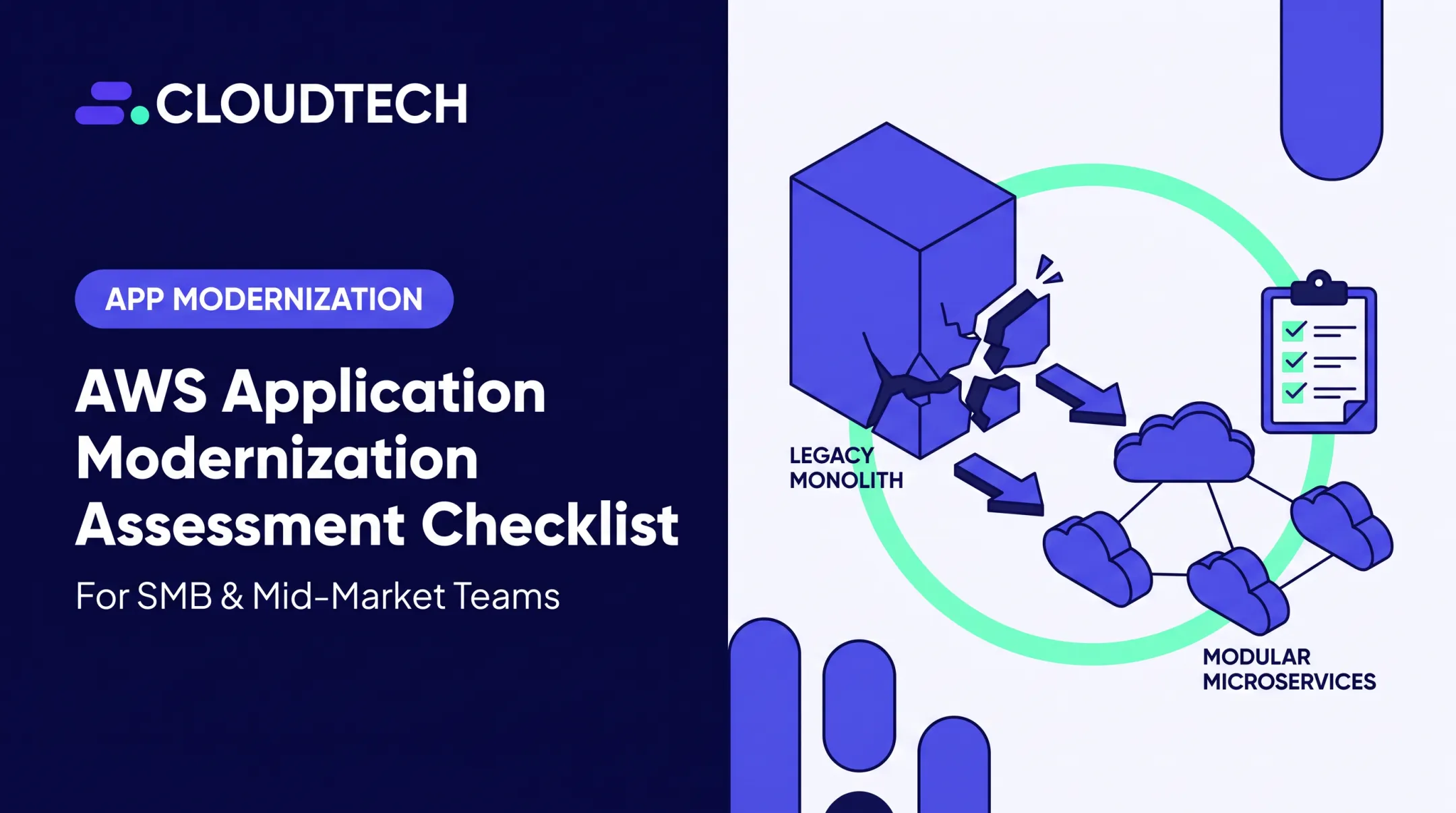
Rewriting an entire application at once is how timelines double and budgets break. AWS's guidance on modernizing legacy monoliths recommends isolating bounded components, mapping data flows, and replacing capabilities gradually with the strangler fig pattern. New services take over piece by piece while the legacy system keeps running underneath.

Supporting tactics include:
- APIs between old and new components
- Phased data migration
- Feature flags for controlled rollout
- Parallel validation
- A documented rollback plan for every phase
Aditya Birla Finance used this strangler fig approach—plus containerization and automated delivery pipelines—to refactor a wealth-management monolith into product-feature microservices. Per AWS's published case study, the release cycle shrank from weeks to hours.
Incremental delivery only holds if security and ownership move in lockstep with each phase.
Build Security and Governance Into Every Phase
Security and quality controls can't be bolted on before launch. Build them into every phase:
- Identity and access management
- Encryption and secrets management
- Vulnerability assessments
- Automated testing and data reconciliation
- Backup validation and ongoing monitoring
Governance matters as much as tooling. Effective programs set up:
- An executive sponsor
- Clear product and engineering ownership
- Subject-matter experts for legacy questions
- Documented architecture decisions
- Measurable success criteria agreed on before work starts
A Practical Roadmap for Modernizing an Application
Most modernization programs move through four stages, each with its own deliverables.
1. Assess the current state Build an application inventory, dependency map, and risk register. This is where undocumented dependencies and tribal knowledge get surfaced before they cause problems later.
2. Define target outcomes and architecture Translate business goals, like reducing infrastructure spend or improving response times, into a target architecture and a modernization backlog.
3. Modernize and validate in controlled increments Execute against a migration runbook and testing plan, validating each phase before moving to the next.
4. Operate and optimize after release Track a cost model against actual spend, monitor the rollout, and measure outcomes against the original business case.

Metrics should tie directly back to what the project was supposed to achieve:
- Deployment lead time and application availability
- Defect rates and security findings
- Operating cost and response time
- Reduced manual effort
Baseline your own application rather than chasing an industry benchmark that may not apply to your workload.
A note on getting outside help: Legacy modernization is harder to execute solo than most teams expect, especially when assessing technical debt and choosing the right architecture.
Cloudtech, an AWS Partner with AWS-certified architects, works with SMBs to assess legacy workloads, design secure cloud architecture, and run a phased modernization plan. The client's team stays involved in every decision.
Frequently Asked Questions
What is application modernization?
Application modernization is the process of updating, restructuring, migrating, or replacing legacy application code, architecture, infrastructure, data, or operational practices to meet current business needs. It's broader than a simple cloud move.
What are the 7 R's of modernization?
The 7 R’s are retain, retire, rehost, relocate, repurchase, replatform, and refactor (also called re-architect). Each represents a different level of change, from leaving an application untouched to rebuilding its core architecture.
What are the biggest application modernization challenges?
Common barriers include unclear goals, limited budget or in-house skills, integration complexity, security and compliance concerns, user resistance to workflow changes, data migration risk, and business disruption during the transition.
How do you overcome application modernization challenges?
Start with a structured assessment, prioritize applications by business value versus effort, and modernize in phased increments rather than one large rewrite. Pair that with strong testing and security controls, clear ownership, and continuous measurement against your original goals.
Is application modernization the same as cloud migration?
No. Cloud migration can be one part of modernization, but modernization often also involves architectural redesign, code changes, data improvements, process updates, or replacing the application entirely.